MONTGOMERY, Ala. — Alabama’s new App Store Accountability Act is facing a federal constitutional challenge before its scheduled January 1, 2027 effective date. The law will require app stores to verify account holders’ age categories and to obtain parental consent before minors download or purchase applications. A technology-industry association argues that the requirements sweep too broadly, affecting access to news, education, religious material and other lawful expression.
The Computer & Communications Industry Association (CCIA) announced its challenge on October 28 against Alabama Attorney General Steve Marshall. Its members include major technology companies such as Apple, Google and Amazon. The association is the plaintiff: describing the lawsuit as one filed individually by all three companies would be inaccurate.
At issue is not whether parents should be able to supervise children’s online activity. The question is how far a state may go in requiring checks at a central gateway to mobile software, especially when many apps distribute constitutionally protected information.
What the law actually requires
Enrolled House Bill 161, enacted as Act 2026-59, creates four age categories: younger than 13, ages 13–15, ages 16–17 and adults ages 18 or older. App-store providers must request and verify an account holder’s age category when an individual in Alabama creates an account. The measure also requires checks for certain existing accounts before October 1, 2027.
When a user is determined to be a minor, the app-store account must be affiliated with a parent or legal guardian’s account. The provider must obtain affirmative, verifiable parental consent before the minor downloads an app, purchases one or makes an in-app purchase. The act also outlines notification and consent procedures after certain significant changes to an app.
The statute does not establish a blanket exemption for an ordinary weather app, mapping tool, news outlet, educational resource or religious app. That breadth is central to the lawsuit.
Does every adult have to upload a government ID?
No specific government-ID requirement appears in the enacted text. Alabama requires age-category verification through commercially available methods designed for accuracy or systems meeting rules adopted under the law. It also describes methods that can use parental age attestations and information already collected during routine account creation or use.
Verification might involve identification documents or other personal information, depending on a provider’s chosen system, but claiming that the law itself orders every adult to upload a driver’s license before each app download overstates the text. An age-category check at the account level is not the same thing as mandatory presentation of a government ID for every transaction.
The law contains limits on unnecessary collection, sharing and use of age-category information. Yet privacy advocates can reasonably question how identity-verification vendors will operate in practice, how errors will be corrected, and what users without conventional documentation will encounter.
Why the companies’ trade association sued
CCIA’s federal complaint, CCIA v. Marshall, argues that Alabama’s age and consent gates burden rights to speak and receive information under the First Amendment. The association also raises a Commerce Clause objection to state-by-state obligations affecting national app distribution, and disputes aspects of the measure’s requirements for developers.
The organization argues that making users verify eligibility before obtaining a news or educational app is different from limiting access to a narrowly defined category of content intended for adults. It compares digital app stores with physical bookstores and libraries as gateways to protected expression.
These are the plaintiffs’ allegations, not judicial findings. Alabama has not been found unconstitutional merely because a lawsuit was filed.
The lawsuit was filed October 28 in the U.S. District Court for the Middle District of Alabama, case 2:26-cv-00897. CCIA requested a preliminary injunction. A public docket-tracking service lists an order dated November 10, but the text and effect of that order were not available for independent confirmation at publication preparation; this report does not characterize it as a ruling on the merits or the injunction.
Why lawmakers supported the bill
Supporters say families need stronger protection against minors downloading inappropriate applications, encountering harmful material, making purchases without consent or losing control over personal data. Those are legitimate policy concerns even if the method is disputed.
The measure advanced with no opposing votes in its recorded final floor actions. Alabama’s House approved the bill 103–0 in January, the Senate passed its amended version 35–0 in February, and the House concurred in the Senate amendment 102–0. Gov. Kay Ivey signed it in February. Legislative records show it became law on February 17.

Who could be affected?
For adults, the central unanswered question is whether verification can be accomplished without creating new reservoirs of sensitive data or imposing barriers on people who lack common identity documents. For minors, it is whether parents or guardians can give approval easily and whether young people without an available guardian could be shut out of useful services.
There is also the matter of geography. The law addresses individuals located in Alabama, but it does not order app stores to track phones through GPS or cell towers. Companies may need to determine which accounts fall within its scope, and the practical methods could raise privacy questions. Those questions are not proof that the statute itself authorizes unlawful government tracking or creates an automatic Fourth Amendment violation.
A similar Texas law shows the legal uncertainty
Texas enacted a comparable app-store law. A federal district court initially blocked it in December 2025, agreeing that the plaintiffs were likely to succeed on constitutional objections at the preliminary stage. A federal appeals court later stayed the injunction, allowing enforcement while the appeal continued. The Supreme Court declined emergency intervention in July 2026 without resolving the law’s ultimate constitutionality.
Alabama sits in a different federal circuit, and the outcome of its dispute remains to be determined. A ruling in one state’s case does not by itself settle all questions surrounding the other state’s statute.
What the viral discussion gets right—and wrong
A TikTok video by @peterispeter captured an unusual political alignment: critics of corporate surveillance finding common ground with large technology businesses opposing the law. The video correctly highlights the reach of the measure beyond adult-content apps and the importance of parental-consent rules.
But two assertions require correction. The final statute does not mandate government ID for each app download; its permitted verification methods are broader. And the video’s claimed 45–0 Senate vote is inaccurate: Alabama’s Senate approved the bill 35–0.
The video also raises scenarios involving residents traveling near state borders and possible location tracking. Those are reasonable implementation questions, but they remain questions, not documented surveillance practices established by this act.
What happens next
Alabama’s law is scheduled to take effect January 1, 2027, subject to court action. The federal challenge will test how lawmakers balance child protection with privacy, parental autonomy and constitutional access to ordinary digital information.
Protecting minors online and preserving civil liberties need not be opposing goals. The unresolved legal issue is whether Alabama’s broad app-store mandate is a proportionate way to pursue both.
Sources and documents: Alabama HB161 enrolled text; Alabama bill history and votes; CCIA lawsuit announcement; CCIA federal complaint; federal docket; Texas trial-court injunction announcement; original video commentary.
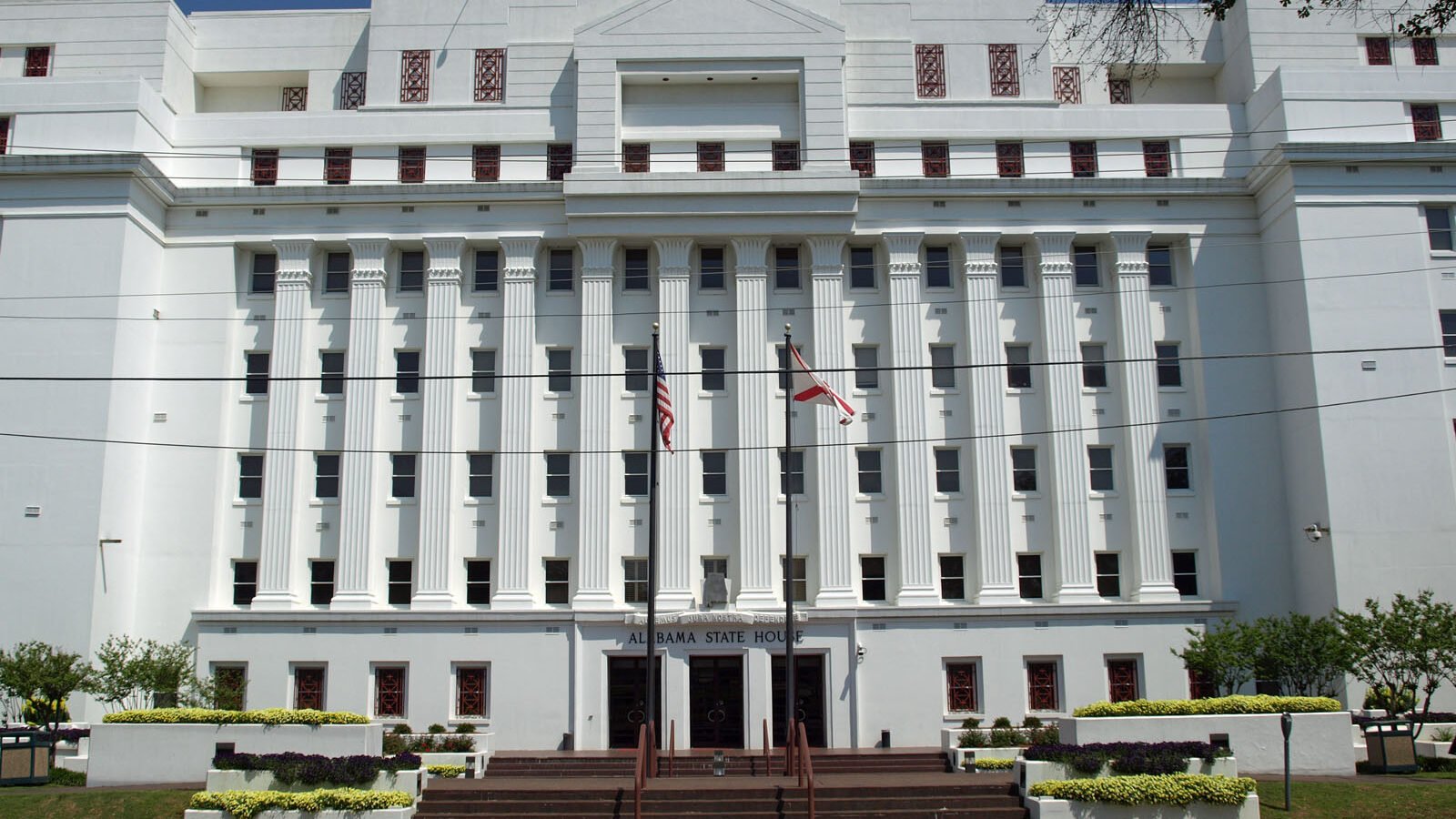
Featured photo: Alabama State House, April 2009; Chris Pruitt, Wikimedia Commons original, CC BY-SA 3.0. Licensed photograph used with attribution.