A harvest was only the beginning. For Ancestral Pueblo farmers in the Four Corners region, keeping food available after the growing season required drying, protected storage and buildings that made room for reserves. The next installment of our Ancient American Technology series examines this less conspicuous infrastructure: the granaries and household spaces that helped turn seasonal crops into food for later months.
Preservation began with the crop
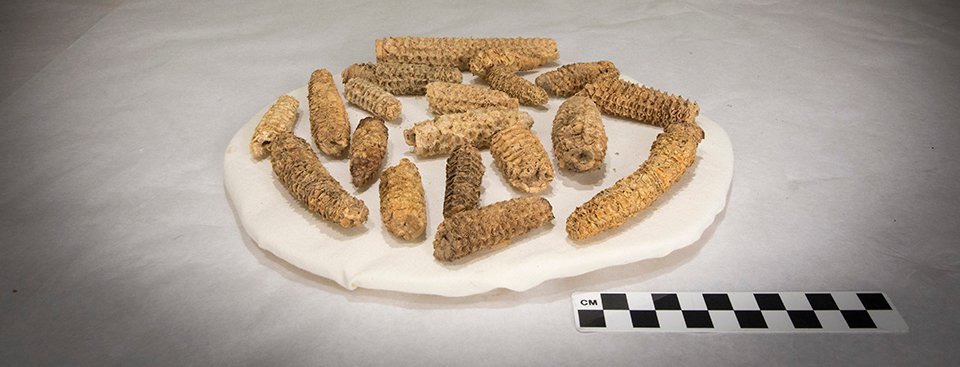
At Mesa Verde in southwestern Colorado, the National Park Service’s corn collection includes cobs more than 800 years old. Its interpretation explains that farmers depended heavily on precipitation rather than irrigation. Spring moisture and summer rain both mattered; a failure in either season could damage the harvest. Storing surplus dried maize helped carry food forward into a disappointing crop year.
Drying and storage performed different jobs. Removing moisture made a crop more suitable for keeping; a granary supplied a protected place to hold it. A stone room by itself did not preserve a wet harvest. Read together, the dried-corn evidence and storage architecture show why preservation is best understood as a sequence of work rather than a single invention.
Architecture for the months ahead
In southeastern Utah, Canyonlands National Park’s interpretation of Ancestral Pueblo granaries describes structures associated with farming communities around eight centuries ago. A covering sheltered their contents from weather. The park identifies maize, beans, squash, seeds and gathered foods among the resources these storage spaces could hold.
Granaries survive at places including Roadside Ruin and Aztec Butte. These are archaeological buildings, not newly built demonstrations. Their survival makes the storage system visible, but an empty structure cannot reveal every item once placed inside it. The park’s imagined scene of a full granary is an interpretation that helps explain function, rather than an inventory recovered from every building.
The engineering question was practical: how could people allocate protected space to food they would need later? Construction materials, a roof or covering, access and maintenance all belonged to that problem. Storage also required decisions about when to open reserves and how much to retain. Those decisions cannot be reconstructed from masonry alone.
Food storage shaped the home
Mesa Verde’s account of Ancestral Pueblo life places these practices within a wider Four Corners history between about 500 and 1300 CE. Buildings combined stone, earth, plaster and timber, and a substantial share of indoor space served winter food storage. Reserves were therefore part of domestic architecture, rather than merely separate facilities beside a village.
The same source distinguishes experimental fields planted with Hopi maize varieties from ancient remains. Such modern experiments can investigate farming possibilities, but they are not untouched ancient fields. Likewise, living Pueblo knowledge deserves recognition in its own right; it should not be treated as a frozen reconstruction of a single archaeological period.
A historical account from Pecos
A different kind of evidence comes from Pecos Pueblo in present-day New Mexico. The NPS account of farming and trade at Pecos reports that a Spanish observer described an extensive stored maize supply. This is historical testimony transmitted through park interpretation, not a modern measurement of excavated grain.
Pecos farmers worked with a short growing season and spread planting across spring to reduce the danger of a late frost ruining all young plants. Trade also contributed to the community’s livelihood. Storage belonged to this larger system of cultivation, exchange and planning; it did not eliminate environmental uncertainty.
Continuing peoples, distinct histories
Ancestral Pueblo is an archaeological designation, not the name of a vanished nation. Descendant communities include Hopi, Zuni and Acoma, among other Pueblo peoples. Their histories and traditions remain distinct. These Southwest examples also should not be generalized to Maya communities or other Indigenous peoples across the Americas without region-specific evidence.
Following our Inka terrace installment, granaries show another essential part of food technology: managing what happened after harvest. Protecting the archaeological structures means leaving their walls and contents undisturbed so their evidence remains available to descendant communities and future study.
Featured photograph: National Park Service, Mesa Verde National Park, preserved corn cobs. Public-domain U.S. Government work. No claim to original U.S. Government works.
Sources and further viewing
Mesa Verde: Corn artifact gallery; Inside Canyonlands: Ancestral Puebloans — ranger video and transcript; Mesa Verde: People; Pecos: Making a Living.