WASHINGTON, Nov. 13, 2026 — President Donald Trump’s September 17 executive order on hunting includes a provision designed to help more wild game meat reach American food banks and schools. But it does not launch a new nationwide venison giveaway or automatically provide money to every state. Instead, the order directs federal agencies to provide guidance and encourage states to use existing conservation funding where legally permitted.
Executive Order 14429, “Reinvigorating America’s Hunting Heritage,” was signed September 17 and published in the Federal Register on September 22. Its Section 5 is titled “Increasing Wild Game Donation.” See the White House text and Federal Register record.
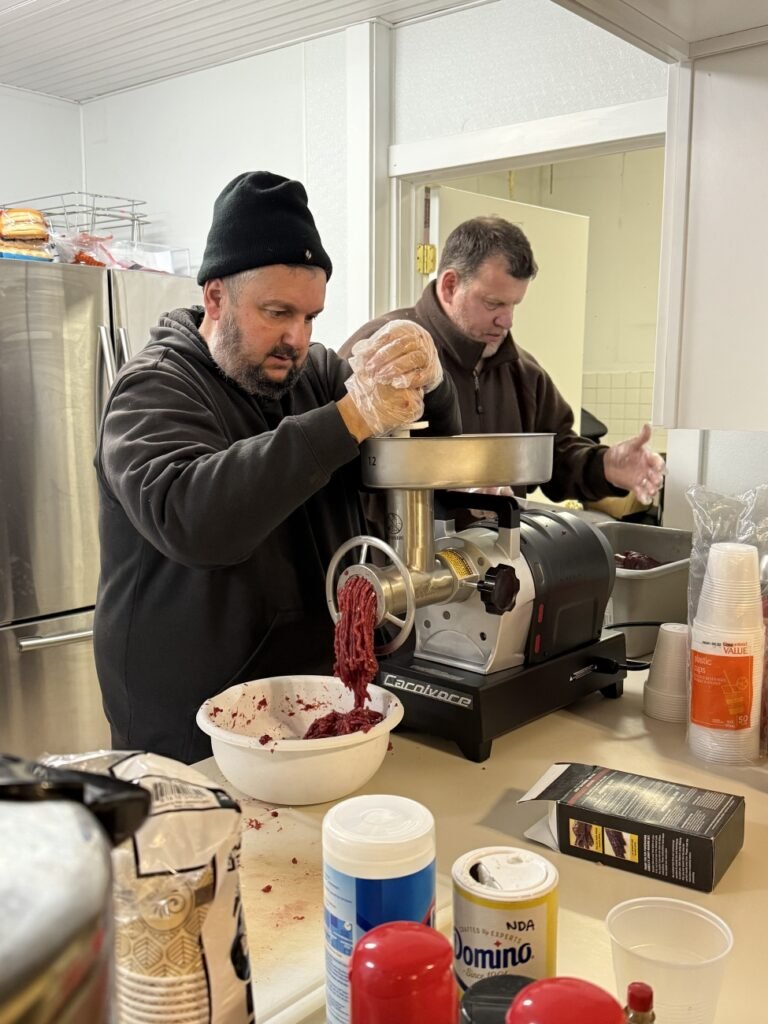
Featured archival photograph: Jeff Patten learns venison processing with Future Farmers of America students at Newton High School in New Jersey, Nov. 14, 2021. Credit: Jared Green/U.S. Fish & Wildlife Service (public domain); original photo and rights. The photograph shows training, not a food-bank donation.
What the executive order actually directs
Section 5 instructs the secretary of agriculture to issue guidance supporting state venison-donation programs, including through the Emergency Food Assistance Program. It also tells the secretary of the interior to encourage state wildlife agencies to use Pittman-Robertson funds to manage unusually abundant wildlife populations—especially white-tailed deer—including activities that facilitate processing and donation of wild game meat for schools and food banks.
That wording matters. The order calls for guidance and encouragement, not an automatic nationwide appropriation. Section 6 says implementation remains subject to applicable law and available appropriations. States still have to address grant eligibility, program administration, licensed or approved processing arrangements, and food-safety requirements.
States have been feeding families with donated venison for decades
The concept predates this administration. Missouri’s Share the Harvest began in 1992. In an October 23, 2026, release, the Missouri Department of Conservation reported more than 6 million pounds of venison distributed since the program’s founding. It said the program has recently averaged around 5,000 deer and 250,000 pounds of venison annually. Partners are aiming for 6,500 donated deer in the 2026 season and 10,000 in 2027—goals, not completed totals.
Wisconsin’s Deer Donation Program reports that hunters have donated over 100,000 deer since 2000, producing more than 4 million pounds of ground venison for charitable distribution. Pennsylvania’s Hunters Sharing the Harvest also connects hunters, processors, and food pantries. The models vary by state; no single national rule covers every drop-off or recipient.
Existing federal food-assistance projects may already intersect with this work. USDA’s FY 2026 Farm to Food Bank project summary lists a $219,649 Tennessee project involving Hunters for the Hungry and meat processors. The publicly described project is not, by itself, proof that the September executive order produced that funding.
Why food banks want additional sources of protein
Food insecurity is an established problem across the country. Feeding America’s Map the Meal Gap 2026, drawing on 2024 data, reports that nearly 48 million Americans, including about 14 million children, experienced food insecurity. Food insecurity means a lack of consistent access to enough food; it is not the same thing as a diagnosis of undernutrition.
Properly processed venison can add a lean protein option to local food pantries. Yet a deer does not translate into a fixed number of school meals: yield depends on animal size, edible cuts, processing losses, packaging, serving size, and whether a recipient organization can accept and serve that product.
Food safety is an essential part of the story
Expansion also brings questions about screening and handling wild game. Chronic wasting disease (CWD), a prion disease affecting deer and related animals, has not been shown to infect humans, but the Centers for Disease Control and Prevention advises against eating meat from an animal that tests positive. State testing requirements and program acceptance rules differ, and some programs hold meat until results arrive.
Lead ammunition is another issue. Wisconsin’s venison-safety guidance warns that lead bullets can leave tiny fragments in meat, with children and pregnant women particularly vulnerable to lead exposure. Lead-free ammunition avoids bullet-derived lead contamination. Separately, Section 2 of the executive order calls for federal agencies to propose changes permitting traditional lead ammunition and tackle in certain circumstances. That policy instruction does not erase the food-safety concern.
How a hunter can participate
Hunters should first check their state wildlife agency’s current donation program and locate a participating processor. They should confirm that the processor can accept a deer, follow all hunting-license, season, tagging, reporting, field-dressing, transport, and disease-testing rules, and complete the donation paperwork. Processing fees may be waived through program funding, but arrangements vary.
Nonhunters can support participating programs through donations that help cover processing and distribution costs, where available. People seeking venison should contact local food banks about inventory rather than assume it is available immediately.
What happens next
The main questions are whether USDA issues new operational guidance, how the Interior Department communicates eligibility for wildlife-restoration funds, which states apply or expand their programs, and what amounts of meat reach food assistance providers as a result. Existing state accomplishments should not be counted as new results of the order without evidence.
Other provisions of the executive order address access to certain federal lands, hunter education, wildlife management, Sunday hunting opportunities, and proposed changes related to lead ammunition. Those provisions have their own timelines and legal limitations; they do not make every kind of hunting immediately lawful everywhere.
Related video
In the Epoch Times video supplied with this story, the host discusses the order and Hunters for the Hungry programs. Khemetic.News independently checked the text of the executive order and the state program records used here. The linked video contains a sponsored segment unrelated to this article.
Watch the full Epoch Times report on YouTube (external video). The video player was not rendering reliably in the article, so this link opens the original publisher’s video directly.
Sources and further reading
- White House — Executive Order 14429 (Sept. 17, 2026)
- Federal Register — Executive Order 14429 (Sept. 22, 2026)
- Missouri Department of Conservation — Oct. 23, 2026 update
- Wisconsin DNR — Deer Donation Program
- Feeding America — Map the Meal Gap 2026
- CDC — Chronic Wasting Disease guidance
- Wisconsin DNR — Safely Eating Venison
- USDA — FY 2026 Farm to Food Bank projects