
By Lotta Goddess | Khemetic.News | November 10, 2026
Public-interest investigation: From Alabama and Georgia to carbon-pipeline fights in the Midwest, the right to condemn land is sometimes exercised by private businesses under authority delegated by government. That helps build necessary infrastructure but also raises questions about conflicts of interest, route selection, property values and whether owners receive meaningful judicial review before irreversible damage occurs.
Key distinction: Investor-owned utilities, privately financed developers and private-equity investment funds are different entities. Alabama Power is an investor-owned utility belonging to Southern Company, not itself a private-equity fund. Being privately financed does not alone confer eminent domain; a specific statute and applicable approvals must authorize it.
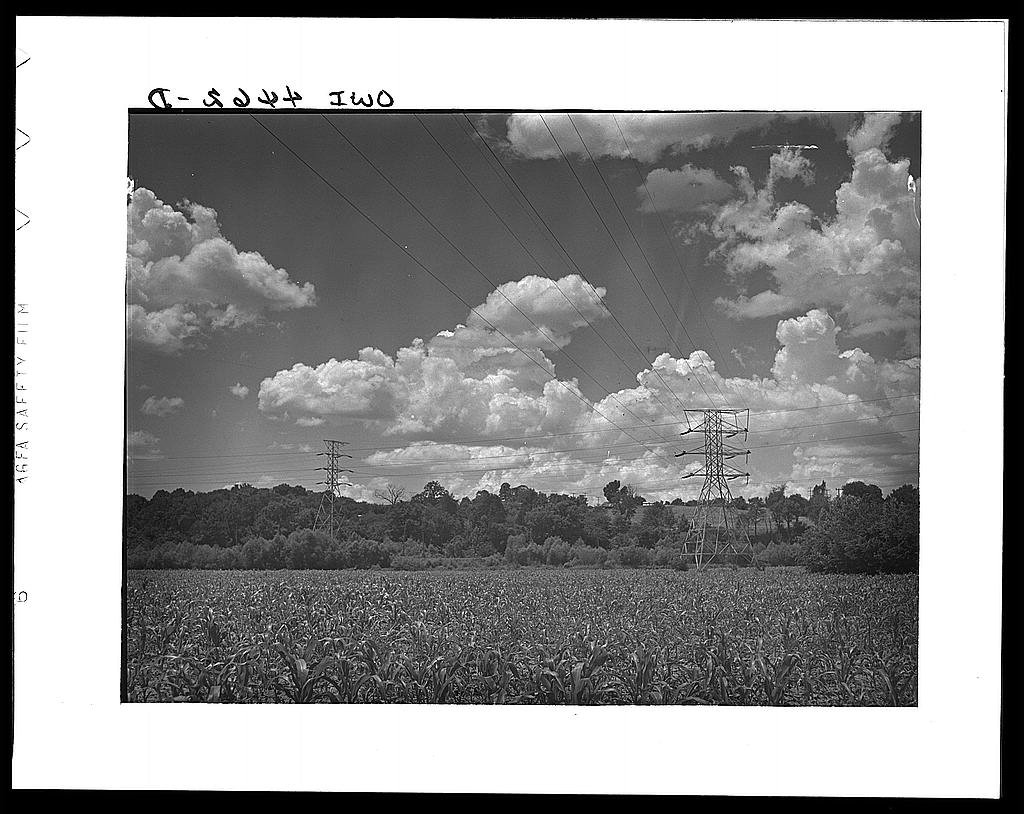
Featured image: Archival photograph of TVA transmission lines in a Lauderdale County, Alabama cornfield, June 1942. Arthur Rothstein / Library of Congress, FSA–OWI Collection (public domain). This historic scene does not show Fenn Church’s disputed property.
Alabama: A court stay, a disputed route and a landowner’s last stand
In Shelby County, Alabama, Fenn Church has challenged Alabama Power’s planned transmission corridor through his property. On September 22, 2026, Circuit Judge Jonathan Spann granted a preliminary injunction against entry. On October 21, the Alabama Supreme Court stayed the injunction without a substantive written explanation. It did not finally adjudicate the legality of every aspect of the condemnation.
Church says a less destructive route through already-cleared land was available. Alabama Power says its proposed route addresses engineering, access and network needs, and it describes its work as necessary for reliable electric service. By November 9, a new hearing addressed the utility’s request to keep Church away from work crews. The final result of that hearing was not established at drafting. See Inside Climate News, Nov. 9, 2026 and WVTM.
Alabama Code §37-4-130 expressly authorizes qualifying utilities to condemn transmission rights-of-way. The question is whether that authority was exercised in compliance with applicable rules in this particular case. Although the utility may take an easement rather than full title, ongoing entry and land-use restrictions can outlast the original owner.
What the Constitution allows—and what it does not
The Fifth Amendment requires public use and just compensation when government takes private property. A state may delegate specific condemnation powers to qualifying private utilities and common carriers, and the federal Natural Gas Act grants such powers to qualifying interstate pipeline certificate holders. It remains essential to separate the legal right to take property from the valuation, necessity, route and possession disputes.
In Berman v. Parker (1954), the Supreme Court gave lawmakers broad room to define redevelopment public purposes. Hawaii Housing Authority v. Midkiff (1984) allowed a legislatively designed transfer of property interests between private owners. Kelo v. New London (2005) upheld a comprehensive economic-development plan under the federal public-use standard; many states subsequently imposed stricter limits. PennEast v. New Jersey (2021) confirmed certain powers of federally certified private natural-gas companies.
On November 9, 2026, the Supreme Court heard Hoffmann v. WBI Energy Transmission (No. 25-159), addressing the role of state compensation rules—including legal expenses—in a federal Natural Gas Act taking. There was no final ruling as of this article date.
Who profits when private businesses wield delegated public power?
Utility shareholders, infrastructure project investors and large industrial electricity customers can all benefit from construction. Those relationships do not prove that any seizure is illegal. The conflict to investigate is whether privately selected projects and routes receive sufficiently independent scrutiny, and whether landowners and ordinary ratepayers bear disproportionate costs.
In Georgia, Georgia Power pursued lines to serve a data-center-heavy region, including sites associated with Blackstone-backed QTS. The utility, not QTS by virtue of private-equity ownership, is the entity with relevant utility condemnation authority. Bloomberg described local homeowners contesting transmission lines, while CBS reported major data-center electricity demand associated with a separate Georgia project. See Bloomberg’s Fayetteville report and CBS.
Other cases show courts and legislatures can impose limits
South Dakota: Governor Larry Rhoden signed HB1052 in March 2025, preventing eminent domain for pipelines predominantly transporting carbon oxide while allowing voluntary agreements. Kentucky: Bluegrass Pipeline v. Kentuckians United found the developer lacked authority under the statute it invoked. Kansas: regulators changed a Grain Belt Express route and set conditions around return of some involuntary easements. KCC release.
Illinois: the state Supreme Court addressed the financial-capability requirements for a private transmission developer in Concerned Citizens v. ICC (2026). Missouri: Grain Belt Express sought condemnation petitions on land along its route. Iowa: Summit Carbon Solutions generated separate disputes over siting, surveying and land acquisition; a right to survey is not a final right to condemn.
Florida: Sabal Trail acquired pipeline easements and a jury awarded substantial compensation and damages concerning remaining land. Mississippi: courts rejected a utility’s particular condemnation petitions. Virginia: homeowner Vicki Wu challenged a transmission route that could substantially affect her yard. These are different legal and procedural outcomes—not proof of one nationwide finding of unlawful condemnation.
Louisiana: Construction moved forward before the right to enter was secured
In Bayou Bridge Pipeline, LLC v. 38.00 Acres (Louisiana Supreme Court, 2021), the pipeline company began clearing and construction on co-owned property in the Atchafalaya Basin before obtaining consent from every owner or a final expropriation judgment. A trial court permitted the ultimate expropriation but found unlawful trespass; subsequent appeals upheld important relief for landowners, including an attorney-fee award under the Louisiana Constitution. The record sharply distinguishes a qualifying public-purpose condemnation from the separate obligation not to trespass or deprive owners of due process while pursuing it.
Five recurring failures of accountability
1. Unclear beneficiary disclosures. A project may help regional reliability while predominantly serving a few large customers. Evidence of projected load and rate allocation should be public.
2. Unequal bargaining power. Developers typically have engineering teams, specialized attorneys and appraisers. Individual owners must find and pay for comparable experts.
3. Early access. Some procedures allow clearing or possession before all issues are resolved. The destruction of trees, heritage or established land uses may be impossible to reverse.
4. Narrow offers. Compensation for the actual strip taken may fail to capture provable loss in the remainder of a parcel or long-term access burdens.
5. Weak route accountability. The lowest-cost route for a developer can impose significant uncompensated community, environmental and cultural burdens, especially around Indigenous lands and historic places.
What effective reform looks like
Legislatures can require independent proof of public necessity and route minimization, clear separation of infrastructure needed for broad reliability from customer-specific projects, public disclosure of financing and principal beneficiaries, early meaningful judicial review, reimbursement of reasonable valuation and legal expenses in qualifying cases, narrow surveyed easements, restoration and expiration of unused rights, and heightened Tribal consultation where applicable.
Maine’s §3136 includes protections for qualifying high-impact transmission projects, while South Dakota’s 2025 reform demonstrates that lawmakers can withdraw certain corporate condemnation powers outright. Any proposal must distinguish negotiated easements, preconstruction survey entry, full condemnation and federal authority.
Fifty-state legal and case research ledger
Research classification: The following sources include actual contested condemnations, court precedent, enacted statutes, proposals and regulatory records. A listed state is not necessarily an example of a private company successfully taking land. Several entries concern government takings or project permitting and are included as contrasts. Entries should be checked against the latest dockets before publication.
| State | Case or legal record | Outcome/limitation |
|---|---|---|
| Alabama | Electric-utility condemnation | Statutory delegation; Fenn Church litigation remains contested |
| Alaska | Alaska Stat. §09.55.240 | Limits certain private redevelopment takings; no specific recent taking asserted |
| Arizona | SunZia and Tribal consultation | Historic-preservation consultation dispute, not a proven private condemnation |
| Arkansas | Plains & Eastern Clean Line | Federal project record; proposal did not proceed under original arrangement |
| California | Utility-asset acquisition proceedings | Example of public acquisition of private utility assets; reverse of corporate condemnation |
| Colorado | Xcel and Dryland Partners | Dispute over statutory authority for generation-associated infrastructure |
| Connecticut | Kelo v. New London | Supreme Court public-purpose doctrine and ensuing reform debate |
| Delaware | Title 29, Chapter 95 | Statutory restrictions and exceptions for public purpose |
| Florida | Sabal Trail v. Thomas | Pipeline easements and disputed compensation costs |
| Georgia | Georgia Power transmission and data centers | Homeowner opposition to route and effects of major electric demand |
| Hawaii | Hawaii Housing Authority v. Midkiff | Supreme Court upheld a legislatively defined land-reform public purpose |
| Idaho | Boardman-to-Hemingway | Interstate transmission rights-of-way and landowner negotiation |
| Illinois | Concerned Citizens v. ICC (2026) | Financial qualifications of privately developed transmission utility |
| Indiana | Grain Belt Express project information | Multistate project reference; individual condemnation not established here |
| Iowa | Summit Carbon Solutions regulator proceeding | Carbon pipeline siting, survey entry and condemnation controversy |
| Kansas | KCC Grain Belt conditions | Route modification and conditioned return of certain easements |
| Kentucky | Bluegrass Pipeline v. Kentuckians United | Court rejected claim to authority under cited utility statute |
| Louisiana | Bayou Bridge Pipeline v. 38.00 Acres (2021) | Company entered and began building before obtaining all owners’ consent or condemnation judgment; courts upheld an award of fees and other relief. A private taking was upheld but premature entry was found unlawful |
| Maine | 35-A M.R.S. §3136 | Enhanced high-impact transmission property rights and compensation protections |
| Maryland | Transource Maryland regulatory file | Transmission regulatory review; not proof of specific condemnation |
| Massachusetts | Sudbury–Hudson transmission | Public dispute over siting, environmental impacts and route |
| Michigan | County of Wayne v. Hathcock | State constitutional limits on redevelopment takings |
| Minnesota | Summit carbon pipeline PUC | Route review; no categorical finding of completed condemnation |
| Mississippi | Mississippi Power & Light v. Conerly | Court affirmed dismissal of a utility condemnation request |
| Missouri | Grain Belt condemnation petitions | Actual condemnation petitions for proposed transmission route |
| Montana | Keystone XL litigation docket | Pipeline litigation record; canceled project, not proof of continuing taking |
| Nebraska | 2026 LB916 legislative coverage | Proposed carbon-pipeline changes, not necessarily enacted law |
| Nevada | Greenlink West federal project record | Federal rights-of-way review; distinct from private land condemnation |
| New Hampshire | Northern Pass | State rejected contested transmission siting application |
| New Jersey | PennEast v. New Jersey | U.S. Supreme Court on federally delegated private condemnation of state interests |
| New Mexico | El Rio Sol Transmission v. Sanchez | Existing easement contract dispute; not new condemnation |
| New York | Goldstein v. Urban Development Corp. | Economic-development condemnation for Atlantic Yards upheld |
| North Carolina | MVP Southgate FERC record | Potential Natural Gas Act condemnation if certification and negotiations fail |
| North Dakota | Hoffmann v. WBI Energy | Pending Supreme Court compensation case argued Nov. 9, 2026 |
| Ohio | Norwood v. Horney | State court rejected vague redevelopment/ deterioration rationale |
| Oklahoma | 27 O.S. §7 | Specified utility condemnation rights and conditions |
| Oregon | Idaho Power v. Bean (2025) | Distinction between survey entry and completed taking |
| Pennsylvania | Mariner East appellate litigation | Common-carrier/utility classification in liquids pipeline condemnations |
| Rhode Island | Johnston eminent-domain challenge | Governmental condemnation and allegations of pretext; not private utility delegation |
| South Carolina | James Island challenge | Governmental taking disputed by an owner; allegations are not findings |
| South Dakota | 2025 HB1052 | Enacted prohibition on eminent domain for predominantly carbon-oxide pipelines |
| Tennessee | Piedmont Natural Gas v. BlueRoad Fontanel | Valuation judgment affirmed in private utility easement case |
| Texas | Miles v. Texas Central Railroad | Private high-speed rail venture held eligible under existing statutes |
| Utah | TransWest Express | Multistate private/federal transmission corridor |
| Vermont | Vermont Gas Addison County | Landowners questioned pipeline easements and safety assurances |
| Virginia | Dominion and Vicki Wu | Homeowner disputes transmission easement serving a high-demand region |
| Washington | Energize Eastside | Transmission permitting and public route review; specific taking not established |
| West Virginia | Mountain Valley Pipeline appeals | Federal court addressed early possession pending compensation |
| Wisconsin | Hodgson v. American Transmission Co. | Cardinal-Hickory Creek related condemnation challenge |
| Wyoming | TransWest Express | Transmission review and federal land approvals, not proof of any specific forced taking |
Eight questions before signing an easement
- What exact entity seeks the land and what statute empowers it?
- Which official approval identifies the public use?
- Who are the major customers and investors benefiting?
- What other routes were studied and why rejected?
- Is the request for survey entry, temporary access, a permanent easement or title?
- What appraisal covers damage to the property retained?
- Can work occur before an owner has meaningful review?
- What rights of future access, sublease and restoration will apply?
A utility or pipeline company may serve a real public need and still owe landowners greater accountability. The necessary standard is not reflexive opposition to infrastructure: it is demonstrable public benefit, the least practicable harm, transparent financial relationships, proper procedure and fair compensation.
Primary legal and reporting sources
Fifth Amendment · Natural Gas Act §7 · FERC transmission-siting explanation · ICN on Fenn Church, Nov. 9 · Original commentary video (context, not a court record)
Reporting note: This original analysis draws from official statutes, rulings and attributed reporting. We did not witness the proceedings or conduct original interviews. Allegations, proposals, procedural rulings and final decisions are distinguished. Draft prepared November 10, 2026.