

Khemetic.News Special Investigation | By Lotta Goddess | November 10, 2026
A paid-off mortgage does not make a home invulnerable. Creditors, fraudulent filings, disputes over possession, unpaid taxes and government condemnation can each threaten an owner’s security—but they operate under distinct laws. An online ranking puts Florida, Texas, Oklahoma, South Dakota and Kansas at the top. Court decisions and statutes show both the value and the limits of that claim.
In New London, Connecticut, the city condemned homes as part of a redevelopment plan connected with anticipated private investment. In Minneapolis, a county retained $25,000 beyond the taxes and penalties owed after selling a woman’s condominium. In Michigan, a disputed homestead-tax bill triggered a foreclosure that reached the U.S. Supreme Court in 2026.
Three cases; three different legal mechanisms. They reveal a recurring challenge: the right to own property may be clear while the cost, complexity and timing of enforcing that right remain formidable.
The video “45 States Are Stripping Property Rights. These 5 Are the Last Line of Defense” evaluates five questions—judgment creditors, deed theft, squatters, foreclosure equity and eminent domain. Those are worth investigating. But the video’s claim that 45 states are actively “stripping” property rights is not established by a tally of states lacking new specialized statutes. Older fraud laws, court rulings, and different foreclosure procedures matter. This investigation treats the ranking as a claim to test, not as an official national score.

Three Supreme Court decisions—and the risks they expose
Kelo: Economic development as a public purpose
The Supreme Court’s 2005 decision in Kelo v. City of New London allowed a comprehensive redevelopment plan to satisfy the federal Constitution’s public-use requirement, even where property could later be used by private entities. A city-approved project and the New London Development Corporation figured in the plans, which were developed amid anticipated activity near a Pfizer research complex.
The ruling did not show that Pfizer directly possessed eminent-domain power or that the participants engaged in criminal misconduct. It established how broadly a municipality could define a public purpose under federal law. States remained free to adopt narrower restrictions. The Duke Law archive preserves court records, photographs and material on what followed.
Tyler: An unpaid tax debt does not transfer all remaining equity
On May 25, 2023, the Supreme Court unanimously ruled in Tyler v. Hennepin County that a county could not simply keep a tax-foreclosure surplus without implicating the Fifth Amendment’s Takings Clause. Geraldine Tyler’s Minneapolis condominium sold for $40,000 after approximately $15,000 in taxes, interest and penalties. The county retained the $25,000 excess. The decision established a constitutional baseline, not a single nationwide filing procedure.
Pung: What happens when an auction price falls far below assessed value?
In Pung v. Isabella County, decided June 23, 2026, the Supreme Court addressed a different question: what just compensation is owed when a tax-foreclosed property sells below an asserted fair value? The Pung family had prevailed in earlier legal disputes about a principal-residence tax exemption, yet a $2,241.93 tax debt remained. The house, assessed for tax purposes at $194,400, sold at public auction for $76,008. Its purchaser later resold it for $195,000.
The Court held that the proper constitutional baseline is generally the auction price where the tax sale was fairly conducted. Questions about whether the sale was fair remained open on remand. Tax-assessed value is not automatically market value, and a later resale does not itself prove fraud or auction manipulation. But the gap illustrates why returning surplus proceeds and preserving full homeowner equity are not necessarily the same thing.
Test one: Protection from ordinary judgment creditors
Homestead protection concerns the equity a creditor can reach through collection on an ordinary civil judgment. The exemption does not generally make valid mortgages, purchase-money liens, property taxes or other specified encumbrances disappear. It also varies by acreage, occupancy and legal setting.
Kansas
K.S.A. § 60-2301 protects a qualifying homestead of up to one acre in an incorporated city or 160 acres of farmland without a general dollar cap. Taxes, purchase obligations, improvement debts and certain consensual liens remain exceptions.
South Dakota
S.D.C.L. Chapter 43-31 supplies substantial homestead protections, subject to eligibility and statutory exceptions. A no-dollar-cap characterization cannot be taken to mean immunity from every financial claim.
Oklahoma
Oklahoma Statutes, Title 31 lists qualifying homestead property among exemptions against attachment and forced sale, within the state’s conditions and exceptions.
Texas
Texas Property Code, Chapter 41 protects qualifying urban homesteads of up to 10 acres and rural homesteads of up to 200 acres for families or 100 for eligible single adults; valid property-related liens remain enforceable.
Florida
Florida Constitution, Article X, Section 4 protects qualifying homesteads without a general dollar limit but typically restricts acreage to one-half acre within a municipality or 160 acres outside. Exceptions include taxes and specified property-related obligations.
These five do not exhaust America’s protections. Iowa, Arkansas and other jurisdictions employ distinct constitutional or statutory schemes, and the amount protected in dollar-limited states may change through legislative amendments or inflation adjustments. Any count that reduces 50 legal regimes to “protected” and “unprotected” hides these qualifications.
Test two: Deed theft, forgery and title fraud
County recorders generally perform prescribed recording functions, not a judicial determination that every signer has lawful authority. A fraudulent deed may cloud title and facilitate further wrongdoing. A forged instrument is not automatically an effective lawful transfer simply because it appears in records. Fraud prevention, criminal prosecution, correction of the land record and compensation are different safeguards.
Kansas
Some Kansas counties offer fraud-alert services, but no comprehensive statewide title-fraud notification or remedy inventory has been established for this report. This is not a finding that deed forgery is lawful in Kansas. Owners should check the procedures of their county register of deeds.
South Dakota
The state provides general real-property recording and fraud laws; this review has not established the existence of a unified statewide no-cost recording-alert mandate comparable to Florida’s. A county-level check remains necessary.
Oklahoma
Senate Bill 925 (2025) created targeted title-fraud provisions, including an offense punishable by up to 10 years where a fraudulent filing is knowingly and willfully intended to defraud the owner. The enrolled bill provides a recorded notice mechanism and took effect November 1, 2025.
Texas
Senate Bill 16 (2025) established specific real-property theft and fraud crimes and recording safeguards. Criminal penalties do not themselves determine the cost or speed of clearing an affected owner’s title.
Florida
Florida Statutes § 28.47 requires circuit court clerks to offer a free recording-notification service. A registrant must be emailed within 24 hours after a relevant land record is recorded. This can alert owners to filings, but it does not authenticate a transaction or guarantee interception beforehand.
Arizona is one example omitted by a static ranking: SB 1479 (2026) made additional changes to fraud-prevention and recording procedures. The correct comparison must include current laws, not just whether a state enacted an act with the specific title “deed theft.”
Test three: Unauthorized occupants, removal procedures and wrongful eviction
Recent legislation addresses situations in which people occupy premises without any legitimate claim. The details matter. A trespasser does not have the same rights as a legitimate tenant, an ex-tenant with a legally disputed claim or a household member who is authorized to reside there. Expedited processes must have safeguards against malicious affidavits and wrongful removal.
Kansas
HB 2378 (2026), approved April 6 and effective with the July 1 statute-book publication, established a sworn-affidavit mechanism for law-enforcement assistance, with criminal consequences for knowing false complaints and a civil remedy for wrongful removal.
South Dakota
No comparable new statewide expedited-removal mechanism has been verified in the reviewed statutes. Ordinary possession, trespass and eviction rules remain relevant; the lack of a new specialty measure does not establish that an intruder has a legal right to remain.
Oklahoma
SB 1994 (2024) established specified procedures for removal of unauthorized occupants. Owners and law enforcement must meet the law’s factual prerequisites; its purpose is not to eliminate ordinary due process for lawful tenants.
Texas
SB 1333 (2025) created a sheriff- or constable-assisted process for qualifying unauthorized occupants and remedies for improper removal.
Florida
Florida Statutes § 82.036, enacted through HB 621 in 2024, gives qualifying owners an expedited sheriff-assisted remedy while excluding specified ordinary tenancy and related disputes.
The question for policymakers is not only how quickly lawful owners regain possession but whether wrongful removals are counted, investigated and remedied.
Test four: Tax foreclosure and what becomes of the surplus
All states must respect the constitutional protections identified in Tyler and clarified in Pung. States nevertheless differ in notice, redemption, auction practice, claims paperwork and when an owner must act.
Kansas
Kansas’s exemption expressly does not bar sale for taxes. Its county tax-foreclosure procedures, distribution obligations and appeal deadlines require separate local-law analysis rather than an unqualified claim that a homeowner can never lose residual equity.
South Dakota
S.D.C.L. § 10-25-39 requires tax-deed-sale surplus after specified taxes, penalties, interest, liens and costs to go to the former owner. If the former owner cannot be found within 180 days, funds must be transferred to the Unclaimed Property Division. The statutory scheme followed the 2024 reforms, with later adjustments.
Oklahoma
Federal constitutional protection applies. An assessment of Oklahoma’s precise county tax-sale procedures, claim deadlines and remedies is necessary before attaching a national pass-or-fail score.
Texas
Texas Tax Code § 34.04 generally requires a petition for excess proceeds before the second anniversary of the tax sale. A right to remaining proceeds can thus depend upon a timely filing.
Florida
Florida Statutes § 197.582 establishes distribution and a 120-day notice-related claim period in tax-deed sales. Crucially, failure to file within that period does not simply authorize a county to keep all of the former owner’s money: the statute provides that, where no claim is filed, certain remaining surplus is processed through the state’s unclaimed-property framework for the legal titleholder.
The difference between having a right to money and receiving it depends on whether the former owner is notified, whether the auction was fair and whether local processes are accessible.
Test five: Eminent domain and private development
After Kelo, numerous states adopted stricter restrictions on condemning land for economic development. None of those provisions should be summarized without looking at utilities, genuine public infrastructure, blight findings and other exceptions.
Kansas
K.S.A. § 26-501b restricts transfers of condemned land to private interests, with stated exceptions, including some instances specifically approved by the Legislature.
South Dakota
The state’s post-Kelo reforms restricted certain uses of eminent domain, but an old Institute for Justice grade is not a substitute for checking present statutes and the particular condemning authority’s powers.
Oklahoma
In Board of County Commissioners of Muskogee County v. Lowery (2006), Oklahoma’s Supreme Court held that the relevant taking could not be justified solely by anticipated economic development benefiting a private utility project. This judicial rule deserves consideration alongside legislative reform.
Texas
Texas Constitution, Article I, § 17 restricts takings for private benefit and primarily for economic development or increasing tax revenue, preserving certain authorized public purposes.
Florida
Florida Constitution, Article X, § 6 restricts transfers of condemned property to private entities unless authorized under a qualifying general law passed by three-fifths of each legislative chamber.
New London illustrates the real tension: a family loses its house immediately, while the promised economic benefits of a development plan depend on uncertain future decisions. That can create a serious accountability failure without proving an illegal conspiracy.
What the debate overlooks: Communities, wealth and Indigenous land
Public housing clearance, urban renewal and road construction have historically displaced families and businesses, disproportionately affecting communities denied equal access to credit and political power. In Black business districts and low-income neighborhoods, a house could also support a family firm, a network of neighbors and future generations’ wealth. The value lost through displacement may not be captured by a simple condemnation check.
Tribal trust and restricted lands also require analysis separate from ordinary fee-simple state homestead law. 25 U.S.C. § 5108 and the Bureau of Indian Affairs describe federal trust processes. A 50-state homeowner ranking cannot simply be applied to tribal trust property without identifying the governing jurisdiction and ownership form.
Different interests are involved in each process: judgment creditors, criminals using forged records, unlawful occupants, tax agencies, auction purchasers, municipal planners and developers. The available evidence does not show one coordinated organization behind all five. It shows different systems in which governments and well-resourced private actors may have more capacity than an individual homeowner to pursue legal remedies.
What homeowners can check without paying a third party
- Search the official county recorder or register of deeds for your current deed and for unfamiliar liens or conveyances. A suspicious document may require legal assistance to resolve.
- Enroll in any free official property-record notification program offered in your county. These services flag filings but are not title insurance or preventive authentication.
- Review your property-tax account, mailing address, exemption status and any outstanding notices. A paid-off mortgage does not eliminate property taxes or guarantee someone else is monitoring notices.
Homeowners facing an actual fraudulent deed or tax-sale notice should obtain state-specific legal advice promptly. This is public-interest reporting, not individualized legal advice.
Why the ranking is not a verdict on all 50 states
The underlying dangers are real, and some of the video’s cited reforms are genuine. But the number of states without an explicitly named deed-theft law is not an adequate measure of whether forgery can be prosecuted; the absence of a new expedited-squatter statute is not equivalent to legal permission to trespass; and unlimited homestead exemptions do not protect against every kind of debt. Each state also has overlapping constitutional, statutory, county and federal safeguards.
A defensible 50-state ranking must publish its weighting, assess which remedies are actually effective, identify changes through November 2026, and distinguish proposed bills from enacted law. The five-state legislative comparison above establishes important contrasts; it does not purport to assign an unsupported national rank to the other 45 states.
The decisive public question is whether owners can discover fraud, receive notice, comply with deadlines and enforce the rights they already have before a loss becomes irreversible.
Original video and documentary sources
Watch the property-rights ranking video. The video is included as the subject of this fact-check and not as independent proof of all the claims discussed.
- U.S. Supreme Court: Kelo (2005)
- U.S. Supreme Court: Tyler (2023)
- U.S. Supreme Court: Pung (2026)
- Kansas homestead law and Kansas Removal of Squatters Act
- South Dakota tax-sale surplus provision
- Oklahoma title-fraud legislation
- Texas tax-sale statute, Texas property-fraud legislation
- Florida property-record notification law, Florida unlawful-occupancy procedure, Florida tax-sale surplus law
- Duke Law’s Kelo documentary archive
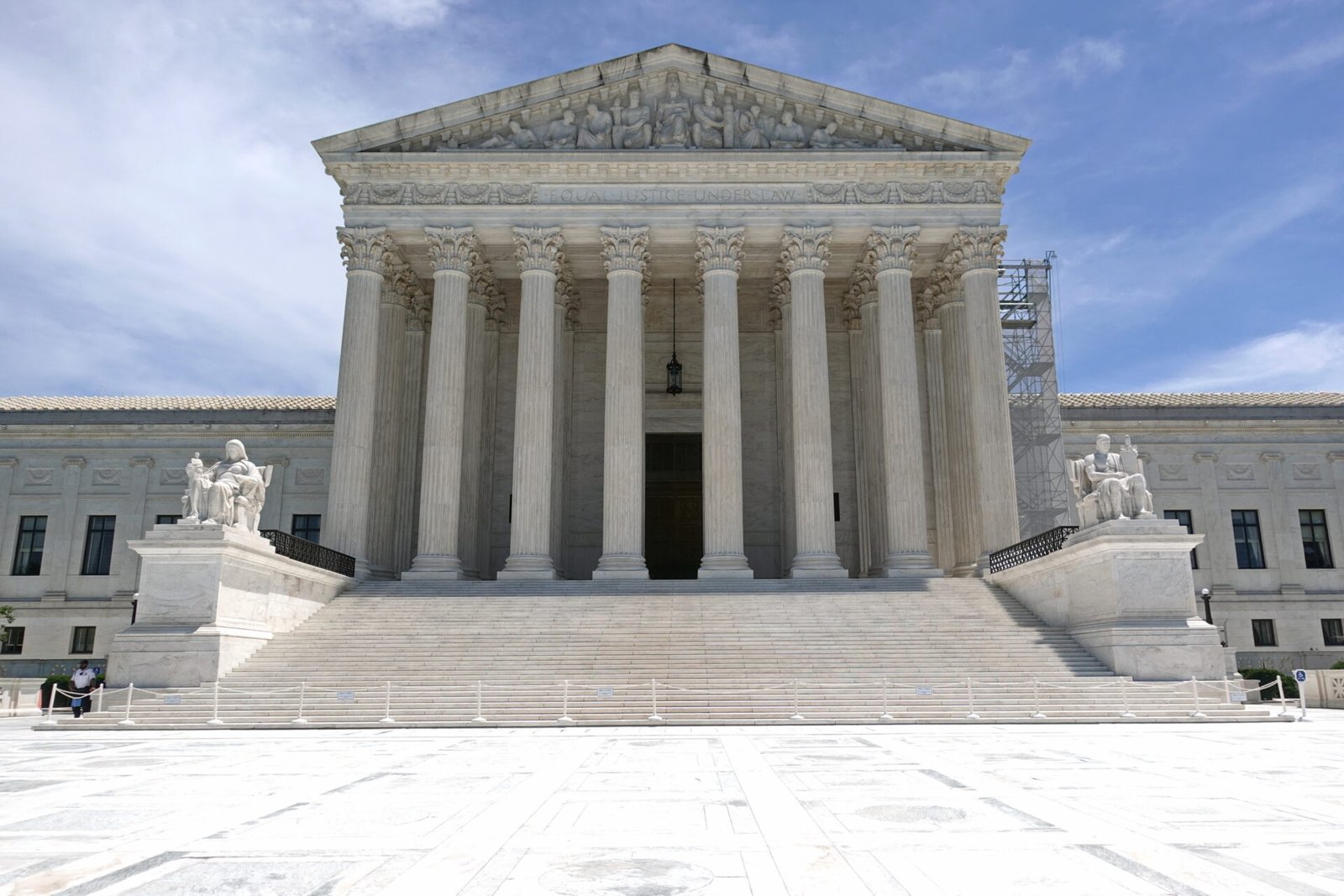
- Photographs: Nard, Fort Trumbull; 颐园居, U.S. Supreme Court; both CC BY-SA 4.0 and resized for WordPress.