Ancient American Technology | By Seba
A hillside field has to solve two problems at once: keeping soil in place and giving water somewhere to go. In the Peruvian Andes, Inka builders joined retaining walls, prepared growing surfaces and drainage into agricultural terraces. Their achievement was not simply making mountain slopes look like staircases. It was making land, water and construction work together.
This installment follows our explainer on ancestral Sonoran Desert canals. The setting now shifts to the Cusco region of Peru, particularly Machu Picchu and the Sacred Valley. These are distinct Indigenous histories, with different landscapes and engineering decisions.
A field is also a structure
Agricultural terraces break a long slope into shorter growing surfaces. A retaining wall holds the material behind it, while the filled platform provides room for cultivation. That arrangement changes how runoff crosses a hillside. Instead of treating the wall as a decorative edge, it is more useful to see the entire terrace as a structure whose stability depends on what happens inside and beneath it.
The engineering principle is straightforward: soil that becomes saturated becomes heavier, and trapped water adds pressure behind a retaining wall. Providing routes for drainage therefore matters alongside the strength and arrangement of the stonework. This is a general engineering explanation, rather than a claim that every Andean terrace used one identical design.
What excavations at Machu Picchu reveal
In their field study of Machu Picchu drainage, Kenneth R. Wright, Alfredo Valencia and William L. Lorah describe archaeological excavations, soil testing and hydraulic investigation. Their evidence includes deliberately placed growing soil and deeper layers of stones and stoneworking debris that allowed water to pass through the terrace fill.
The researchers also distinguish agricultural drainage from irrigation. Their investigations found no agricultural irrigation delivery system at Machu Picchu; they argue that rainfall met the fields’ water needs. This matters because an impressive water channel near a terrace is not automatically proof that the field was irrigated. Domestic water supply, storm runoff and crop watering are separate functions that require separate evidence.
These conclusions come from modern archaeological and engineering analysis. They are not surviving written instructions from the original builders. Excavated layers reveal construction choices; calculations help explain their performance. Neither gives us every conversation, trial or adjustment that went into building the landscape.
Different water problems in the Sacred Valley
The Smithsonian’s Native Knowledge 360° account of agricultural terraces includes a June 2014 interview with Ollantaytambo community leader Alan Alberto Loayza Carrién. He describes the relationship between terraces, irrigation and drainage in the Sacred Valley, and explains that earlier Andean cultures built terraces before the Inka expanded and modified the technology.
His account adds a living local perspective to the archaeological record. It also cautions against presenting Inka engineering as an isolated invention or treating contemporary Andean people as absent from its interpretation. Quechua-speaking communities in the region continue agricultural knowledge, while present-day practices and infrastructure must still be distinguished from securely identified ancient remains.
Labor, upkeep and the limits of a photograph
Terracing required more than a successful wall. Materials had to be collected and moved, growing surfaces prepared, and water routes maintained. From the physical requirements, it follows that engineering included repeated work and coordination. The surviving stonework alone cannot identify every worker or establish the exact labor arrangements for each terrace.
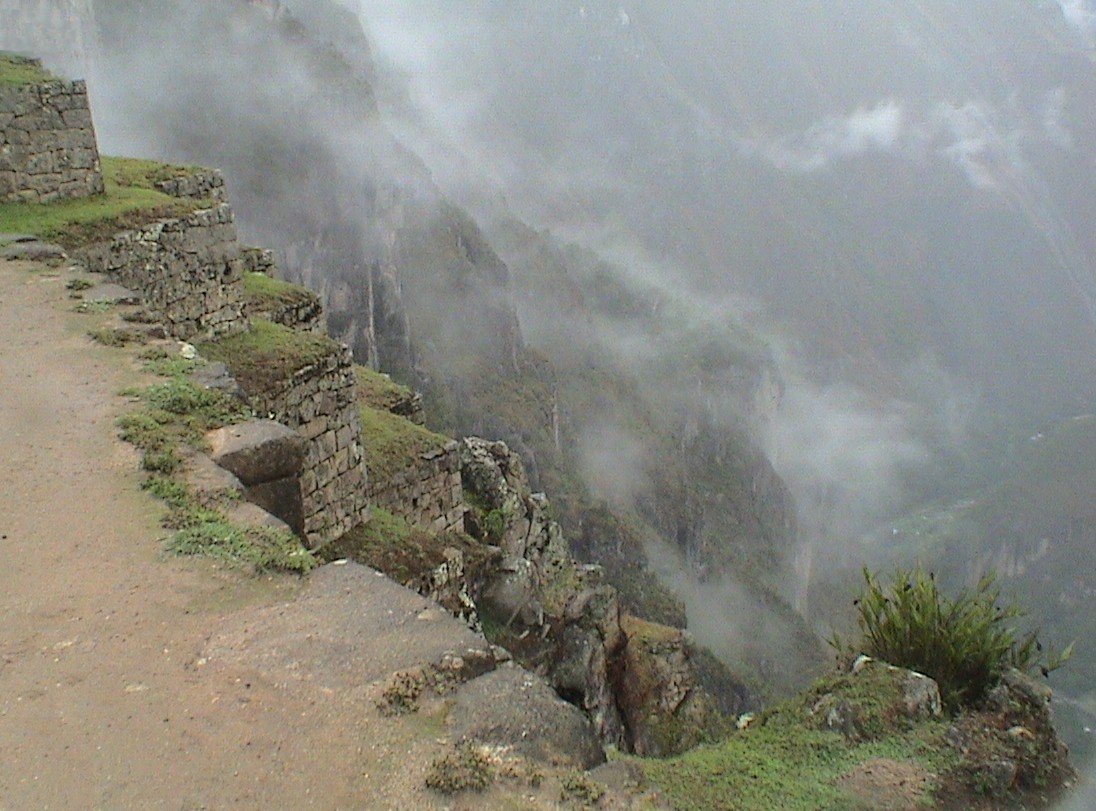
A modern photograph records the landscape as it appears today. It cannot by itself show buried drainage layers or separate every original stone from later conservation. Likewise, the Smithsonian’s terrace-building learning activity is a modern educational model, not an excavation report or an ancient construction manual.
Why the technology matters
The central lesson is the connection between the visible field and the less visible movement of water. A retaining wall, its fill and its drainage should be evaluated together. The historical achievement lies in the builders’ practical decisions within specific Andean conditions, rather than in claims of mysterious or universal construction secrets.
Terraces remain part of an inhabited Indigenous landscape. Understanding them means reading archaeological evidence carefully, listening to local knowledge and recognizing that maintaining productive land is itself technical work.
Sources and photograph
Wright, Valencia and Lorah: Ancient Machu Picchu Drainage Engineering; Smithsonian NMAI: Extending the Agricultural Area, including the 2014 community interview; Smithsonian NMAI: Engineer an Inka Terrace.
Featured photograph: YanikB, Machu Picchu terraces, October 21, 2013, via Wikimedia Commons. CC BY-SA 3.0; unmodified. The photograph depicts the surviving site today, not a reconstruction of ancient farming.