
Khemetic Nation News Network | History & Restoration
Long before the monumental cities of ancient America, people walked across the muddy margins of Lake Otero in what is now New Mexico. Their footprints, preserved at White Sands National Park, provide evidence of human presence during the Last Glacial Maximum. Repeated dating studies support an age of roughly 23,000 years, and research published in October 2026 adds a more precise chronology and environmental context.
The finding matters because it places people in the region thousands of years before the approximately 13,000-year-old Clovis horizon once widely treated as the starting point for American settlement. It records people already living within an Ice Age landscape; it does not identify the first arrival in the Americas.
What the footprints preserve
White Sands today is associated with brilliant gypsum dunes, but the ancient setting was different. The National Park Service describes a lake and surrounding habitats used by humans and large animals. Tracks preserve movements that stone tools alone cannot show, including the passage of smaller and larger individuals. Interpretations of age, activity and social roles require care: a footprint can record a step without revealing the person’s name, language or purpose.
The footprint archive spans different locations and surfaces. Accounts of people carrying children or interacting with animals should not automatically be assigned the precise age of a separate dated track horizon. Each interpretation depends on its own archaeological context.
Why the dates were tested again
The initial 2021 chronology used radiocarbon dating of aquatic plant seeds associated with the footprint-bearing sediments. A significant concern followed: aquatic plants can absorb carbon from water that makes their remains appear older than they actually are. Testing that possibility was essential to assessing the dates.
In 2023, researchers used terrestrial pollen and optically stimulated luminescence of sediment to test the chronology independently. Pollen provides a different carbon source from aquatic plants. Luminescence estimates the time since mineral grains were last exposed to light. The USGS research record reports that these results supported the earlier age estimates and human presence during the Last Glacial Maximum.
These methods date materials within the geological sequence, rather than directly dating the impression of a foot. Their value depends on the relationship between the samples, sediment layers and tracks. Agreement among different methods strengthens the interpretation while leaving room for continued testing and refinement.
The October 2026 update
A Science Advances study published online October 14, 2026, led by Kathleen Springer and Jeffrey Pigati with a multidisciplinary team, reports 20 stratigraphic horizons containing human footprints, animal trackways and linear features. Improved pollen dating, combined with aquatic-seed ages, refines the footprint-bearing sequence to approximately 23,500–21,700 years ago.
The study also reconstructs environmental change. Its abstract describes a transition from a persistent lake to a playa, including a major drying episode around 23,200 years ago. The chronology shows repeated human presence during changing conditions. It does not establish that the same individuals occupied the site throughout that entire interval.
People living through environmental change
A University of Arizona account of the research explains how sediments, pollen and plant-derived chemical signatures reveal changes in water availability and vegetation. Studying climate evidence beside human traces helps researchers examine the conditions people actually encountered.
This gives the site significance beyond a debate over the oldest date. The tracks preserve a human landscape: people navigating ground that could become wetter or drier, alongside other animals, over many generations. Specific survival strategies remain questions for research rather than conclusions supplied by the footprints alone.
Placing White Sands beside Maya history
Our recent coverage of Maya pyramid construction examines built environments, skilled labor and accumulated knowledge. White Sands reaches far deeper into the past and preserves a different kind of record: bodily movement in sediment rather than monumental architecture.
The comparison helps show the breadth of Indigenous American history. It does not make the footprint makers Maya or demonstrate a direct ancestral relationship with a particular later nation. Archaeological evidence must establish such connections rather than assume them from geography or antiquity.
What the evidence can—and cannot—settle
White Sands strongly challenges a short chronology that begins American human history with Clovis. But the footprints alone do not establish a migration route, the birthplace of their makers, their genetic ancestry, or the earliest moment people entered the hemisphere. No DNA result follows simply from a footprint’s age.
They do establish an extraordinary subject for continued investigation: people were present in this landscape during the Ice Age, leaving repeated traces now studied through increasingly refined methods. The strongest account of that history keeps the dates, methods and limits together.
Reporting note: This explainer was prompted by Tim Newcomb’s February 18, 2026 Popular Mechanics article. The October 2026 research discussed above is a later update. This article is original reporting from published research and institutional sources, not a reproduction of that feature.
Sources and further reading
Pigati and colleagues, Science, 2023: independent age estimates; Springer and colleagues, Science Advances, 2026: chronology and environmental change; National Park Service: fossilized footprints.
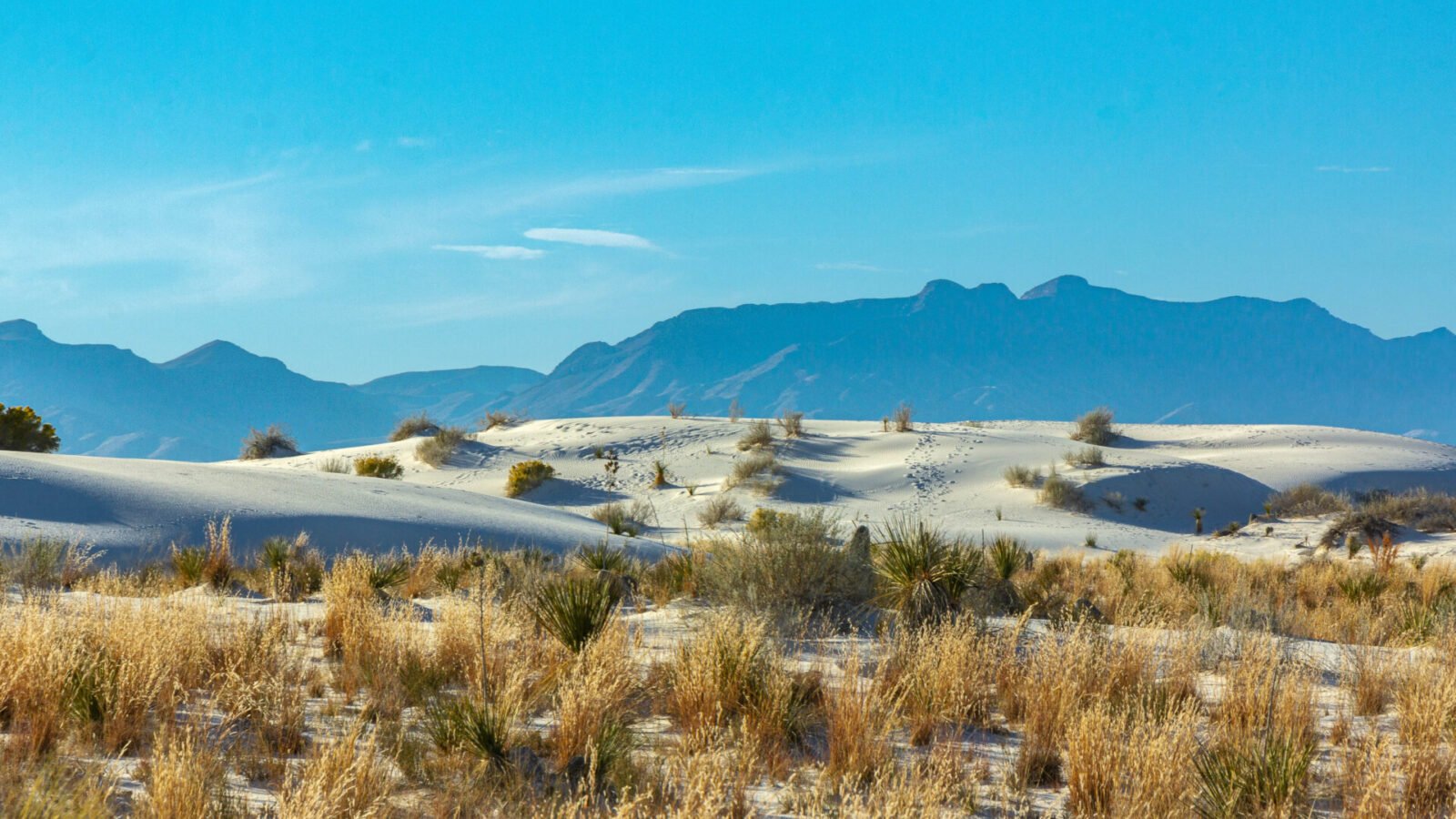
Featured image credit: White Sands National Park, photographed by Larry Mills, CC BY 2.0. Landscape context only: the photograph does not show the excavated footprint trackways.