

An investigation into birth order, autism, parental decisions about vaccines, a controversial Oregon pediatrician’s research, and the evidence needed to distinguish association from causation.
A major U.S. study involving more than 10 million siblings has uncovered an intriguing pattern: firstborn children were more likely than second-born children to receive diagnoses of autism, ADHD, Tourette syndrome and several other neurodevelopmental conditions.
Published August 3, 2026, in Nature Health, the analysis raises questions about how birth order, biology, family behavior and medical screening influence childhood health. But what happens when parents suspect vaccines contributed to their first child’s developmental condition and subsequently delay or decline vaccines for younger siblings?
That family behavior is documented in American research. It is relevant to the design of studies comparing vaccinated and unvaccinated children. Yet the new birth-order paper did not measure vaccination histories, and it provides no direct evidence that vaccines cause autism. Other studies that directly examined MMR vaccination and autism—including among children with autistic siblings—found no increased risk associated with the vaccine.
Featured photograph: Heather Hazzan for SELF Magazine / American Academy of Pediatrics vaccine photo project (2019), CC BY 2.0. Staged vaccination photograph; no depicted child participated in the studies discussed.
Inside the 10-million-sibling study
Benjamin Kramer and Andrey Rzhetsky of the University of Chicago, together with Steven A. Kushner of Columbia University, examined insurance claims involving 10,270,012 individuals belonging to 5,135,006 American two-child families. The Merative MarketScan records covered 2003–2024.
The researchers assessed 569 disease categories. Of 418 with sufficient cases in their primary scan, 150 showed statistically significant birth-order associations after stringent adjustment for multiple comparisons.
Firstborn children had higher recorded odds of autism, ADHD, obsessive-compulsive disorder, Tourette syndrome, food allergies and allergic rhinitis. Second-born children had higher recorded odds of conditions such as substance-use disorders, migraines, gastritis and shingles.
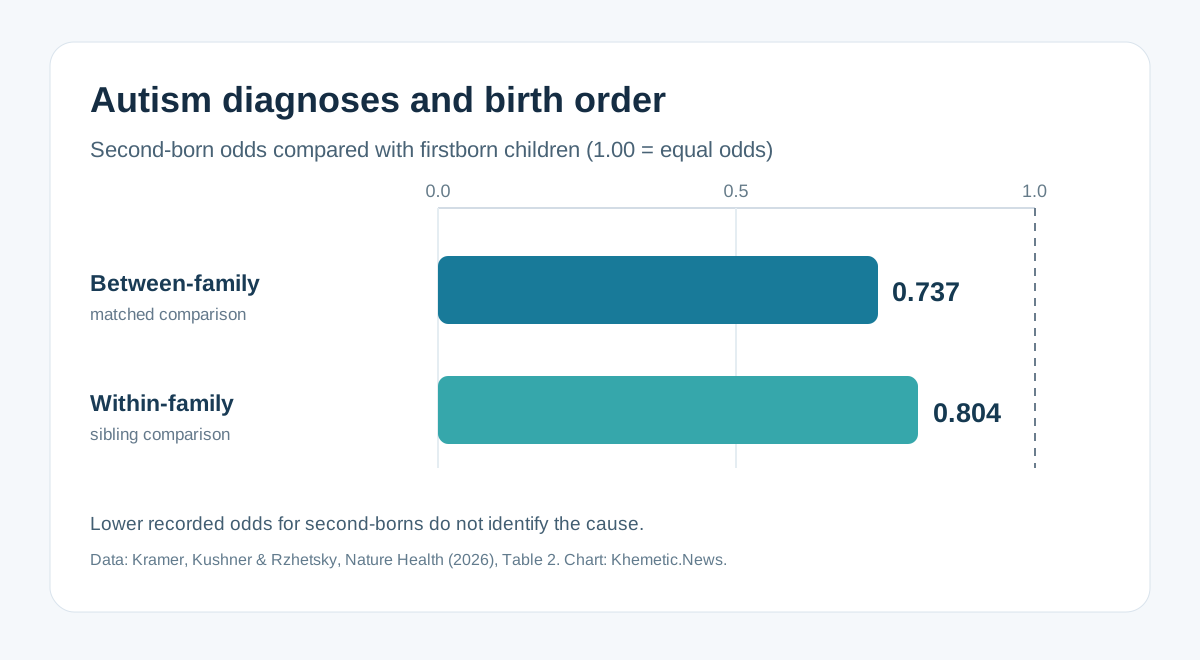
The team conducted matched comparisons of children from different families and separate comparisons of siblings within the same family. The autism association persisted in both approaches.
| Analysis | Odds ratio | What it means |
|---|---|---|
| Matched between-family comparison | 0.737 | About 26% lower recorded odds for second-borns |
| Within-family comparison | 0.804 | About 20% lower recorded odds for second-borns |
Those figures are relative odds, not percentage-point changes in the probability of autism. Insurance claims record diagnostic billing codes rather than all underlying conditions; differences in healthcare access, parental age, medical surveillance and family composition could influence the findings. The population was also disproportionately commercially insured.
Original research: Kramer, Kushner and Rzhetsky, Birth order and disease risk across the human phenome, Nature Health (2026).
What the study did not examine: childhood vaccination histories
Crucially, the researchers did not use individual vaccination records to explain the birth-order differences. They did not compare vaccine schedules among firstborns and second-borns or investigate whether families changed vaccine decisions after an older child’s autism diagnosis.
Therefore, their findings cannot establish whether differences in vaccination contribute to the birth-order association. The question can be tested with appropriate data, but the new study did not test it.
Parents do sometimes change vaccine decisions after an autism diagnosis
A JAMA Pediatrics investigation published in 2018 followed 3,729 children diagnosed with autism, 592,907 children without autism and their younger siblings across six U.S. healthcare systems.
Children diagnosed with autism were less likely to receive certain subsequently recommended vaccinations. Younger siblings of autistic children were also less likely to be fully vaccinated than younger siblings of children without autism. Parents of an autistic child were more likely to refuse at least one recommended vaccine for a younger sibling and limit the number of doses administered during the younger sibling’s first year.
A separate 2015 American study in JAMA documented lower MMR uptake among younger siblings of autistic children:
| Age | Older sibling autistic | Older sibling not autistic |
|---|---|---|
| Age two | 73% | 84% |
| Age five | 86% | 92% |
These findings demonstrate lower vaccination uptake in some higher-risk families. They do not demonstrate that most such families stop vaccinating. In the JAMA study, most younger siblings of autistic children still received MMR.
Sources: Zerbo and colleagues, JAMA Pediatrics (2018); Jain and colleagues, JAMA (2015); Canadian sibling-vaccination research (2014).
Could those family decisions distort comparisons?
Imagine a firstborn child receives recommended vaccines and later receives an autism diagnosis. The parents become worried and postpone some vaccinations for a second child, who does not receive an autism diagnosis.
Comparing the two children without additional information cannot demonstrate that vaccination caused the difference. Their ages, inherited genetic variation, prenatal circumstances and medical screening also differ.
Furthermore, if the older child’s diagnosis causes parents to alter the younger child’s vaccination schedule, the sequence involves reverse causation: an earlier diagnosis influences later vaccination behavior, not necessarily the reverse. A rigorous analysis needs vaccination dates, the timing of developmental symptoms and diagnosis, family history and healthcare utilization.
The kind of stoppage the 2026 researchers actually investigated
The authors examined reproductive stoppage: whether parents are less likely to have another child after a firstborn receives a serious diagnosis. A firstborn autism diagnosis was associated with reduced odds of having a second child (adjusted odds ratio 0.870).
That matters because families who stop after one child are absent from the main two-child study cohort. The researchers found that reproductive stoppage could account for part, but not all, of the firstborn autism association. The within-family results still showed higher firstborn odds.
Stopping childbearing is different from stopping vaccination. The study analyzed the former, not the latter.
The Oregon pediatrician’s vaccinated-versus-unvaccinated study
In November 2020, the International Journal of Environmental Research and Public Health published a paper by James Lyons-Weiler and Oregon pediatrician Paul Thomas analyzing approximately a decade of records for 3,324 children in Thomas’s practice.
In their sample, 2,763 children had received at least one vaccine and 561 had received none. The authors reported higher rates of billed visits for certain conditions among vaccinated children, including visits related to asthma, anemia and allergic disorders. They reported no ADHD diagnoses in the unvaccinated group.
The study was widely promoted as a vaccinated-versus-unvaccinated comparison, but important design problems undermine conclusions about causes. It involved one practice, not a representative national sample. Families selected their vaccination arrangements and could differ in healthcare use, diagnostic evaluations, demographic factors and pre-existing medical concerns.
Most importantly, a billed office visit is not equivalent to the incidence of a disease. Children with more healthcare encounters have more opportunities to receive diagnostic codes. Children with fewer visits may have unrecorded conditions.
On January 22, 2021, the authors published a substantial correction: the reported ADHD rate among vaccinated children in the abstract changed from 0.063% to 5.3%, and the study-wide autism rate was corrected from 0.84% to 0.361%.
On July 22, 2021, the journal retracted the study, reporting methodological issues and concluding that its findings were not supported by strong scientific data. The authors disagreed with that decision.
A retracted study can be examined for historical and methodological lessons, but it does not constitute reliable proof that vaccination causes autism or that unvaccinated children are healthier.
Sources: Original article (RETRACTED); correction; journal’s retraction notice.
Was Thomas punished for publishing the study?
The original study appeared November 22, 2020. On December 3, the Oregon Medical Board voted to suspend Thomas’s license on an emergency basis over concerns about patient safety. The close timing helped fuel claims that his research triggered the suspension.
But timing does not establish cause. The public licensing record documents professional-conduct proceedings concerning clinical care. After further proceedings, Thomas entered a stipulated order in October 2022 and surrendered his Oregon medical license, with the status effective December 5, 2022.
The public record does not justify saying he lost his license solely for publishing a paper. Conversely, a licensing action alone does not determine whether scientific findings are valid.
Primary source: Oregon Medical Board license verification and board actions, Paul Norman Thomas, MD15689.
The crucial test: MMR vaccination and autism among younger siblings
A 2015 JAMA study directly examined 95,727 American children with older siblings, including 1,929 with an autistic older sibling. It confirmed lower MMR uptake in families with autistic children but found no increased autism risk associated with MMR vaccination, including among younger siblings already at higher familial risk.
A 2019 Danish nationwide study of 657,461 children found the same lack of increased MMR-associated autism risk, even when evaluating family history and other possible vulnerability factors. Its adjusted hazard ratio was 0.93 (95% confidence interval 0.85–1.02).
These are especially relevant studies because they investigate the very family-history concern that the birth-order explanation raises. They do not establish that every theoretical vaccine exposure has been exhaustively tested, but they contradict claims that MMR vaccination has been demonstrated to cause autism in susceptible families.
Sources: JAMA (2015); Annals of Internal Medicine (2019).
Autism runs in families regardless of changed vaccine decisions
Research has consistently found significant familial and genetic contributions to autism. A 2024 Pediatrics study followed 1,605 infants with an autistic older sibling and found a 20.2% autism recurrence rate by age three. That is a recurrence estimate for families already raising an autistic child, not an estimate of autism prevalence across all children.
This means that studies comparing siblings must take baseline family risk seriously. A younger child developing autism after parents reduced vaccination would not, by itself, establish that vaccines cause or prevent autism. Neither would a younger child without autism after reduced vaccination establish a protective effect.
Source: Familial Recurrence of Autism, Pediatrics (2024).
What the broader safety evidence establishes
A 2025 Danish study involving more than 1.2 million children examined cumulative aluminum exposure from childhood vaccines and a range of chronic conditions. It found no evidence of increased risk of the neurodevelopmental disorders investigated.
The World Health Organization’s reviews of vaccine safety likewise conclude that high-quality evidence does not support vaccines causing autism.
This does not imply vaccines have no adverse effects. Different vaccines have recognized risks and contraindications, and transparent safety surveillance remains necessary. A report of a developmental change after vaccination should be assessed carefully, but chronological sequence alone cannot prove causation.
Sources: Danish aluminum-vaccine study (2025); WHO vaccine-autism evidence review.
What a stronger birth-order and vaccination investigation would require
A rigorous follow-up could measure vaccination dates for every sibling, the timing of initial developmental concerns, diagnosis dates, changes in family vaccination decisions, parental ages, relevant genetic and pregnancy factors, access to care, frequency of pediatric visits and whether parents stopped having children after a diagnosis.
Researchers would need to distinguish delayed vaccination, refusal of certain doses and refusal of all vaccines; account for family risk and medical surveillance; and determine whether vaccination decisions preceded or followed developmental symptoms.
That work could test whether changes in parental behavior explain any part of the observed birth-order association. Until then, that explanation remains a research question rather than a demonstrated cause.
Conclusion: what parents and the public deserve
Families raising autistic children deserve to have their concerns heard, their experiences investigated appropriately, and their children offered timely developmental evaluation and support.
The new 10-million-sibling study finds differences in recorded diagnoses by birth order. Separate U.S. research shows that some parents alter vaccination decisions after an older child’s autism diagnosis. The Oregon study cannot settle the question because of its design limitations, subsequent corrections and retraction. Larger studies specifically evaluating vaccination and autism, including among families with autistic older siblings, do not find an increased MMR-associated autism risk.
The finding worth reporting is the birth-order association and the documented family behavior—not proof that vaccines cause autism. Reliable answers require research that measures the actual exposures, timing and family circumstances rather than treating correlation as causation.
Research and primary-source references
- Kramer et al., Nature Health (2026)
- Zerbo et al., JAMA Pediatrics (2018)
- Jain et al., JAMA (2015)
- Canadian sibling immunization study (2014)
- Lyons-Weiler and Thomas paper (RETRACTED)
- Correction (2021)
- Retraction notice (2021)
- Oregon Medical Board record
- Hviid et al., MMR and autism study (2019)
- Familial recurrence of autism (2024)
- Childhood vaccine aluminum-exposure study (2025)
- WHO evidence review