A randomized clinical trial involving 309 older adults found that a year of resistance training improved MRI-based estimates of brain age. The changes were still evident at a two-year follow-up. The finding is promising—but it does not prove lifting weights reverses aging, prevents dementia or makes people live longer.
Strength training is usually discussed as a way to preserve muscle, bone health and mobility. Researchers studying older adults in Denmark now report a possible additional benefit: measurable changes in how the brain’s functional networks operate.
In a randomized controlled trial published February 10, 2026, in GeroScience, scientists analyzed repeated brain scans from 309 people ages 62 to 70. Both heavier and moderate resistance-training programs were associated with lower estimates of brain age after one year, and the effects remained evident in imaging performed one year after the training period ended.
How the study worked
The research drew on the Live Active Successful Aging (LISA) trial, run in Denmark. Participants were randomized to three groups: heavy resistance training, moderate-intensity training or a control group instructed to continue its usual activity.
The heavy-training group attended three supervised sessions a week. The moderate group attended one supervised session weekly and completed two additional sessions at home. The programs combined resistance exercises with functional training to improve strength, endurance and balance. Researchers collected MRI and physical-performance data at baseline, after one year and after two years.
The investigators also trained an algorithm on functional MRI data from 2,433 other healthy adults. This “brain clock” model used patterns of communication between brain regions to estimate brain age. The comparison between a person’s estimated brain age and actual age is called a brain-age gap.
What changed after a year of lifting weights?
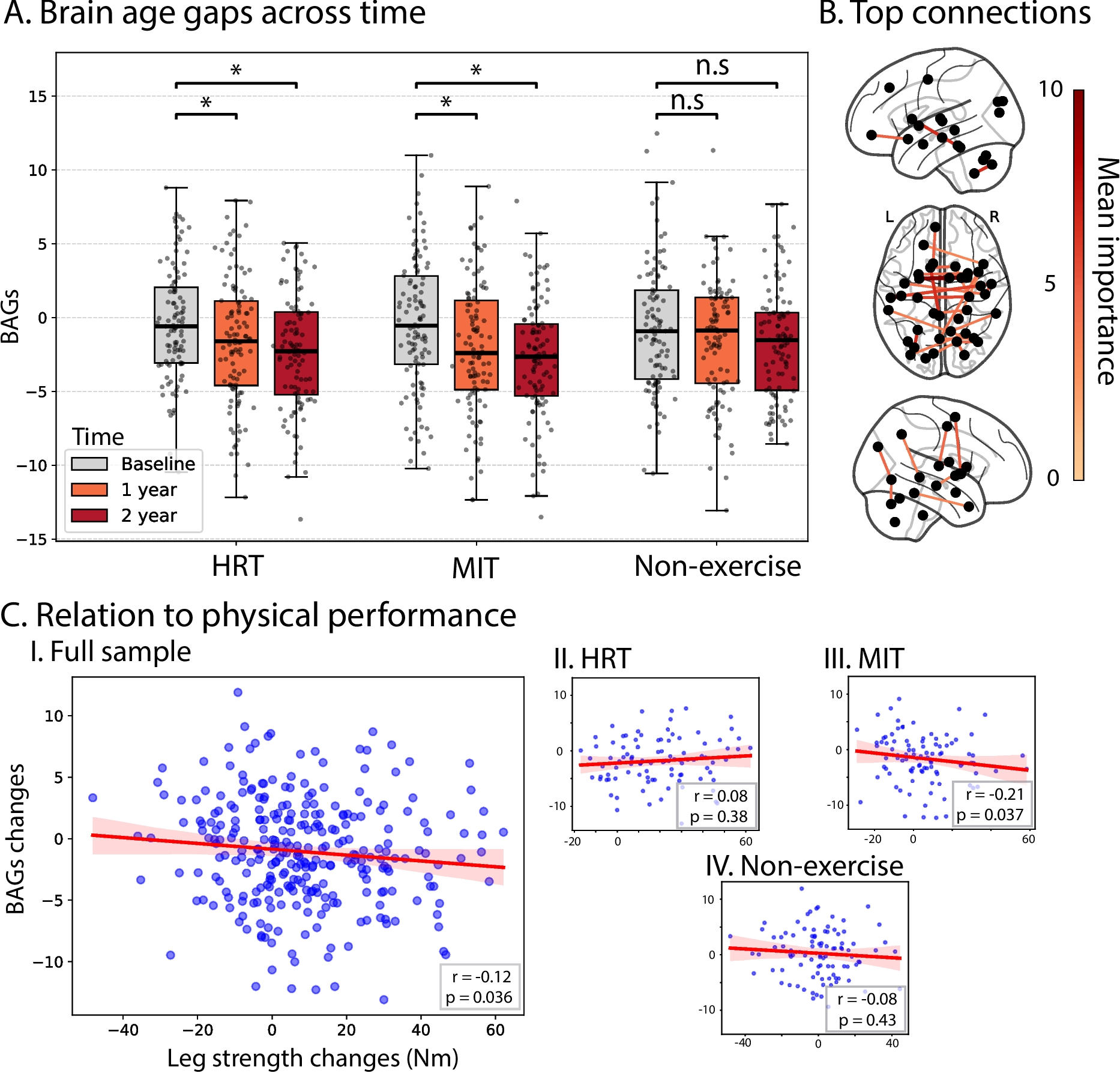
After the first year, the estimated brain-age gap declined by 1.40 years in the heavy-training group and 1.39 years in the moderate-intensity group, relative to baseline.
At the two-year follow-up, the reductions relative to baseline were 1.84 years and 2.26 years, respectively. The control group showed no statistically significant change. The figures represent changes in an imaging-based model—not added years of life or literal rejuvenation of brain tissue.
Heavy training also produced changes in functional connectivity involving parts of the prefrontal cortex, regions associated with planning, attention and other higher-order functions. The study did not establish that participants’ memory or decision-making improved as a direct result of those connectivity changes.
Why moderate exercise matters
The findings did not show that the heaviest lifting was required for the brain-age effect. Moderate resistance exercise was associated with an improvement of similar magnitude to the heavy-training program.
Exactly how resistance training might influence the aging brain remains uncertain. Physical activity affects circulation, metabolism, muscle function and other systems that could contribute to brain health. The researchers found distributed changes in functional connections, rather than an effect confined to one particular brain network.
Changes in leg strength were only weakly associated with changes in the brain-age estimate. That is another reason not to assume that bigger strength gains automatically mean greater brain protection.
A separate U.S. study linked lifting with lower mortality
A second study, published in June 2026 in the British Journal of Sports Medicine, followed 147,374 adults in three large U.S. cohorts for up to 30 years. Compared with no resistance training, reporting 90 to 119 minutes a week was associated with a 13% lower relative risk of death from any cause, a 19% lower risk of cardiovascular death and a 27% lower risk of death from neurological diseases, after adjustments that included aerobic activity.
Those numbers come from an observational investigation, not a randomized trial. Although the researchers adjusted for several factors, differences between people who exercise and those who do not could partly explain the associations. This study cannot prove that lifting itself caused the survival advantage.
The Danish MRI study and the U.S. mortality study address different questions. Taken together, they support further investigation of strength training and long-term health; neither provides proof that resistance exercise prevents dementia.
What it means for older Americans
The Centers for Disease Control and Prevention recommends that adults 65 and older perform muscle-strengthening activities at least two days each week, alongside aerobic exercise and balance activities.
Depending on physical ability, strength training can involve weight machines, adjustable dumbbells, resistance bands or body-weight movements. Older adults with serious health conditions, balance problems or movement limitations may need individualized guidance and gradual progression.
The research offers a possible brain-health reason to take those recommendations seriously, without suggesting that lifting weights should replace medical care or other healthy-aging measures.
What researchers still need to establish
The imaging study included relatively healthy Danish adults, so the results may not generalize to every population. Its brain-clock algorithm also had an average prediction error of roughly 8.7 years in the separate training-and-validation data. Statistically significant changes in groups can be detectable even when estimates for an individual are imprecise; a brain-age reading is not a clinical diagnosis.
Most importantly, the investigators did not measure whether resistance training reduced dementia diagnoses or prolonged life. Longer studies in more diverse populations will be needed to determine whether these MRI findings translate into meaningful cognitive benefits.
For now, the central result is clear: a year of regular resistance training—moderate or heavy—was associated with a more favorable MRI-based brain-aging measure. That is a meaningful research finding, but not a fountain-of-youth claim.
Video: Strength training for older adults
The U.S. National Institute on Aging provides this educational workout demonstration. It is not footage from the Danish trial.
Watch “Strength Training Workout for Older Adults” on the National Institute on Aging’s YouTube channel (published September 27, 2017).
Sources and references
- Gonzalez-Gomez, R., et al. (2026). Randomized controlled trial of resistance exercise and brain aging clocks. GeroScience, 48, 3251–3262. DOI: 10.1007/s11357-026-02141-x.
- Zhang, Y., et al. (2026). Long-term resistance training with all-cause and cause-specific mortality. British Journal of Sports Medicine.
- CDC: Adult activity recommendations for ages 65 and older.
- National Institute on Aging: How can strength training build healthier bodies as we age?
- Men’s Journal: Scientists Found a Surprising Longevity Benefit From Lifting Weights.
Featured photograph: Older woman lifting weights, by kutibeng, licensed under CC BY 2.0. Illustrative; the person pictured is not identified as a participant in the study.