Birchbark canoe construction joins materials with very different jobs: a bark skin, a wooden supporting structure, root lashings and a sealant. For Ojibwe communities of the Great Lakes, this combination made a watercraft that could travel waterways and be carried between them. This Ancient American Technology installment examines the craft through documented objects and present-day building projects, while keeping those sources distinct from archaeological evidence.
A boat that could leave the water
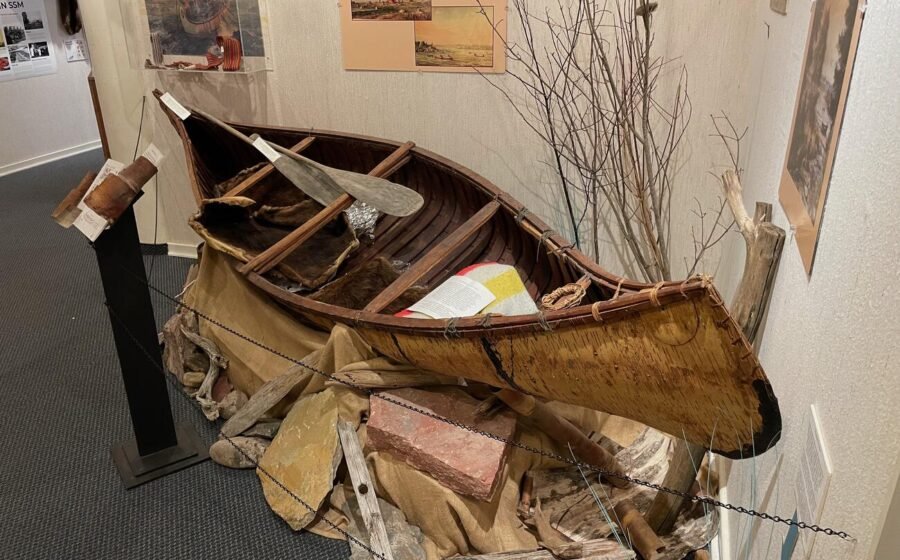
The Ojibwe People’s Dictionary documents a birchbark canoe built in 1918. Its description emphasizes light weight, portability around obstacles, and the possibility of repairs using bark, roots and resin. It also identifies this kind of boat with gathering wild rice. The catalog calls the object Algonquin style; that wording should not be turned into a claim that one design represented every Ojibwe canoe.
Portability changes the meaning of a transport system. A boat that can be carried around a rapid can connect stretches of water that would otherwise interrupt a journey. Repairability matters for the same reason: a useful vessel must be maintained through actual travel, not merely float at its launching place.
Building a shell and supporting it
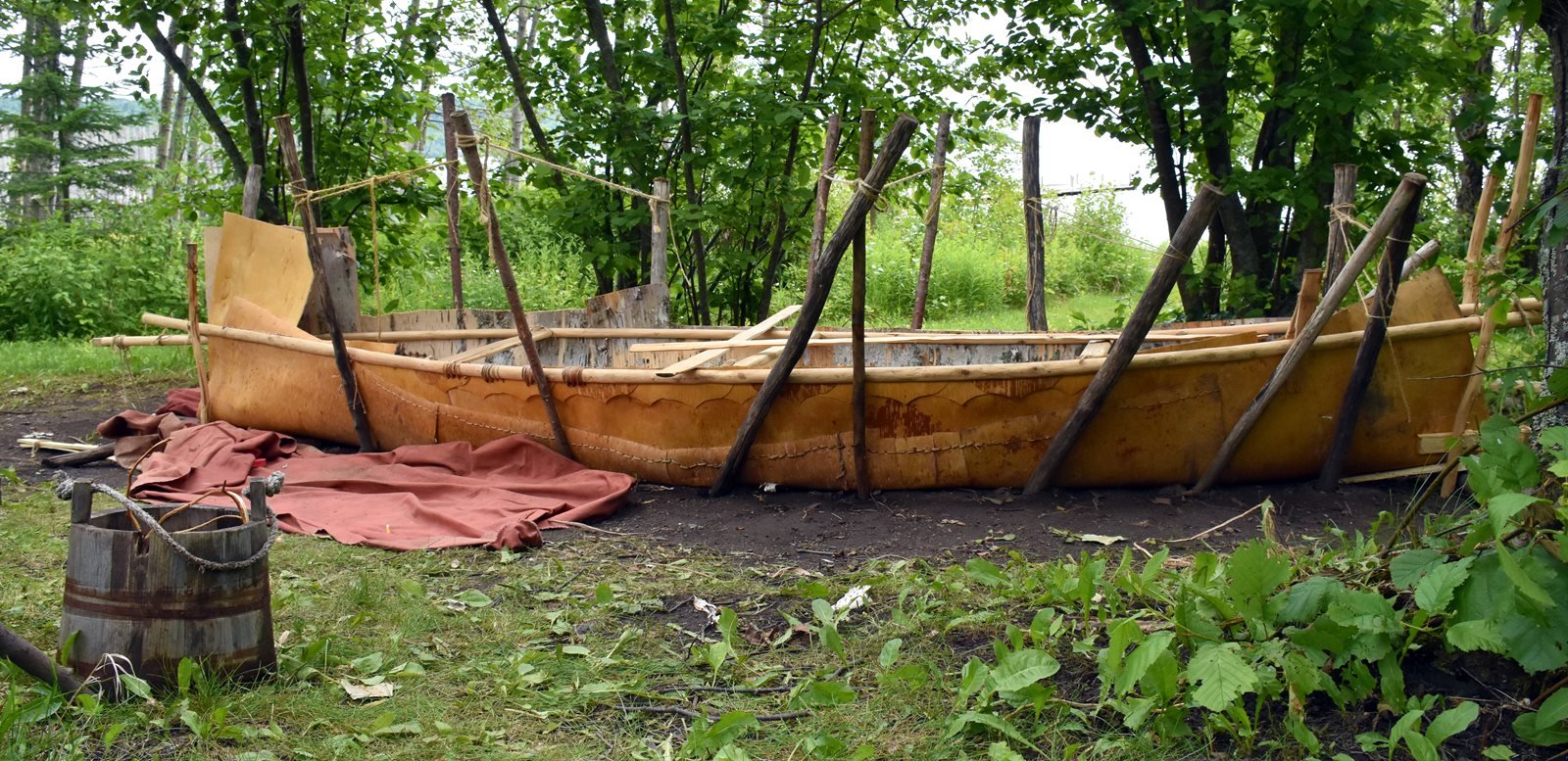
Grand Portage National Monument’s illustrated construction account documents a modern demonstration. Builders fit bark around a weighted template, hold the sides with stakes and stitch panels using prepared spruce root. Cedar supplies structural parts. The root is kept pliable for sewing, and holes are pierced before it passes through the bark.
Ribs and interior sheathing support the hull; sealant closes the stitched seams. These components do not perform interchangeable tasks. The bark forms the skin, the interior wood maintains its shape, and the joints must both hold together and resist leaking. The park photograph accompanying this article shows modern work in progress, not an ancient excavated boat.
Grand Portage also quotes Alexander Mackenzie’s journal on repairing a damaged canoe during travel. That is historical testimony, reproduced within a modern interpretation. It records a practical problem encountered on a journey; it is not a complete account of Indigenous design history.
Living Ojibwe engineering at Lac du Flambeau
The University of Wisconsin’s These Canoes Carry Culture project follows Wayne Valliere’s 2013 construction work connected with Lac du Flambeau. Its authors explicitly present the canoe as contemporary Ojibwe practice rather than a historical reenactment. That distinction is essential: continuing knowledge can include deliberate innovation.
The documented project used long red-cedar pieces purchased from a Pacific Northwest mill for the gunwales. Soaking made them pliable enough to shape. The account describes a plywood form and worktable as innovations by Wayne and his brother Leon compared with anchoring work in sand. These details prevent an inaccurate picture of living builders as people restricted to an unchanged ancient toolkit.
The same project organizes construction around gunwales, bark shell, thwarts, lashings, ribs, sheathing and waterproofing. Its explanation is not strictly chronological. It is a component-based account of how the parts cooperate, and should not be mistaken for a universal sequence followed by every maker.
Teaching through construction
An archived July 10, 2009 NPS announcement documents Ron Paquin and assistant Dylan Semansky building a birchbark canoe at Pictured Rocks National Lakeshore in Michigan. The completed boat was intended for educational outreach. This is evidence of a specific modern demonstration, not a newly announced event or an archaeological discovery.
Such projects make normally hidden labor visible: preparing materials, fitting parts and maintaining workable joints. They also show that Indigenous technology belongs to makers and teachers in the present. A historic object, a travel journal and a contemporary building project answer different questions; none should silently substitute for the others.
Following our fiber-technology installment, canoe construction shows another use of flexible joining materials. This account concerns Ojibwe and Great Lakes examples. It does not generalize birchbark construction to Maya boats or imply unsupported contact between those regions.
Featured photograph: Modern canoe construction at Grand Portage, NPS/G.M. Spoto. Public-domain U.S. Government work. No claim to original U.S. Government works.
Sources
Ojibwe People’s Dictionary: 1918 canoe; NPS: Building a Bark Canoe at Grand Portage; University of Wisconsin: Construction; NPS: Birch Bark Canoe Maker, 2009.