On Wisconsin’s Lake Mendota, called Tee Waksikhominak in Ho-Chunk, submerged wooden canoes preserve one way Indigenous builders turned a tree into a vessel. Farther north around Lake Superior, Ojibwe builders worked with a different set of materials. They joined thin sheets of birchbark to make a hull that could be carried between waterways. Both approaches began in the forest, but each put different parts of the tree to work.
A hull carved from a single log
In 2022, Wisconsin Historical Society maritime archaeologists and partners from Wisconsin’s Native Nations recovered a canoe made from a single piece of white oak. The hull measures about 14.5 feet, and radiocarbon testing placed it around 1000 BCE. The recovery report records the material and dimensions. The society’s updated site inventory now lists 16 dugouts, with the earliest estimated at around 3000 BCE. Two were brought to the surface for conservation.
A dugout builder works within the width and grain of a single trunk. The hollow has to make room for people and cargo while leaving enough wood in the sides and floor to hold the hull together. The remaining wood also adds weight, so decisions about how much to remove affect both handling on the water and transport on land. The recovered oak canoe establishes the one-piece design. Its shape alone cannot tell us the complete sequence of tools used or identify the people who made that individual boat. The Ho-Chunk name of the lake and the participation of Native Nations belong to the site’s documented history and stewardship.
A hull sewn from bark
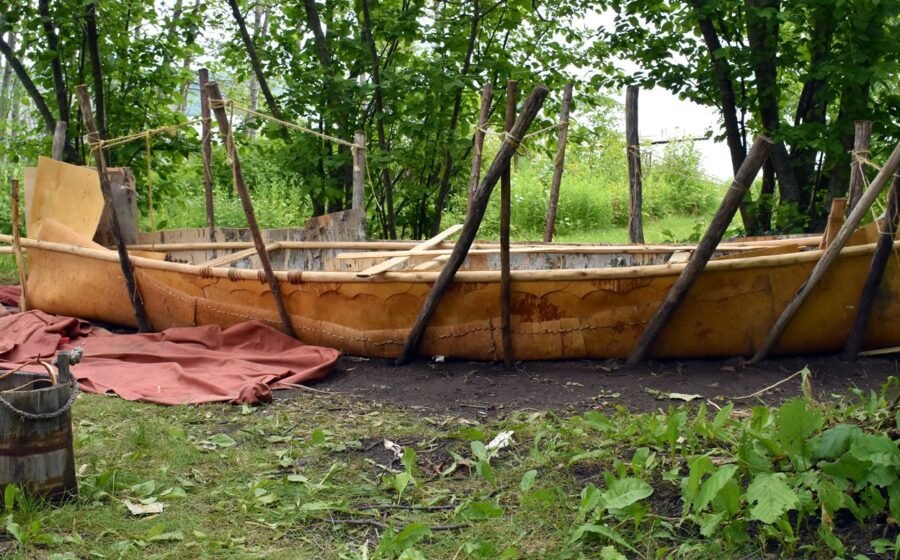
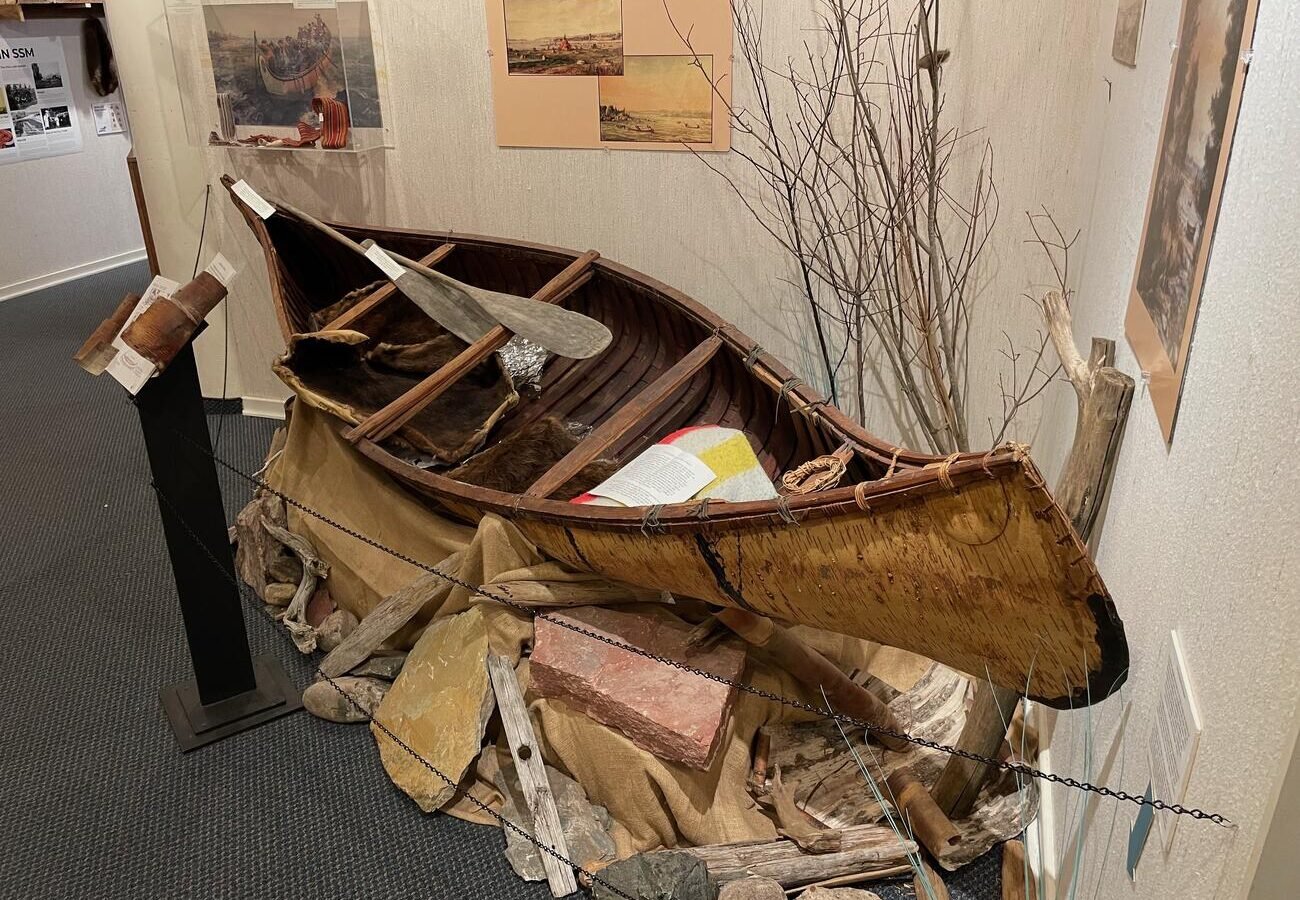
Ojibwe birchbark canoes in the Lake Superior region distributed the job of keeping a boat afloat across several materials. Birchbark formed the skin. Wooden ribs supported the hull from the inside, and wooden rails called gunwales helped hold the upper edges in shape. Flexible roots could be used to stitch bark panels together or lash parts in place. Tree pitch sealed the seams. A NOAA maritime cultural landscape study documents these materials and how Ojibwe communities used bark canoes for fishing, hunting and carrying goods along inland routes.
The result was a hull light enough to carry over a portage between waterways. The joints also created places where water could enter, so tight stitching and an intact seal mattered throughout the life of the boat. A historical building account reprinted by the Fond du Lac Band describes soaking spruce roots to make them pliable and pitching the seams after assembly. That account documents a particular practice. An individual canoe’s construction still depends on its maker, its intended use and the materials available.
Building canoes and teaching the language
The Fond du Lac Band of Lake Superior Chippewa’s Wiigwaasi-Jiimaan Project brings canoe construction and Ojibwe language instruction together. The Cultural Center and Museum documented its 2010 build in a book with Ojibwe vocabulary and a time-lapse video. The project records how people teach the craft in a modern workshop. The Lake Mendota finds answer a different question because their wood, dimensions and radiocarbon dates come directly from archaeological objects.
A Maya comparison from Yucatán
At the San Andrés cenote in Yucatán, Mexico’s National Institute of Anthropology and History documented a small Maya canoe carved from a single piece of wood. Its investigators proposed a possible ritual use and reported a preliminary sixteenth-century radiocarbon result, with more sampling planned to clarify the date. The INAH investigation illustrates how a single-log hull could serve a different purpose in another region. The shared design principle gives no evidence of contact with Great Lakes builders.
Sources
Wisconsin Historical Society Lake Mendota inventory · White-oak canoe recovery report · NOAA maritime landscape study · Fond du Lac Band historical account · Wiigwaasi-Jiimaan Project · INAH San Andrés canoe investigation
Featured photograph of a birchbark canoe at the Sault Ste. Marie Museum by Fungus Guy via Wikimedia Commons, licensed under CC BY 4.0. Resized.