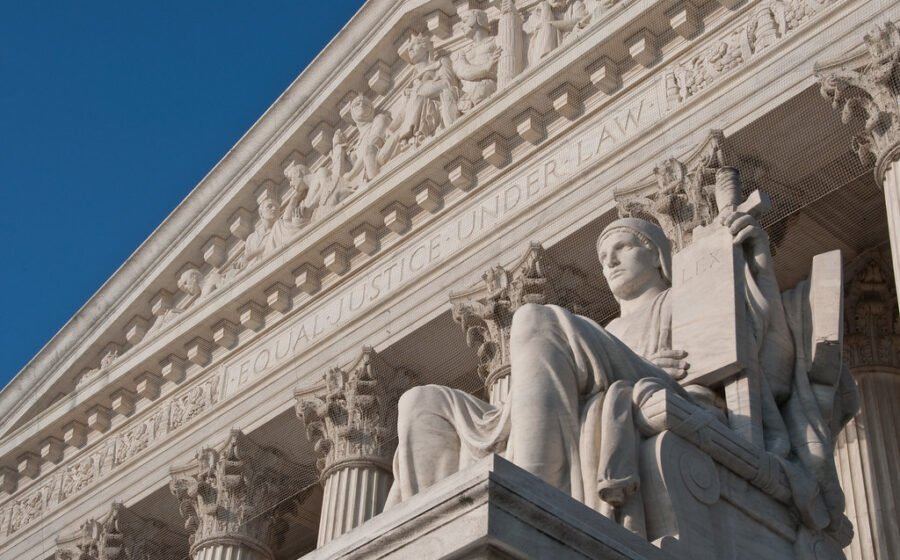
By Lotta Goddess | Khemetic.News | November 19, 2026
Investigative analysis. Arkansas prosecutors allege manipulated scores and missing examination records; racial targeting remains unproven. The historical record illustrates why the unanswered question deserves scrutiny.
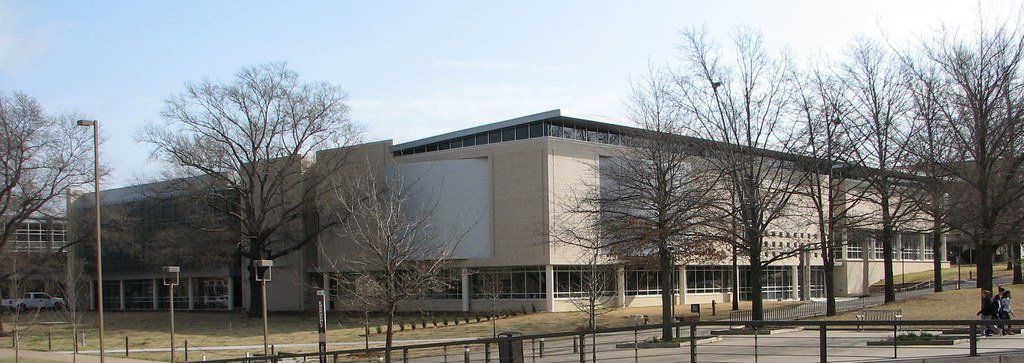
Featured photo: Modern University of Arkansas School of Law, connected to the history of Silas Herbert Hunt’s 1948 admission and the article’s examination of racial barriers in legal education. The law school is not accused in the bar-exam score case. Photo: greatdegree, CC BY-SA 2.0, via Openverse/Flickr.
Arkansas: a scandal at the gates of justice
LITTLE ROCK, Arkansas — The examination that determines who may become an attorney is supposed to measure competence, not connections. Its results should reflect what an applicant earned, not what a government administrator secretly decides to award or take away.
Former Arkansas Supreme Court Office of Professional Programs executive director Nancie Michelle Givens, 62, faces 65 felony counts of tampering with public records after investigators identified alleged manipulation of bar-examination scores from July 2020 through July 2025. She has pleaded not guilty, and the charges remain unproven.
According to the Arkansas Supreme Court’s November 5, 2026 joint statement, points were allegedly removed from some examinees and transferred to others who took the same exam. Some scores were increased enough to reach the passing threshold of 270. At least one candidate might have been wrongly failed. In a separate case, the top-scoring applicant allegedly lost the honor to someone else after points were deducted.
The internal review also uncovered approximately 11,400 electronic files that were deleted or made inaccessible, including records subject to a 25-year retention requirement. These figures are alleged investigative findings described by the court, not a final criminal determination.
What the record proves—and does not
Following Givens’s resignation in February 2026, Robert Brech assumed supervisory responsibilities and identified missing records and altered scores. A criminal investigation by the FBI and Arkansas State Police began in April; the Sixth Judicial District prosecutor filed the charges in November. The public docket records a not-guilty plea.
Reporting on the probable-cause affidavit described at least 64 affected examinees. That is not the same as 65 criminal counts, and it does not establish that 64 people fraudulently passed. Some score changes may not have changed the passing status. The court said the overwhelming majority who were notified they passed had legitimately earned passing scores.
A disciplinary panel separately ordered Givens’s interim suspension as a lawyer in Arkansas. The suspension is not a criminal conviction. Public sources do not establish the full list of harmed applicants, people who benefited or knowing participants.
Did race play a role?
Viral TikTok commentary claims that points were taken from Black applicants and transferred to white applicants. As of November 19, available official records do not disclose the affected examinees’ races or establish racial targeting.
This is not a reason to avoid the question. It is a reason to demand evidence. A proper investigation should compare the original scores with the altered ones, examine the racial demographics of winners and losers using lawful and reliable methods, and review professional, social and financial relationships and relevant communications.
A racial pattern would be important to report, especially if supported by evidence of intent. A pattern that did not exist would also deserve publication. What must not happen is treating someone’s perceived race, age or state of residence as proof of their motive.
American history explains why Black communities legitimately want the issue investigated. It does not determine the facts of this particular prosecution.
The real financial and professional costs of a stolen passing score
A wrongful bar-examination failure can mean a revoked job offer, postponed licensing, years of lost income, debt from additional preparation, relocation or an abandoned career. The harm can extend to a spouse, children and older relatives depending on a first-generation professional.
An applicant wrongly failed might otherwise have become a civil rights lawyer, public defender, prosecutor or future judge. Those are possible consequences, not proven outcomes for any named candidate in the Arkansas case.
The contrast is fundamental: if one person earned a pass but was told to try again while another failed yet received a license, the official system would have inverted merit. If race or insider status influenced that inversion, the consequences could reach far beyond the examination room.
Arkansas law students confronted racial gatekeeping before this scandal
In 1948, Black World War II veteran Silas Herbert Hunt entered the University of Arkansas School of Law, an historic step in the desegregation of Southern higher education. His admission did not secure equal treatment; he was subjected to segregated conditions and unequal access.
Hunt was followed by Jackie Shropshire, George Haley, Christopher Mercer, Wiley Branton and George Howard Jr., remembered collectively as the Six Pioneers. Their experience exposes a contradiction: Black people were told to meet professional standards while being denied equal entry to the classrooms, resources and networks needed to achieve them.
This is documented institutional discrimination, not an assertion that individual white students lacked talent. It is evidence that legal opportunity was unequally administered in Arkansas within living historical memory.
Historic court setting: Before its move to the Justice Building in 1958, the Arkansas Supreme Court met in the State Capitol. This photograph shows that former venue, not the court’s current headquarters or the location of the score alterations alleged in 2026.

The American Bar Association’s own exclusionary history
The American Bar Association has acknowledged racial exclusion in its early membership practices. In 1912, the association initially revoked the membership of William H. Lewis, a Black lawyer serving as an assistant U.S. attorney general. Black professionals were excluded from influential networks that shaped referrals, authority and prestige.
The National Bar Association was established in 1925 by Black legal professionals amid these conditions. Membership in a prestigious professional organization could open doors even when the bar examination itself was nominally neutral.
This is one reason the history of whiteness and privilege cannot be reduced to explicit government statutes alone. Professionally sanctioned access and informal gatekeeping also affected whose careers could flourish.
The meritocracy double standard: legacy admissions and affirmative action
Opponents of affirmative action have often portrayed race-conscious admissions as proof that applicants receive places they did not earn. Yet selective institutions have long offered preferences through alumni ancestry, athletics, donor connections and the interests of powerful insiders.
A National Bureau of Economic Research study of historical Harvard admissions data found that more than 43 percent of admitted white students in the reviewed data came from special consideration categories, including recruited athletes, legacies, dean’s-interest cases and faculty or staff children. The authors estimated large admissions advantages for those groups.
That research did not conclude all white students lacked ability or that every institution operated identically. It demonstrated that forms of unearned institutional access can exist while political debates single out affirmative action for criticism.
The central question is why family inheritance or donor privilege so often seems ordinary when remedies for historic exclusion are treated as exceptional.
Government-assisted white wealth: the GI Bill and redlining
The Servicemen’s Readjustment Act of 1944 offered educational and housing benefits to returning veterans. Black veterans were legally eligible, but segregated colleges, discriminatory lenders and unequal housing markets severely constrained many from obtaining comparable benefits.
The Federal Housing Administration historically helped support lending practices that favored white neighborhoods and marginalized Black neighborhoods. Public finance and private discrimination reinforced each other.
A white family obtaining a government-backed mortgage could build home equity, fund schooling and pass assets to children. A Black family denied comparable credit could lose opportunities for generations. Later discussion of who ‘worked hard’ often ignores these policy-created differences.
The relevant distinction is not that all white people enjoyed wealth or all Black people were excluded. It is that a public system distributed major opportunities inequitably while retaining the language of neutral merit.
When elite connections become actual fraud
The 2019 Operation Varsity Blues college-admissions prosecutions exposed manipulation of test results and recruitment credentials through paid intermediaries. Wealth and access could corrupt outcomes in institutions publicly committed to merit.
The scandal was not found to be a racially motivated scheme against Black applicants. The comparison is about covert advantage: how people with access to gatekeepers can sometimes obtain results denied to equally or better-qualified people.
Investigators in Arkansas should determine whether the alleged alterations had financial, personal, institutional or racial motives; whether beneficiaries knew; and whether supervisors noticed warning signs. The answer cannot be guessed, but neither should it be left unexplored.
Could affected attorneys have prosecuted people—or become judges?
A lawyer may negotiate pleas, prosecute a defendant, represent someone facing imprisonment, bring civil rights cases and later seek the judicial bench. An inaccurate licensing record therefore raises questions about public trust and possible downstream harm.
But a failed bar exam does not automatically establish incompetence, and a questioned license does not automatically invalidate every judgment. Ineffective-assistance claims commonly require proof of deficient performance and resulting prejudice under Strickland v. Washington, while prosecutor authorization and judicial eligibility raise other legal questions.
No public evidence reviewed here identifies a prosecutor or judge whose position was obtained through the alleged Arkansas score changes. The state nevertheless should identify any affected attorneys, distinguish knowing conduct from unwitting receipt of changed scores, and consider a careful review of relevant proceedings.
Elaine, Arkansas: courts can wear the form of legality and deny justice
In 1919, Black residents and sharecroppers in Phillips County faced mass racial violence during the Elaine Massacre. Black defendants were prosecuted and sentenced to death amid intimidation and mob hostility.
In Moore v. Dempsey (1923), the U.S. Supreme Court held that federal courts could review whether state criminal proceedings were dominated by a mob and thus deprived defendants of due process.
The massacre and an alleged score-fraud case are not equivalent. The connection is the institutional danger of assuming that because a process has official forms and signatures, it must be fair. Courts and licensing authorities must protect the integrity of how decisions are actually made.
Scottsboro, Mississippi torture cases and racialized credibility
The 1931 Scottsboro Boys cases involved nine Black teenagers and young men accused in Alabama of raping white women. Eight initially received death sentences after proceedings tainted by racism. One accuser later testified that the rape claim was fabricated. The litigation helped reshape constitutional protections concerning counsel and jury discrimination.
In Brown v. Mississippi (1936), the U.S. Supreme Court overturned convictions resting on confessions extracted from Black defendants through torture. Both episodes show how authorities can manufacture or privilege evidence, making an apparently official record profoundly unreliable.
The comparison to Arkansas’s licensing inquiry is about integrity, not equivalence of harm: falsified records or unequal credibility can cause institutions to reward people who did not meet a standard and punish people who did.
Rainey Bethea: legal procedure and a public spectacle
In 1936, Rainey Bethea, a young Black man, was publicly hanged in Owensboro, Kentucky, as a crowd estimated at around 20,000 watched. His legal proceedings involved an all-white jury, limited defense and disputed confessions, according to historical scholarship discussed by WKMS.
Bethea was executed under a court sentence, not lynched by a mob outside legal process. The historical record also does not conclusively resolve his guilt. Scholars nonetheless examine the case as an example of how the culture of racial spectacle and the legal system intersected.
The underlying warning is that formal authorization cannot by itself guarantee a fair process or human dignity.
George Stinney and an irreversible outcome
South Carolina executed George Stinney Jr., a 14-year-old Black child, in 1944. A court vacated his murder conviction in 2014 because the original proceedings failed basic standards of due process.
The later ruling did not identify the actual killer. It established that the state had imposed an irreversible punishment through a constitutionally defective process.
His case should defeat any assumption that an official conviction is necessarily the same thing as justice.
Curtis Flowers: a modern example of discriminatory jury selection
Curtis Flowers of Mississippi faced six trials arising from four murders in 1996. Prosecutors used peremptory challenges to exclude almost every available Black prospective juror across those proceedings.
In Flowers v. Mississippi (2019), the Supreme Court found racial discrimination in jury selection at his sixth trial. The eventual prosecution ended without another conviction.
Bias in law is not always announced openly. It may appear in repeated discretionary choices. That is why an independent audit of Arkansas’s score changes should examine patterns rather than waiting for an explicitly racist statement.
The National Registry of Exonerations documents disproportionate harm
A 2022 National Registry of Exonerations report found Black people accounted for about 53 percent of the 3,200 exonerations analyzed, far higher than their share of the U.S. population. The researchers also estimated markedly elevated wrongful murder-conviction risk for innocent Black people.
Exoneration records are not a census of all innocent people behind bars. They reflect the cases eventually reviewed and cleared. Nonetheless, the racial disparities are powerful evidence that mistakes and misconduct have not fallen evenly across Americans.
The lesson is not to presume that a particular defendant is guilty or innocent because of race. It is to demand equal rigor in how police, prosecutors, attorneys and courts carry out their responsibilities.
Racial-terror lynchings and the killers who walked free
The Equal Justice Initiative documents more than 4,400 racial-terror lynchings of Black Americans in the period covered by its historical research. Some murders were performed openly before crowds and recorded in photographs.
The Without Sanctuary archival collection documents disturbing scenes, including historical lynchings such as those of Jesse Washington in Texas and Laura Nelson and her son in Oklahoma. Such photographs should be approached as evidence of atrocity, not spectacles.
Physical evidence and public witnesses often did not translate into accountability. Officials responsible for investigating or prosecuting crimes sometimes tolerated, excused or participated in racial domination. That is among the clearest examples of institutional preference taking the form of impunity.
Tulsa: destroyed wealth and a century of denied accountability
White mobs attacked Tulsa’s Greenwood district in 1921, killing Black residents and destroying homes, businesses and accumulated wealth. A Department of Justice historical review released in 2025 documented the racial violence, official failures and the absence of any viable modern prosecution.
The harm extended to descendants through lost real estate, businesses, educational opportunity and generational security. White economic achievement was often publicly attributed to private effort while equivalent Black wealth had been physically destroyed or structurally obstructed.
Government accountability requires acknowledging both crimes and the social conditions they produced.
Emmett Till: an acquittal despite later admissions
Fourteen-year-old Emmett Till was murdered in Mississippi in 1955. Roy Bryant and J.W. Milam were arrested and tried, then acquitted by an all-white jury. Both men later acknowledged involvement in the killing.
Because double-jeopardy protections generally bar retrying an acquitted defendant for the same offense in the same sovereign jurisdiction, the later admissions did not result in another Mississippi murder trial. It would be inaccurate to say there had been no arrests or prosecution.
The Department of Justice later revisited aspects of the case but did not establish the evidence needed for new federal charges. The continuing injustice is stark: a child was murdered and his killers were never convicted.
Medgar Evers and Birmingham: accountability delayed decades
Civil-rights leader Medgar Evers was murdered in 1963. Byron De La Beckwith went through two trials without conviction and was finally convicted in 1994.
The bombing of Birmingham’s 16th Street Baptist Church in 1963 killed four Black girls. Major convictions followed years later, including in 1977, 2001 and 2002.
These cases show that evidence can sometimes survive for decades, and justice can still be pursued. They also show the terrible cost when institutions fail to bring timely and impartial prosecutions.
Why no statute of limitations is not the whole answer
Many states, including Arkansas for specified murders, allow prosecution without a statute of limitations. But a case can still be blocked by lost evidence, death of witnesses or suspects, constitutional double jeopardy or jurisdictional restrictions.
Federal hate-crime law under 18 U.S.C. § 249 generally concerns violence or attempted violence. A racially motivated manipulation of test scores would not automatically be a federal hate crime carrying extra punishment simply because the victims were Black.
An official’s willful deprivation of constitutional rights could implicate 18 U.S.C. § 242 if the facts satisfy that statute’s exact requirements. The correct demand is investigation of every viable theory, not an unsupported claim that prosecutors are suppressing a hate-crime charge.
Legal obstacles today do not excuse failures to investigate serious racial violence when perpetrators and evidence were readily available.
Is the government withholding names to protect racial favoritism?
There are legitimate reasons for protecting applicants’ identities and private examination records during an investigation. Some people may be innocent recipients of changes. Others may have been harmed. Publicly naming them before findings are verified can create fresh injustice.
Confidentiality does not preclude statistical accountability. An outside auditor could review the demographics of people whose scores were raised and lowered and release aggregate findings where lawful, together with methods and limitations.
If proof emerged that officials deliberately hid a racial pattern to protect favored candidates, that would require separate scrutiny. At present, no verified evidence establishes such a cover-up. The state has disclosed the allegations and referred them to criminal investigators.
Transparency should be demanded without transforming unanswered questions into allegations of additional wrongdoing.
What an accountable Arkansas investigation should deliver
First, restore or independently reconstruct original score records, preserve all electronic evidence and identify every altered result. Second, distinguish score changes that actually changed admission from those that did not.
Third, notify affected applicants with a clear explanation and provide meaningful correction and avenues for remedies. Fourth, determine whether any improper beneficiaries knowingly participated and whether money, relationships or discrimination influenced selection.
Fifth, conduct a professionally independent demographic review. Sixth, assess whether particular licensed attorneys’ clients or legal proceedings require notice or scrutiny without automatically invalidating cases. Seventh, publish a clear audit of institutional safeguards.
Arkansas officials have described new security procedures implemented with the February 2026 examination. An independent review should test whether those controls truly prevent a single official from quietly altering scores or records.
The American question beneath the bar examination
Black Americans have repeatedly been told to study, qualify, obey the law and prove themselves while institutions denied equal access to professional networks, government-supported wealth and impartial justice.
That history is documented. A racial motive in this particular Arkansas case is not yet documented. Keeping both truths visible is not a contradiction; it is the basis of credible investigative journalism.
If a candidate earned a passing score, nobody should be permitted to secretly take it away. If another candidate did not meet the threshold, nobody should be permitted to manufacture the necessary points. And if any of those decisions were influenced by race, public accountability must extend to the discrimination and to the injuries it caused.
A criminal case can determine whether a law was broken. A serious public investigation must also answer who was harmed, who benefited, what opportunities were lost and how the institution will earn back public trust.
Watch: official tour of Arkansas’s Justice Building
For context on the Arkansas Supreme Court and the building in which the state’s judiciary operates, watch the Arkansas Judiciary’s 2020 video tour of the Justice Building. The tour, produced through the court’s Public Education Program and presented by public education coordinator Karen Steward, predates the allegations and is not evidence about the alleged score alterations. Original source: Arkansas Judiciary announcement.
Sources and editorial disclosure
Arkansas Supreme Court joint statement · State v. Nancie Michelle Givens criminal docket · Arkansas professional suspension order · Reuters case reporting · FindLaw on the effects of the scandal · University of Arkansas and Silas Hunt · Six Pioneers · American Bar Association historical timeline · NBER legacy and athlete admissions study · National Archives GI Bill history · Federal Reserve redlining history · Moore v. Dempsey · Brown v. Mississippi · Flowers v. Mississippi · National Registry of Exonerations · Equal Justice Initiative lynching report · Without Sanctuary · DOJ Tulsa Race Massacre review · FBI Emmett Till history · FBI Medgar Evers history · National Park Service Birmingham bombing · WKMS Rainey Bethea history
Editorial disclosure: Based on public documents, published reporting and historical scholarship. Khemetic.News has not interviewed the parties or examined the original test files. The racial identities of affected applicants and any race-based motive remain unverified. Nancie Givens pleaded not guilty and is presumed innocent unless proven guilty. Social-media allegations about Black-to-white point transfers are unverified and are not presented as fact.