GUANGXI, CHINA — Fossil teeth recovered from two limestone caves in southern China are rewriting an important part of the history of Homo erectus. Two peer-reviewed studies published in Nature on November 18, 2026, conclude that the ancient human relative lived in the region sometime within an estimated 324,000-to-184,000-year-old range and used resources from tropical rainforests.
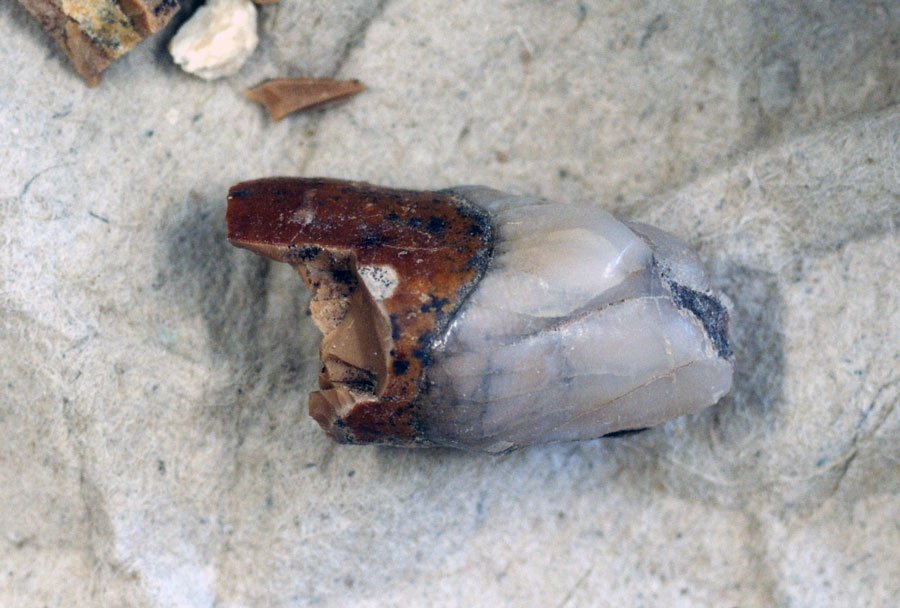
Photo note: The featured archival photograph shows a genuine Homo erectus fossil tooth held at Uppsala University in Sweden. It is not one of the nine teeth newly reported from the Guangxi cave sites. The researchers’ photographs of the new finds are available at the Australian Science Media Centre.
The findings extend the securely documented presence of Homo erectus on the Chinese mainland well beyond the previous evidence, which was about 400,000 years old. They also challenge the idea that these early humans depended mainly on savannas and open woodlands. The results come from an international research team working with remains from Baxian and Naxian caves in the Guangxi Zhuang Autonomous Region. One study reconstructs the environment and possible movement of the hominins; the other analyzes their teeth and identities.
What researchers found in the two caves
The caves lie about 15 kilometers, or nine miles, apart in a landscape of steep limestone hills. The researchers examined nine hominin teeth along with more than 18,000 mammalian fossils. Eight teeth were assigned to Homo erectus through their anatomical features. Of five teeth selected for ancient-protein analysis, four also showed protein evidence consistent with that identification.
Importantly, the molecular evidence involved ancient proteins preserved in tooth enamel, not the recovery of a complete Homo erectus genome. The work combined several techniques to avoid relying on any single line of evidence.
For the dating study, researchers combined 43 age measurements from five dating approaches, examining teeth, surrounding sediments and mineral deposits. Their modeled age range places the fossil-bearing populations in southern China roughly 324,000 to 184,000 years ago. That range describes the uncertainty around the evidence; it does not establish uninterrupted occupation for every year in between.
Evidence of life in a tropical rainforest
The team investigated the chemical composition of human and animal tooth enamel, along with the species represented in the cave deposits, to reconstruct ancient diets and local environments. Carbon-isotope results from a small number of the hominin teeth are consistent with food resources associated with dense-canopy vegetation. The wider faunal assemblage reinforces a rainforest setting.
That matters because prominent Homo erectus finds from Java have long been associated with more open woodland and grassland environments. Evidence from Guangxi shows at least some later populations could exploit a much denser ecosystem. The finding revises an older assumption about adaptation, but does not tell researchers exactly which plants or animals each individual ate.
“The animal teeth and the Homo erectus teeth are telling the same story: these individuals were part of a rainforest ecosystem,” said Nicolas Bourgon of the Max Planck Institute of Geoanthropology in the institute’s November 18 research announcement.
Did these ancient humans travel long distances?
Strontium isotope patterns in four hominin teeth suggest that the individuals drew on food or water from geologically distinct areas while their teeth formed in childhood. The researchers say this could reflect movement through the region, or the use of resources originating in multiple locations.
Some modeled source regions reach toward northern Vietnam. One study discusses potential ranges on the order of 250 kilometers, about 155 miles, but these are tentative reconstructions. Isotope measurements do not document a specific journey, an exact route or confirmed travel by a named individual.
The ninth tooth remains a mystery
One tooth, known as PA1796, did not fit the same anatomical and protein pattern as the eight attributed to Homo erectus. Researchers say it may represent another ancient human population in the region. Some outside specialists have raised the possibility of a connection to Denisovans, also discussed in connection with the Homo longi lineage.
That identification remains unresolved. The find does not demonstrate that Homo erectus and Denisovans interbred at the caves, or that a newly identified species has been discovered. More comparable fossils and molecular evidence are needed.
Why the finding matters to American researchers
The research has relevance well beyond China, including for American museums and university teams studying human origins. In CNN’s November 18 reporting, Smithsonian paleoanthropologist Ryan McRae discussed the uncertainties surrounding the unidentified tooth. In Live Science, University of Wisconsin–Madison anthropologist John Hawks described the new anatomical and protein findings as persuasive evidence for a later mainland presence of Homo erectus.
The findings also reinforce a broader scientific point: human evolution was not a tidy procession of one population replacing another everywhere at once. Different ancient human groups may have occupied overlapping landscapes, and ecological adaptability was not exclusive to modern humans.
What scientists still do not know
The caves do not reveal the exact extinction date of Homo erectus. Fossils from Java in Indonesia indicate that the species survived there until approximately 117,000 to 108,000 years ago, later than the age range estimated for the Guangxi remains. The fate of the mainland populations and any interactions with other hominins remain subjects of research.
Further fossil discoveries, isotope sampling and ancient-protein analysis will be needed to test how widespread rainforest adaptation was and whether the mystery tooth belongs to a different lineage. For now, the strongest conclusion is also a significant one: Homo erectus survived later on mainland East Asia than previously documented and made use of tropical forest environments.
Sources and research materials
- Nature (November 18, 2026): Rainforest adaptation in late Homo erectus from southern China.
- Nature (November 18, 2026): Evidence for late Middle Pleistocene Homo erectus in mainland East Asia.
- Max Planck Institute of Geoanthropology research announcement.
- Australian Science Media Centre: researcher briefing and original excavation media.
- CNN report by Katie Hunt (November 18, 2026).
Editorial note: This article summarizes published scientific research and attributed expert commentary; Khemetic.News did not conduct field reporting at the caves.