

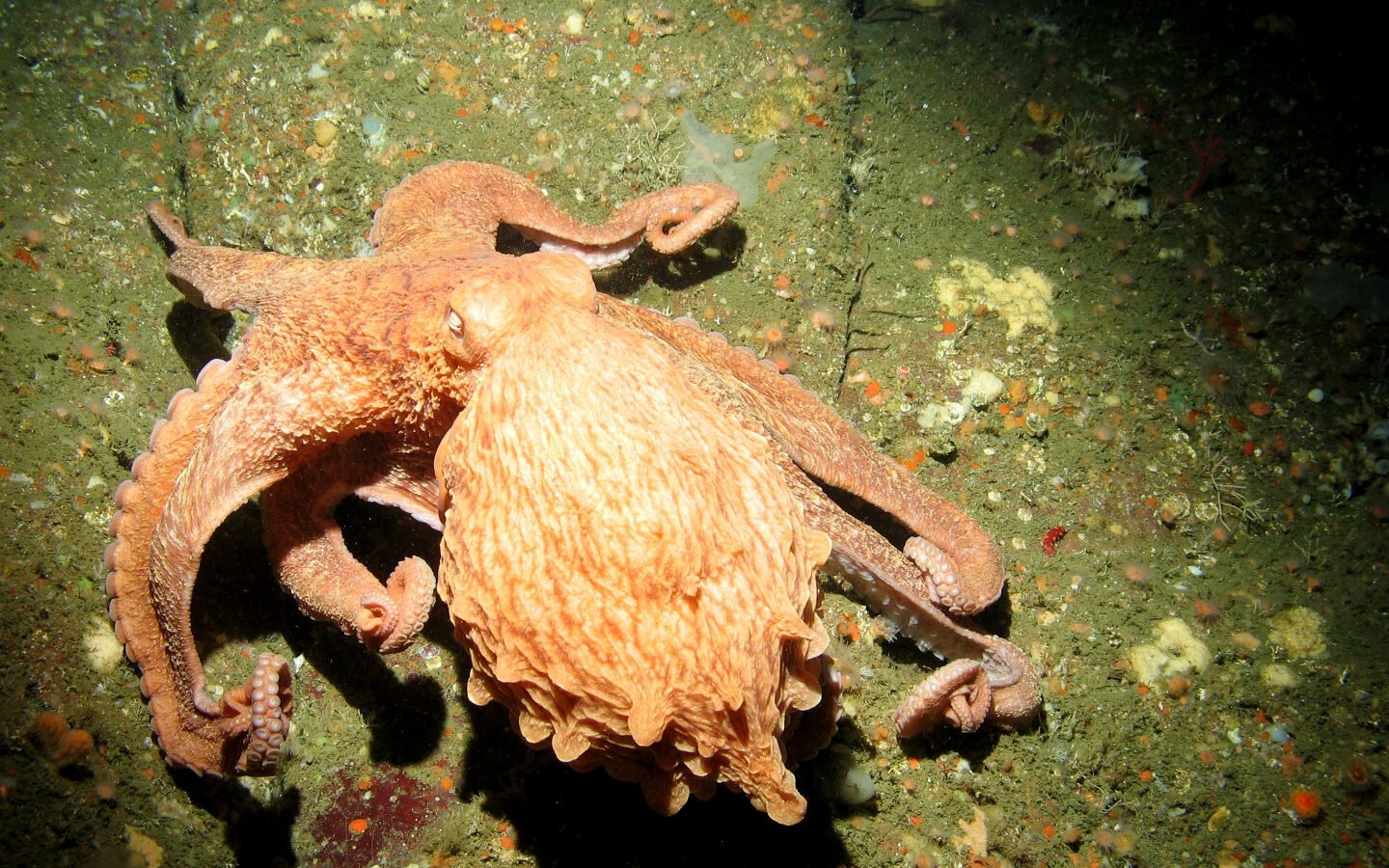
Octopuses have three hearts, copper-based blue blood and a nervous system so unusual that most of its nerve cells are outside the central brain. Those remarkable traits are established biology. The harder question—what it feels like to be an octopus—remains unanswered.
A November 3, 2026, feature from Animals Around the Globe revisited these adaptations. For a clearer account of what is known and what is still being investigated, Khemetic.News examined primary studies and research from U.S. universities and federal marine scientists.
Three hearts, and blood that carries oxygen with copper
An octopus has two branchial hearts that move blood through the gills and a systemic heart that circulates oxygenated blood through the rest of the animal. Its blood appears blue when oxygenated because the oxygen-carrying molecule is hemocyanin, which contains copper. Human blood instead relies on iron-containing hemoglobin.
These are not extraordinary claims or a newly announced discovery. They are standard features of octopus anatomy, described in National Geographic’s educational overview and in accounts from the Marine Biological Laboratory in Massachusetts. Different respiratory pigments are adaptations, not evidence that octopuses are biologically unrelated to other Earth animals.
Two-thirds of the neurons: a nervous system distributed into eight arms
Frequently cited estimates put the octopus nervous system at roughly 500 million neurons, with about two-thirds in the arms. This does not mean an octopus possesses nine separate, independently conscious brains. It has a centralized brain, optic lobes and extensive peripheral circuits. Arm nerve cords can process sensory inputs and organize many movements locally while still communicating with other parts of the nervous system.
The distinction matters because the catchy claim that octopuses have “nine brains” can mislead readers about how coordination works. A 2023 University of Chicago study reported neural signals traveling between arms through a nerve ring, demonstrating coordination outside the central brain rather than eight isolated minds.
In a paper published January 15, 2025, in Nature Communications, University of Chicago researchers Cassady Olson, Natalie Grace Schulz and Clifton Ragsdale described how octopus arm nerve cords are organized into segments associated with the control of flexible muscles and suckers. Their research helps explain how an animal without a rigid skeleton can grasp, reach and explore so precisely. Read the original study.
Octopuses can taste what they touch
Octopus suckers do more than grip surfaces. Specialized receptors register both physical contact and chemicals on objects that an arm encounters. In 2020, scientists at Harvard University identified chemotactile receptors that help octopuses detect substances associated with prey. The findings were published in the journal Cell and provide a molecular explanation for the animal’s distinctive “taste by touch” ability.
That means an arm reaching into a crevice may gather chemical information while simultaneously probing and manipulating its surroundings. This is sophisticated sensing and local information processing—not proof that each arm has a separate personality. Read the Harvard researchers’ paper.
Do octopuses feel pain—and do they experience the world consciously?
Scientists distinguish a reflexive response to tissue damage, called nociception, from the experience of pain. A 2021 study by San Francisco State University researcher Robyn Crook found that octopuses avoided locations associated with a harmful stimulus and preferred places associated with pain relief. Together with specific injury-directed behavior and nerve recordings, the results provide substantial evidence consistent with an unpleasant pain experience.
The study, published in iScience, involved controlled experiments; it does not reveal precisely what pain feels like to an octopus or answer every question about consciousness. Read the full study.
There is also no established scientific method for directly observing another species’ subjective inner life. Experiments can test learning, perception, memory, reactions to injury and neural communication. They cannot yet determine whether the animal’s sensations form an experience comparable to ours or how unified that experience is.
Why research in the United States matters
From California to Chicago and Massachusetts, American researchers are using octopuses to investigate a larger question: must complex behavior be controlled from one central brain? Their findings are relevant to basic neuroscience and may help engineers design flexible robots that can sense and move without requiring every tiny adjustment to be centrally directed.
The animals also live in American waters, including the Pacific Northwest, Alaska, Hawaii and the Atlantic coast. Federal scientists document their ecology and behavior in national marine sanctuaries and aquariums. The NOAA Fisheries Kodiak Laboratory has described how its giant Pacific octopus used its arms, suckers and problem-solving ability during enrichment activities.
What the evidence does—and does not—establish
Three hearts, blue blood and a densely innervated network of arms are facts. The ability to taste by touch and coordinate arm movements is supported by laboratory research. Evidence consistent with pain has also strengthened the case for careful treatment of these animals in scientific settings.
But the claim that an octopus is composed of eight independent conscious minds is not established. Nor does the distribution of neurons alone answer whether octopus awareness is unified, divided or unlike familiar human categories. That uncertainty is a reason for further research—not a license to fill the gaps with speculation.
Watch and explore
Video: Understanding the Giant Pacific Octopus, NOAA Fisheries (original publisher).
Sources
- Animals Around the Globe, November 3, 2026 — topic prompting this explainer.
- Olson, Schulz & Ragsdale, Nature Communications (2025) — neural segmentation and arm control.
- Chang & Hale, iScience (2023) — interarm neural signaling.
- van Giesen et al., Cell (2020) — touch-taste receptors.
- Crook, iScience (2021) — evidence consistent with affective pain.
- NOAA Fisheries: octopus behavior in Kodiak Laboratory.


