LOS ANGELES — Loneliness may involve more than having too few friends or spending too much time alone. Researchers at the University of California, Los Angeles found that college students reporting greater loneliness had brain responses that were less similar to those of other participants, including other people who felt lonely.
The findings, published in Psychological Science in 2023, suggest that the subjective experience of feeling misunderstood could be connected to how people process the same information. They do not establish that loneliness causes someone’s brain to work differently or that brain scans can diagnose loneliness. Read the original peer-reviewed study.
How the UCLA researchers studied loneliness
The research team, led by Elisa C. Baek, analyzed functional magnetic resonance imaging (fMRI) data from 66 first-year university students. Participants watched the same set of short videos while researchers measured changes in blood-oxygen-level-dependent signals, an indirect index of brain activity. The participants also completed a questionnaire about their feelings of loneliness.
To examine how similarly two people responded to the same material over time, the researchers used intersubject correlation, a statistical measure of synchronization between the participants’ brain signals.
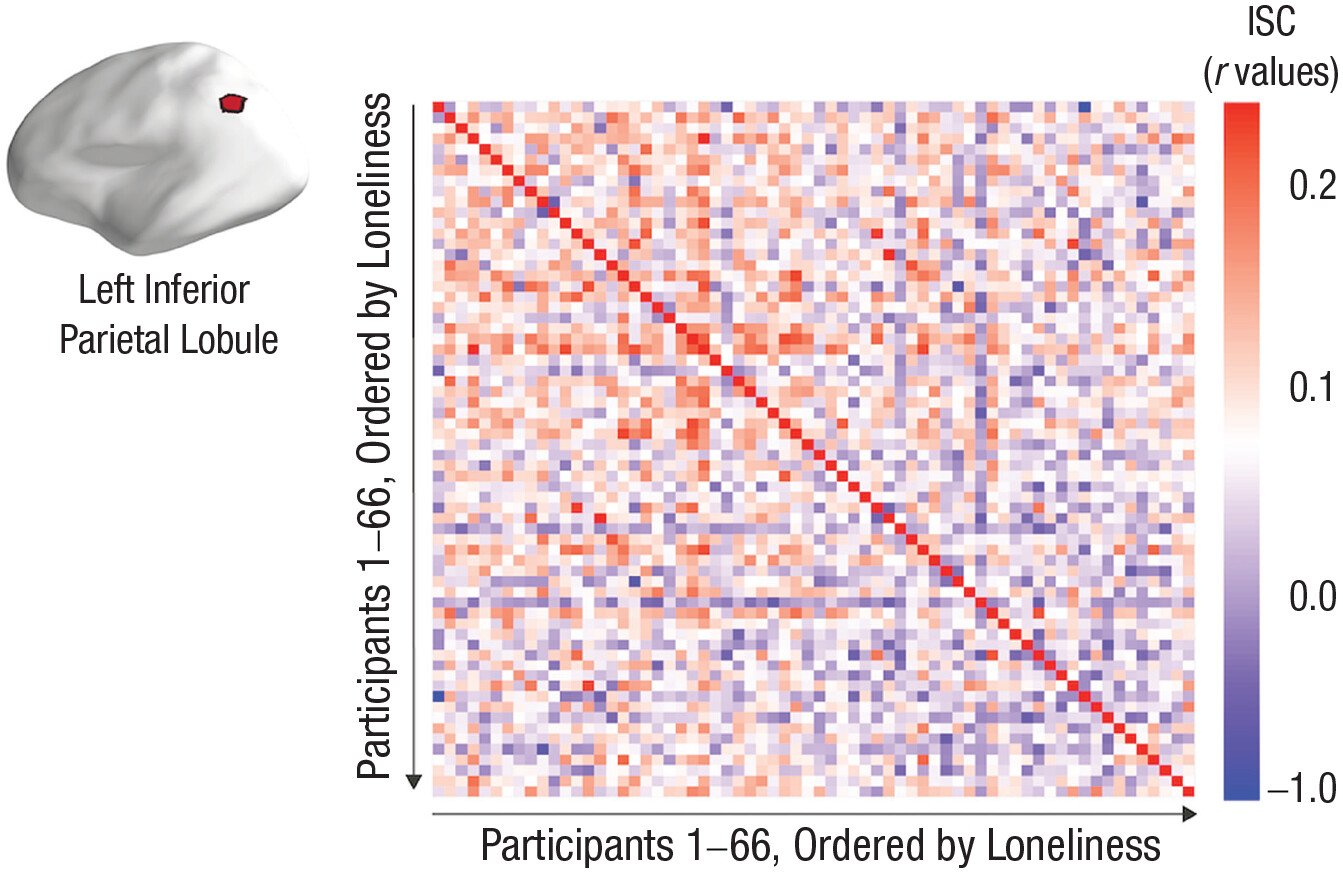
The team found that less-lonely students generally had more similar neural responses, while more-lonely students showed increasingly idiosyncratic patterns. These associations remained after adjusting for factors including demographic similarities, objective social isolation, and whether participants were friends with one another.
Why having friends and feeling understood are different
One of the most important distinctions in the study is between the number of someone’s social ties and the subjective feeling of connection. A person might have friends, classmates, colleagues or relatives around them yet still feel that other people do not see events the way they do.
The findings suggest a potential role for shared understanding in the experience of belonging. They should not be read to mean that holding unconventional beliefs, being creative, or disagreeing with a group necessarily makes someone lonely.
Which brain regions showed differences?
The researchers reported differences in several regions involved in social cognition and the interpretation of complex information, including areas within the default-mode network. This network is implicated in processes such as autobiographical reflection and making sense of experiences.
Differences also appeared in regions associated with motivation and reward, including the nucleus accumbens. Those observations do not prove that lonely people experience less pleasure or have a particular dopamine imbalance; the study measured synchronization of responses between people, not neurotransmitter concentrations.
In the study’s Figure 3, a participant-by-participant matrix shows how brain-response similarity in the left inferior parietal lobule tended to decline among pairs ordered toward higher loneliness scores. In Figure 4, the authors show related comparisons that account for social connections and demographic factors.
A second study examined shared cultural perspectives
A related study published in Communications Psychology in May 2024 examined whether loneliness corresponded with mental representations of familiar public figures that differed from wider group perceptions.
Across two independent brain-imaging datasets involving 40 participants each, researchers found that lonelier individuals’ neural representations of famous people tended to deviate more from shared representations in the medial prefrontal cortex. In a separate language-based study involving 923 participants, lonelier people used more distinctive language when describing celebrities for whom there was strong cultural consensus. Read the 2024 paper.
That work supports the possibility that perceived social disconnection is related to differences in shared interpretations. It, too, does not settle which way the relationship runs.
Does loneliness change perception—or does different perception contribute to loneliness?
The original UCLA study cannot establish cause and effect. It is possible that people whose interpretations differ from those of their peers sometimes struggle to feel understood. It is also possible that persistent loneliness shapes attention, expectations or responses to social situations. Both directions—or other factors—could matter.
The sample was relatively small and limited to students at one university. The authors also noted timing differences between measurements of social ties and the imaging experiment. Additional studies involving other age groups, communities, and repeated observations over time are needed to test how widely the findings apply.
What this means for American communities
The research invites a distinction in discussions about loneliness: more social contact is not always the same as feeling genuinely understood. Schools, families, workplaces and neighborhood organizations may want to consider how they foster listening, respect, trust and meaningful relationships alongside opportunities to gather.
The U.S. Surgeon General’s 2023 advisory on social connection described loneliness and social isolation as important public-health issues. Those broader health findings are separate from the UCLA brain-imaging study; the imaging research did not test a treatment or evaluate any particular community program.
What the evidence really shows
The clearest conclusion is not that lonely individuals have fundamentally different brains. It is that in this study, higher reported loneliness was associated with less similar patterns of neural activity among participants watching the same videos—including when comparing people who were both lonely.
That finding offers a scientifically grounded explanation worth exploring for why a person can feel alone even in the company of others. Whether different interpretations contribute to loneliness, result from it, or interact with it remains an open question.
Video: Shared understanding and social connection
For additional research context, watch Elisa Baek’s April 21, 2021 Dartmouth seminar, “Shared understanding promotes social connection: neural and behavioral evidence.” This researcher presentation predates and is not a video report on the 2023 experiment. Original Dartmouth listing.
Sources and further reading
- Baek et al., “Lonely Individuals Process the World in Idiosyncratic Ways,” Psychological Science (2023)
- UCLA eScholarship open-access copy
- Association for Psychological Science — Research context (2023)
- Broom et al., “Loneliness corresponds with neural representations and language use that deviate from shared cultural perceptions,” Communications Psychology (2024)
- U.S. Surgeon General — Our Epidemic of Loneliness and Isolation (2023)
Image credits: Figures 4 and 3, Baek et al., Psychological Science (2023), © the authors, CC BY 4.0. Original figures reproduced without alteration.