
Research feature — originally published in 2021; includes a 2024 follow-up.
Researchers have demonstrated that protected enzymes embedded inside selected polyester plastics can make those materials break down under appropriate composting conditions. The research does not prove that all biodegradable plastic is compostable in every environment.
Researchers at the University of California, Berkeley developed a technique for making certain plastics degrade more completely after use by distributing polymer-breaking enzymes throughout the materials during manufacturing. Their study, published in the journal Nature on April 21, 2021, reported up to 98% conversion of particular polyesters into smaller molecules under tested conditions.
The work, led by materials scientist Ting Xu, addressed a practical problem: products labeled “biodegradable” may not break down in household compost or may require conditions absent from municipal waste systems.
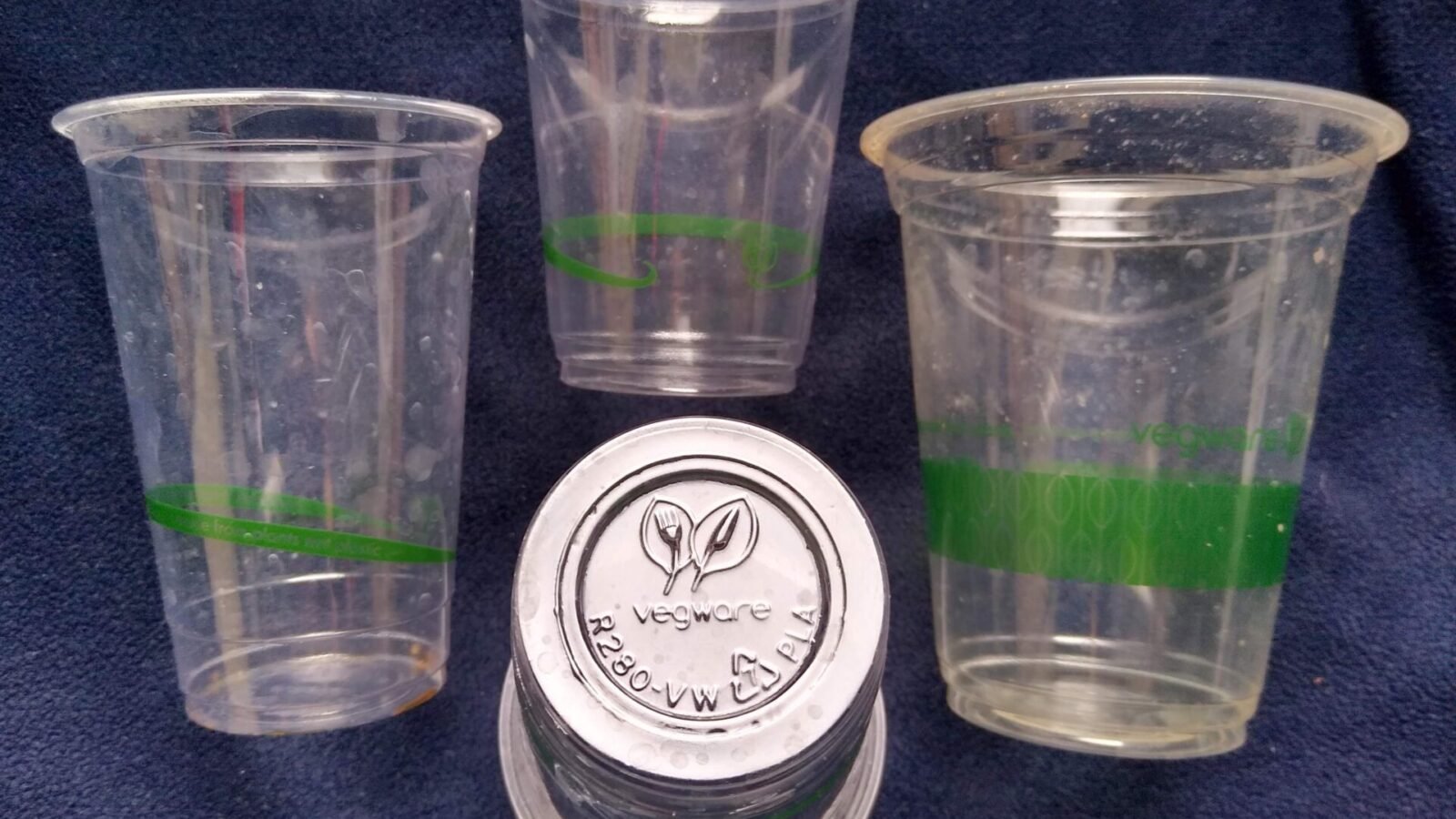
Featured photograph: Four actual polylactic acid (PLA) cups, shown as an example of the material class studied—not enzyme-containing Berkeley test products. Photo: Cmglee / Wikimedia Commons, CC BY-SA 4.0. Original photograph, no editorial alterations; WordPress may resize the display.
How enzymes change the behavior of plastic
Plastics consist of long molecular chains called polymers. The same durable structures that make products useful can also make discarded plastics resistant to degradation.
The Berkeley team worked with two polyester plastics, polylactic acid (PLA) and polycaprolactone (PCL). It protected enzymes with specially designed random heteropolymers and embedded nanoscale clusters throughout the plastic. With sufficient moisture and warmth, the enzymes could break nearby polymer chains into smaller chemical components.
For PLA, researchers used proteinase K. For PCL, they used a lipase enzyme. The goal was depolymerization—chemical breakdown of the long chains—rather than merely shattering plastic into progressively smaller plastic particles.
What the original experiments demonstrated
According to UC Berkeley’s research announcement, the modified PLA degraded within approximately six days in industrial-composting conditions at 50°C (122°F). Modified PCL degraded within about two days at 40°C (104°F). In another test, roughly 80% of modified PLA fibers degraded within about one week at room temperature.
The Nature paper reported up to 98% polymer-to-small-molecule conversion in specific experiments. That figure applies to the engineered test samples, not to every bag, cup or packaging film marketed as biodegradable. Results depend on polymer chemistry and environmental conditions.
What later research added in 2024
A separate research group reported another approach in a Nature paper published July 17, 2024. Scientists embedded an engineered enzyme into PLA film using a manufacturing process intended to be scalable.
That modified film fully disintegrated in the researchers’ evaluated home-composting conditions within about 20–24 weeks, meeting the home-composting standards assessed in the study. This was a different formulation and study from Berkeley’s 2021 work. Disintegration under a tested standard should not be confused with proof of harmless breakdown everywhere in nature.
Why this matters in the United States
Communities across the United States must decide how to collect and process packaging discarded after a single use. The Environmental Protection Agency explains that not every biodegradable plastic is compostable, and a product labeled compostable often requires a commercial or industrial composting facility rather than a backyard compost bin.
Better-designed materials could eventually help composters manage certain products more effectively, but manufacturing costs, collection systems, durability, testing and compost quality all matter. The EPA also advises keeping compostable plastics out of conventional plastic-recycling streams, where they can cause contamination.
What remains unknown
The findings do not establish that every type of plastic can be converted to compost. The original study’s most promising results concerned selected polyesters, not the entire range of petroleum-based plastics. Researchers still must evaluate commercial scale, long-term performance, varied climates and environmental impacts.
Breaking polymer chains into smaller molecules is also not identical to proving that the material has been completely converted into carbon dioxide, water and biological biomass in every disposal setting.
The studies offer evidence that some plastics can be designed with their eventual disposal in mind. That innovation complements, rather than replaces, strategies to reduce unnecessary single-use products, expand reuse and maintain effective waste systems.
Official research video
UC Berkeley’s “Truly biodegradable plastic” video (2021) features graduate researcher Ivan Jayapurna explaining the actual work in Ting Xu’s laboratory. Watch the university’s accompanying explanation.
Sources
- DelRe and colleagues, “Near-complete depolymerization of polyesters with nano-dispersed enzymes,” Nature, April 2021.
- UC Berkeley, original research announcement, April 21, 2021.
- Guicherd and colleagues, “An engineered enzyme embedded into PLA to make self-biodegradable plastic,” Nature, July 2024.
- U.S. Environmental Protection Agency, Plastic Recycling and Composting FAQs.
- UC Berkeley, official video report, August 2021.