


HHS has opened a conditional pathway for licensed professionals to compound six experimental peptides. The change expands potential access, but it does not mean the FDA has approved these substances as medicines.
By Lotta Goddess | Khemetic.News | November 6, 2026
The U.S. Department of Health and Human Services has established an interim enforcement policy affecting six experimental peptides promoted for uses ranging from tissue repair and inflammation to metabolism and neurological conditions.
The policy, announced in the Federal Register on October 30, 2026, covers BPC-157, TB-500, Epitalon, KPV, MOTS-c and Semax. Under specified safeguards, HHS says it does not intend to take enforcement action against qualifying state-licensed pharmacies, federal facilities or licensed physicians who compound products containing the listed ingredients while officials consider a permanent regulatory list.
None of the six is FDA-approved as a drug for the proposed uses. The federal announcement is a temporary enforcement-discretion policy, not a determination that the substances are safe, effective, or appropriate for unrestricted sale. Compounded drugs are not reviewed by the FDA for safety, effectiveness, and quality before marketing in the way approved drugs are.
What exactly changed?
Section 503A of the Federal Food, Drug, and Cosmetic Act governs important aspects of traditional, patient-specific drug compounding. When conditions are met, qualified pharmacies and physicians may prepare customized medicines for individual patients. One longstanding question is which bulk drug substances can be used when they are not ingredients in approved drugs and do not have an applicable federal pharmacopeial monograph.
Several peptides were placed in the FDA’s Category 2 group beginning in September 2023 because of potential significant safety risks. Some were removed from that category in April 2026 following changes to their nomination status, but HHS explicitly states that the removal did not itself alter their legal status under Section 503A.
On July 23–24, 2026, the FDA’s Pharmacy Compounding Advisory Committee considered seven peptide-related substances. The panel recommended inclusion of six of them, contrary to the Center for Drug Evaluation and Research’s recommendation against inclusion. Those advisory votes are nonbinding; they do not constitute drug approval. The seventh, emideltide, is not among the six named in HHS’s interim policy.
HHS says the temporary pathway may offer a more controlled option than research-chemical products sold without adequate oversight. The policy may be reconsidered if safety signals or product-quality problems emerge. The department has not permanently placed these substances on the 503A bulk drug substances list.
Which six peptides are covered?
Peptides are short chains of amino acids, and some have important functions in human biology. That does not mean all proposed peptide therapies have been shown to work. Each substance and proposed medical use requires its own evidence.
| Peptide and chemical form | Uses FDA reviewed or scientific areas under investigation | Routes covered under the interim HHS policy |
|---|---|---|
| BPC-157 acetate | Ulcerative colitis; also promoted for tissue repair | Subcutaneous, intramuscular, oral, topical |
| TB-500 acetate | Wound healing | Subcutaneous or intramuscular |
| Epitalon acetate | Insomnia; also promoted for longevity | Subcutaneous or intramuscular in intermittent courses |
| KPV acetate | Wound healing and inflammatory conditions | Oral or topical |
| MOTS-c acetate | Obesity and osteoporosis | Subcutaneous or intramuscular |
| Semax free base | Cerebral ischemia, migraine, trigeminal neuralgia | Intranasal |
These are policy limitations, not medical instructions, approved indications, or recommended treatment regimens. The HHS policy and Appendix B specify the chemical identities and additional conditions.
BPC-157: The attraction of tissue repair
BPC-157 has been studied in experiments involving gastrointestinal tissue, inflammation and injury-related biological processes. The FDA committee examined it in connection with ulcerative colitis. Claims that it can reliably heal human tendon, ligament or muscle injuries go beyond what has been established by adequate clinical trials. Research findings from animals or isolated tissues cannot, on their own, confirm a treatment works in people.
TB-500: A fragment is not the same as its parent protein
TB-500 has attracted interest because of research connected with thymosin beta-4, a protein involved in processes relevant to tissue migration and repair. But observations concerning the parent protein are not automatically proof of safety or benefit from the TB-500 peptide fragment. FDA reviewed it for wound healing; the interim policy covers only qualifying TB-500 acetate injections.
Epitalon: Longevity claims still need human proof
Epitalon is often promoted in the longevity market, including claims about cellular aging and telomeres. The FDA committee’s evaluated use was insomnia. Laboratory mechanisms and limited exposure records do not establish that epitalon extends human lifespan or meaningfully treats insomnia. HHS restricts its policy to qualifying epitalon acetate injections dispensed in intermittent courses.
KPV: A possible inflammation target
KPV is a three-amino-acid peptide investigated in research on inflammatory signaling and wound healing. Its potential biological effects warrant scientific scrutiny, but it has not been established as an effective general treatment for inflammatory conditions. The policy addresses qualifying oral and topical KPV acetate products only, subject to the additional requirements for oral bioavailability documentation.
MOTS-c: A metabolic research subject
MOTS-c, a mitochondrial-derived peptide, has generated interest in cellular energy regulation and metabolism. FDA reviewed potential uses involving obesity and osteoporosis. Experimental findings do not demonstrate that compounded MOTS-c safely treats these conditions in patients. The covered formulation is a specified acetate form for injection.
Semax: A neurological research candidate
Semax has been investigated in connection with cerebral ischemia, migraine and trigeminal neuralgia. HHS cited limited historical human use and updated quality-characterization information in explaining its decision. That is different from establishing effectiveness through the full FDA approval process. The interim pathway is limited to qualifying intranasal Semax free-base formulations.
Why regulators reached different conclusions
FDA drug-center reviewers recommended against including the peptide substances under consideration on the permanent compounding list. The independent advisory committee recommended inclusion for six of seven candidates. HHS points to new information about historical use, ingredient characterization, certificates of analysis and conditions intended to reduce quality risks. Critics remain concerned that clinical evidence may be inadequate for widespread patient use.
The disagreement is substantive: promising laboratory biology, reports of historical use, evidence that a supplier can characterize ingredients, and clinical proof of safety and effectiveness are different kinds of evidence. A temporary decision to exercise enforcement discretion should not be presented as scientific consensus that the treatments work.
Ten conditions govern the interim pathway
The HHS document spells out ten conditions. They cover the eligible ingredient list; identity and permitted route; detailed lot-level characterization; registered and adequately validated manufacturers; reports of compounded products, serious adverse events and quality issues; specific labeling; just one listed active pharmaceutical ingredient per product; documentation of oral bioavailability when relevant; restrictions on co-packaged delivery devices; and compliance with other applicable federal requirements, including patient-specific prescriptions and sanitary compounding.
For oral products, compounders are expected to document adequate bioavailability for the actual formulation supplied to patients. Serious adverse events are to be reported to the FDA’s MedWatch program and relevant states. The policy requires labeling identifying the product as compounded and not for resale.
These safeguards address particular manufacturing, prescribing and monitoring issues. They cannot substitute for trials establishing whether a peptide benefits patients.
What patients should know about safety
The FDA warns that compounded drugs carry risks because they do not go through the agency’s normal premarket review for safety, effectiveness and quality. Relevant concerns include contamination, inaccurate ingredient strength, immune reactions and unrecognized side effects. Injectable preparations require special attention to sterility.
A certificate of analysis can provide important ingredient-quality information. It cannot show that a given drug works for a specific disease. Similarly, calling a product a peptide, natural, regenerative, or research grade does not establish that it is safe for self-administration.
Consumers should not interpret the HHS announcement as authorization for research-chemical websites to sell experimental drugs for human treatment, or as permission for unrestricted peptide combinations. The federal policy applies only to specified circumstances and does not displace applicable state requirements.
Why this matters for American healthcare
Patients with difficult-to-treat conditions may be especially interested in promising but unproven therapies. Expanded avenues for access could reduce reliance on poorly regulated sellers, as HHS argues. Yet access alone is not the same as an effective treatment. Patients may incur substantial costs or postpone established care when products are marketed more confidently than the evidence warrants.
For communities already facing barriers to quality healthcare, meaningful choice requires clear information about uncertainties, medical supervision, transparent pricing and reliable product standards. Public scrutiny of adverse-event reports and independently conducted human trials will matter more than promotional claims.
What happens next?
The October 30 Federal Register notice invited comments under Docket HHS-OASH-2026-0496, with submissions accepted for two weeks after publication—through November 13, 2026. The government may subsequently propose including some or all of the peptides on the permanent 503A bulks list, or reach a different conclusion based on the evidence.
Patients considering a compounded peptide should ask their licensed clinician about the condition being treated, quality of human clinical evidence, potential risks, available approved alternatives, pharmacy credentials and how side effects will be monitored. No one should treat this policy as a recommendation to start peptide injections or replace established medical care.
The bottom line
The federal government has opened a narrow, temporary compounding pathway for six peptides that remain experimental. The change could affect how some patients and pharmacies access them. It does not erase concerns about clinical proof, product quality or long-term harms. Scientific promise deserves investigation. Medical claims deserve proof.
Official video: FDA advisory proceedings
July 23, 2026: FDA Pharmacy Compounding Advisory Committee — Day 1, covering BPC-157, KPV, TB-500 and MOTS-c.
July 24, 2026: FDA Pharmacy Compounding Advisory Committee — Day 2, covering Semax, Epitalon and Emideltide. Source: U.S. Food and Drug Administration.
Sources and documents
- HHS Enforcement Discretion Policy Regarding 503A Compounding Using Certain Peptide Bulk Drug Substances, including Appendices A and B.
- Federal Register: HHS notice, October 30, 2026.
- FDA Pharmacy Compounding Advisory Committee July 23–24 meeting materials, votes and recordings.
- FDA: Compounding and the FDA, Questions and Answers.
- Reuters independent reporting on the October 28 announcement.
- The Epoch Times original report prompting this fact-check.
Editorial note: This report relies on government documents and attributed reporting, not firsthand interviews. It is not medical advice.
PHOTO CREDIT — FEATURED IMAGE: FDA Building 1, Silver Spring, Maryland, photographed March 12, 2015; Michael J. Ermarth / U.S. FDA, public domain. Original photo and rights.
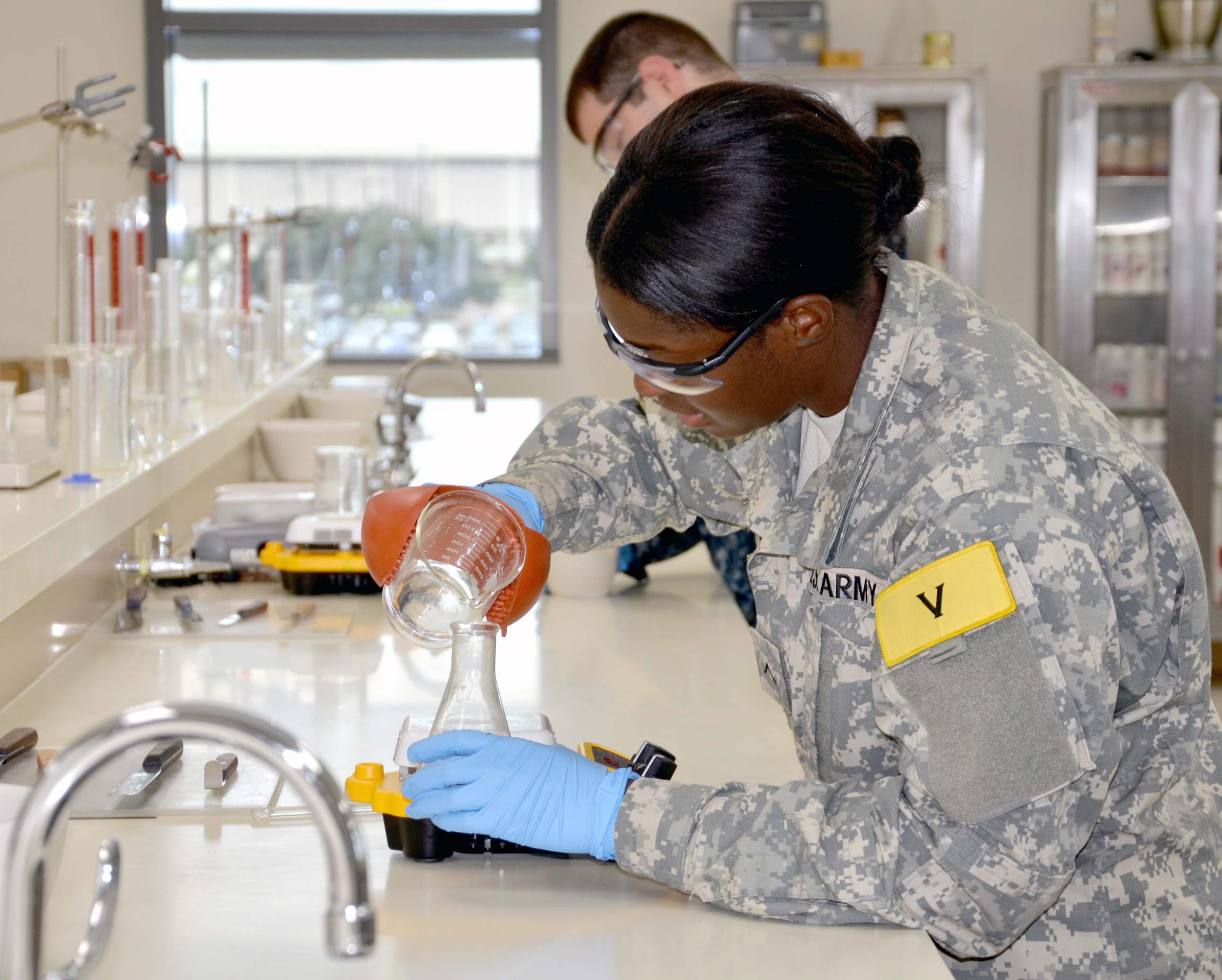
INLINE PHOTOGRAPH — EXTERNAL PUBLIC-DOMAIN IMAGE: Pvt. Simonique Burns transfers compounded simple syrup at a military pharmacy training laboratory in 2013; Lori Newman / JBSA-Fort Sam Houston Public Affairs, public domain, credit requested. Photo does not depict the preparation of peptides or imply military endorsement. Original photo and rights.