Khemetic Nation News Network | Science Desk | Reporting date: November 1, 2026
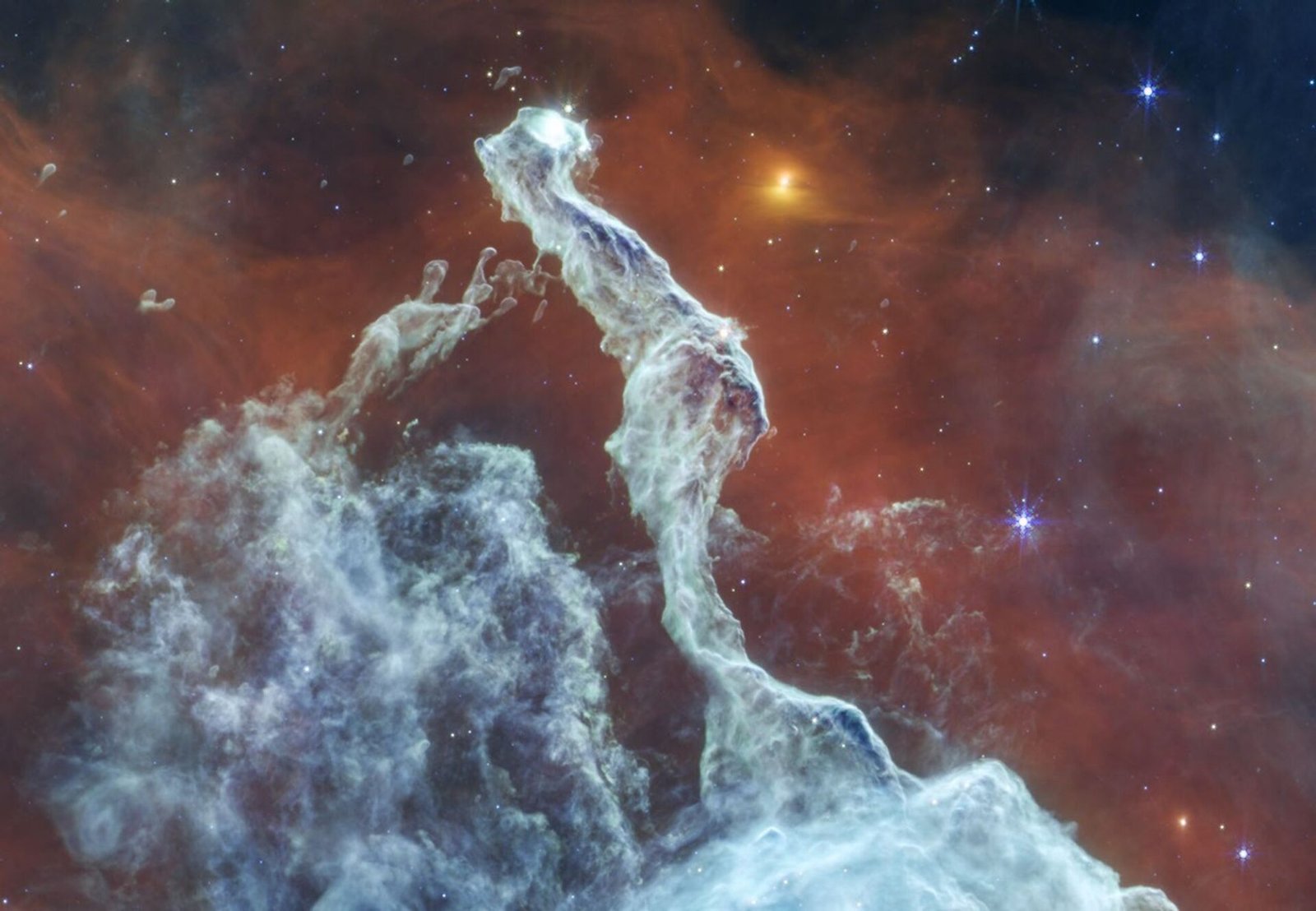
NASA has released new views of a dusty structure within the Carina Nebula that looks uncannily like a cat turning its head. The images, published on October 29, 2026, combine observations from the Hubble Space Telescope and the James Webb Space Telescope to examine how new stars form inside enormous clouds of gas and dust.
The structure, nicknamed the Cat’s Head Nebula, lies in a star-forming region roughly 7,500 light-years from Earth. Its apparent “eye” may be a young star shining from within the obscuring material. The familiar-looking silhouette is a visual description, not an animal-shaped object in space.
One cloud, three portraits
Hubble’s visible-light image shows a mostly opaque dust pillar against colorful surrounding gas. The dark material blocks much of the background, while radiation from nearby stars illuminates its rim. Webb’s near-infrared camera can peer through more of that dust, revealing stars and faint galaxies that are hard to see in the visible-light view.

Webb’s mid-infrared instrument tells a third part of the story by detecting radiation from warm dust and carbon-bearing molecules energized by starlight. These are not three separate celestial objects: they are different measurements of the same region, made with instruments sensitive to different ranges of light.

What scientists can—and cannot—conclude
The comparison helps researchers trace how radiation and stellar winds reshape dense clouds. Astronomers expect this pillar to change and eventually disperse. The images show an active stellar nursery, but they do not establish that every bright point is a newly born star or settle all questions about the region’s formation history.
A Book of Maat perspective: appearance and hidden structure
In the 2018 Book of Maat, printed page 156, The Seven Principles of Maat discusses the Principle of Correspondence, inviting readers to consider relationships between what is observable and what is not immediately apparent. There is a philosophical parallel in the way new instruments allow us to look beyond an initial appearance. The comparison is interpretive: Webb’s infrared detections are physical measurements and do not validate spiritual or metaphysical claims.
Watch: a flight across three wavelengths
NASA’s October 29 video tours the Hubble and Webb views of the Cat’s Head. Play NASA’s official multiwavelength video.
Sources
NASA October 29 science release; Hubble image and observation notes; Webb near-infrared data; Webb mid-infrared data; Book of Maat (2018), p. 156.