A stone surface could become a lasting place of knowledge through carefully controlled blows. In the Indigenous Southwest, petroglyph makers worked with the color, texture and hardness of rock to produce images that remain visible centuries later. Their achievement joined material skill with cultural knowledge: knowing how to make a mark was only part of knowing where, when and why it belonged.
A regional history, not one universal tradition
This installment focuses on ancestral Pueblo communities in present-day New Mexico, particularly the Albuquerque escarpment and Chaco Canyon. “Pueblo” encompasses distinct peoples and communities rather than a single nation; a photograph alone cannot identify an individual maker’s community. At Petroglyph National Monument, the National Park Service attributes roughly 90 percent of the images to ancestors of today’s Pueblo peoples and places most production between about 1300 and the late 1680s. Those estimates concern that monument, not every rock-image site in the Americas. NPS regional history.
Working with the surface
Many Southwestern rock faces carry a dark coating commonly called desert varnish. Removing portions of that coating exposes lighter material underneath, creating contrast without adding paint. The rock itself supplies both the background and the newly exposed image. This helps explain why surface selection matters: the same action on a differently colored or weathered face can produce a very different result.
Pecking removes material through repeated impacts. A hammerstone can strike the surface, or blows can be directed through a stone chisel. The task involves controlling the position and extent of removal so that individual marks accumulate into an outline or filled area. These are explanations of documented techniques, not a claim that every maker used an identical toolkit or sequence.
Several techniques, several kinds of line
The NPS distinguishes fine lines produced with sharp stone edges from thicker marks made with blunter tools. Abrasion rubs material away and can prepare a surface or fill a shape; sideways rubbing can alter texture, while drilling produces small holes. A panel may preserve several techniques together. The surviving marks are physical evidence, while a modern demonstration of a possible hand movement is a reconstruction of the process. NPS guide to manufacturing techniques.
That distinction matters when reading a photograph. An image can show the shape and placement of a groove without preserving the maker’s entire working procedure. Nor should carved images be confused with pictographs, which are painted onto rock. Both are sophisticated forms of image making, but they involve different operations and materials.
Chaco: what the photograph establishes
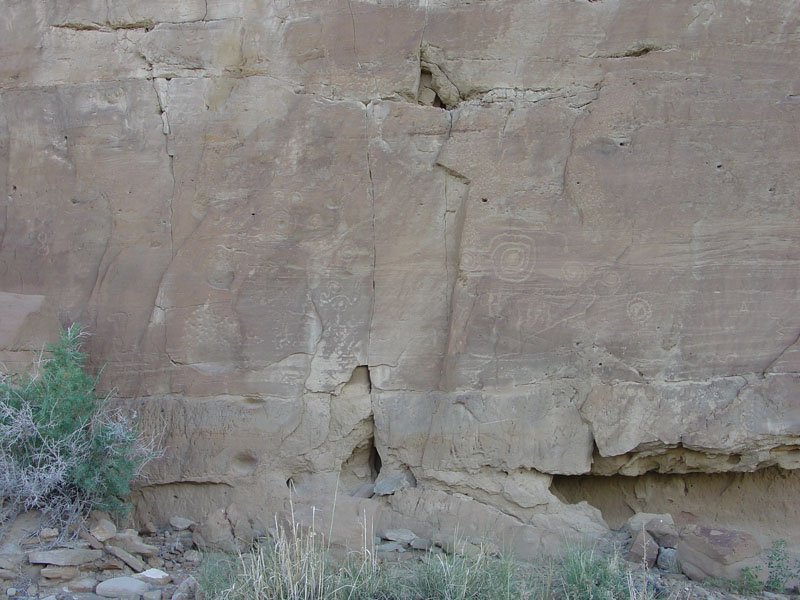
The featured photograph shows carvings on sandstone between Chetro Ketl and Pueblo Bonito at Chaco Culture in New Mexico. The USGS identifies the markings as cut through desert varnish and explicitly states that their meaning is unknown in its account. The photograph documents surviving forms; it does not supply a translation. A familiar spiral therefore should not automatically be labeled a calendar, map or astronomical instrument. USGS photograph and description.
Knowledge belongs to places and people
At Petroglyph National Monument, NPS interpretation incorporates Native explanations that image placement was deliberate and that some figures concern clan, religious or travel histories. Traditional ceremonies continue within the sacred landscape. These living relationships are a different kind of evidence from tool marks, and both deserve clear attribution. Some knowledge is community specific; other meanings remain uncertain. An outside observer’s inability to translate an image does not make it meaningless. NPS discussion of cultural meaning.
Orientation, neighboring images and the surrounding terrain can all matter. Removing a carved stone from its setting would separate it from those relationships. Respectful study keeps the physical object and its cultural landscape together, rather than treating every motif as an isolated symbol with a universal definition.
A brief Maya comparison
Maya sculptors also made durable records in stone, but the comparison has limits. At Copán, in present-day Honduras, the Hieroglyphic Stairway preserves a substantial Maya inscription. Harvard’s Peabody Museum documents its archaeological investigation and continuing study. It provides a useful contrast between a recognized writing system and Southwestern images whose meanings cannot simply be read as equivalent texts. The shared use of stone carving does not establish shared language, identical purpose or contact between the makers discussed here. Peabody Museum: Copán’s Hieroglyphic Stairway.
Technology as an enduring relationship
Petroglyph making brought together controlled impact, abrasion, visual planning and knowledge of place. Its importance lies in the relationship between those practical operations and the communities that gave the images meaning. Studying the technology closely allows Indigenous makers’ skill to come into focus while leaving room for what archaeology cannot determine and what living communities retain.
Photograph: U.S. Geological Survey, “Chaco Culture — petroglyphs,” public domain. The image depicts Chaco Canyon, not the Albuquerque monument. Original image and rights statement.
Sources
National Park Service: makers and regional chronology; NPS: carving, abrasion and painting techniques; NPS: cultural context and continuing meaning; USGS: Chaco photograph, description and public-domain designation; Peabody Museum: Copán research.