A newly published study has identified a striking biological contrast: healthy newborn babies carried higher blood concentrations of several forms of phosphorylated tau—a protein modification associated with Alzheimer’s disease—than older patients diagnosed with the disorder. The finding does not mean babies have Alzheimer’s. Instead, it suggests that the same molecular signal can have very different meanings early and late in life.
The research, published October 29, 2026, in the peer-reviewed journal Brain Communications, measured proteins in blood plasma from 42 healthy full-term newborns, 41 older adults without Alzheimer’s disease and 73 patients with Alzheimer’s. The international research team included scientists from the University of Gothenburg and U.S. institutions, including the University of Pittsburgh and University of Wisconsin. Read the original research.
The same tau signal—at very different stages of life
Tau helps support the internal structure of neurons, the nerve cells that form the brain’s communication network. Chemical changes called phosphorylation can alter how tau behaves. Those changes are part of normal early development, when nerve cells grow, extend axons and form connections.
Abnormal tau phosphorylation and accumulation are also closely associated with Alzheimer’s disease, where tau can form neurofibrillary tangles and contribute to neuronal dysfunction. But the context matters: measuring a particular protein in blood is not the same as establishing the presence of tangles in a person’s brain.
The team measured two phosphorylated forms—p-tau217 and p-tau205—and reported that both were highest in the newborn group. The study’s mean p-tau217 concentration was 17 picograms per milliliter (pg/mL) among newborns, compared with 8.6 pg/mL among Alzheimer’s patients and 2.6 pg/mL among older controls.
| Group | Mean plasma p-tau217 | Mean plasma p-tau205 |
|---|---|---|
| Healthy full-term newborns (n=42) | 17 pg/mL | 3.3 pg/mL |
| Alzheimer’s patients (n=73) | 8.6 pg/mL | 0.7 pg/mL |
| Older adults without Alzheimer’s (n=41) | 2.6 pg/mL | 0.5 pg/mL |
Source: Gonzalez-Ortiz and colleagues, Brain Communications, published October 29, 2026. These are group averages from blood samples, not brain tissue measurements or individual diagnoses.
Why elevated tau does not mean newborns have Alzheimer’s
The newborns’ wider biomarker profile was different from that of Alzheimer’s patients. The researchers also measured glial fibrillary acidic protein (GFAP), neurofilament light (NfL) and amyloid-beta species. Newborns had high GFAP but relatively low NfL and amyloid-beta markers. By contrast, NfL—a marker associated with nerve injury—was highest among the patients with Alzheimer’s.
The research team also used an additional exploratory protein-measurement method in a smaller subset of 27 newborns and 12 older controls. That analysis supported elevated levels across several phosphorylated tau sites early in life. The authors examined whether factors around birth explained the results; mode of delivery was associated with GFAP and NfL but not with the principal tau measurements.
These findings are consistent with the idea that tau phosphorylation can be part of healthy neurodevelopment, while changes involving tau in older adults may occur alongside amyloid-related pathology and neurodegeneration.
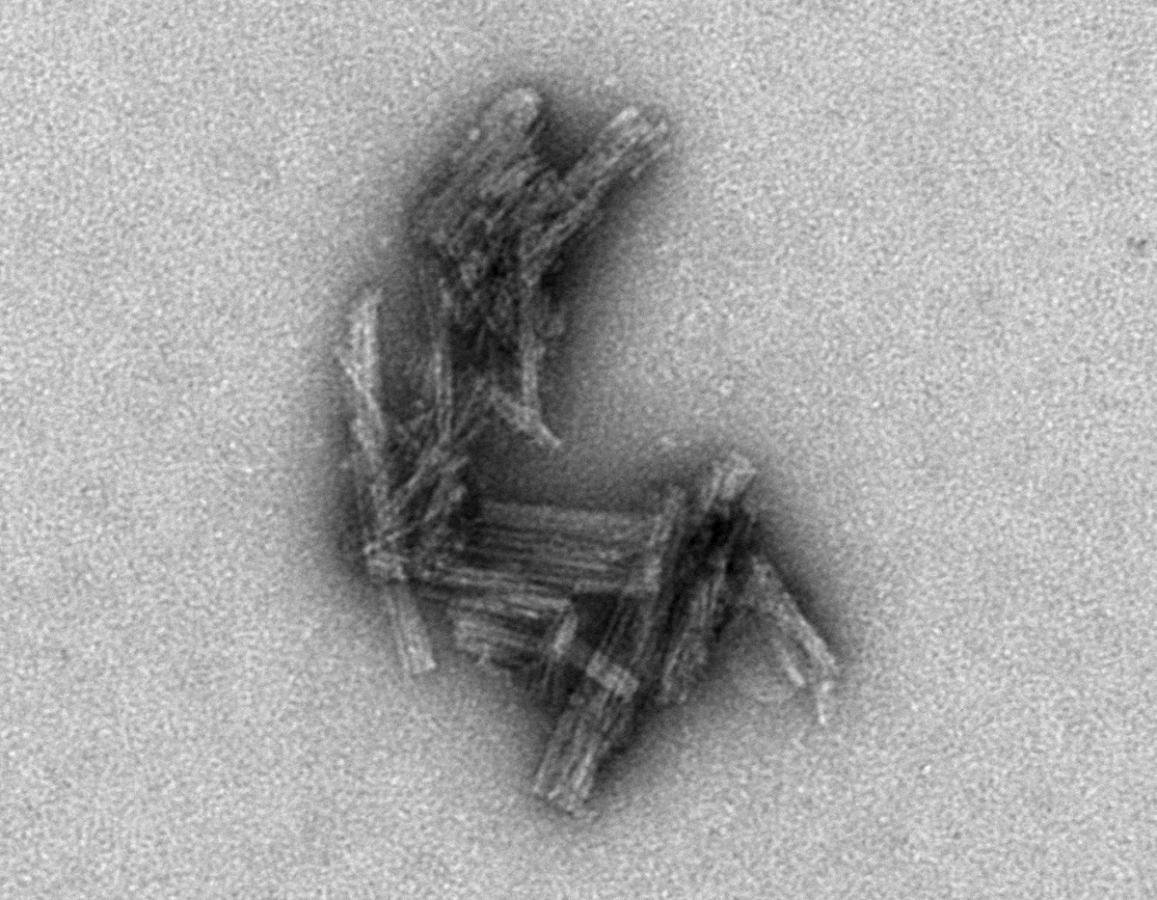
For additional background on the structure of neurons and neural connections, see the National Institutes of Health BRAIN Initiative research overview. The featured electron micrograph above is archival NIH imagery, not material taken from the newborn participants.
A biological process that may change meaning with age
The researchers frame their results using a hypothesis called antagonistic pleiotropy: a biological process may provide an advantage early in life while contributing to harm under different conditions later. In this case, tau phosphorylation may allow developing neurons to grow and adapt, even though abnormal tau changes are linked to neurological disease in aging brains.
That framework is an interpretation, not proof that the same newborn process later causes Alzheimer’s. The study compared separate age groups at a single point in time; it did not follow children into adulthood or observe tau directly inside their brains.
Why the finding matters for U.S. research and dementia testing
Blood tests detecting phosphorylated tau, particularly p-tau217, have become a major focus of Alzheimer’s research. This study underscores that biomarkers need to be interpreted in the proper clinical and age-related context. A high reading in a newborn cannot be assigned the same meaning as a similar reading in an older adult being evaluated for cognitive decline.
In interviews with IFLScience, study co-lead Fernando Gonzalez-Ortiz emphasized how much is still unknown about normal tau changes between childhood and old age. Researchers hope to use additional experiments, including organoid and animal models, to explore how developing brains tolerate high concentrations of phosphorylated tau without the typical Alzheimer’s-associated biomarker pattern.
For families, the finding is not a reason to screen babies for Alzheimer’s, and it does not establish a new treatment or preventive measure. Its value lies in a more precise understanding of the biology behind disease tests and brain development.
What scientists still need to establish
The sample was modest, especially for measuring biological differences across a lifespan. The results came from blood plasma rather than direct brain measurements. The researchers did not establish why tau levels vary so sharply with age, whether other healthy life stages produce similar signals, or whether the mechanisms that protect young brains could one day inform treatment.
The central lesson: a protein associated with disease in one setting can also be a normal part of development in another. Understanding the difference may help scientists interpret biomarkers more accurately.
Sources and further reading
- Gonzalez-Ortiz F. et al., “The antagonistic pleiotropy of tau phosphorylation: plasma tau species in newborns and Alzheimer’s disease,” Brain Communications, October 29, 2026 (open-access research).
- IFLScience interview and coverage, November 2026.
- National Institute on Aging: What Happens to the Brain in Alzheimer’s Disease?
- NIH/NIAID electron micrograph of tau clusters — public domain, originally published 2019 (planned featured image; archival illustration of tau, not from this research).
- U.S. National Library of Medicine: Alzheimer’s disease educational video (supplemental background on plaques and tangles).
Editorial note: This report summarizes independently published research. It does not provide medical advice, a diagnosis, or evidence of a new Alzheimer’s treatment.