
At Ocmulgee, in present-day Macon, Georgia, earth became architecture. Indigenous builders raised platforms that supported buildings and shaped a community’s ceremonial landscape. The achievement lay in repeated, organized work: moving material, enlarging a stable form and maintaining access to its summit.
A particular place and people
This installment focuses on the Macon Plateau’s Mississippian-period builders rather than treating every North American mound as one tradition. “Mississippian” is an archaeological designation, not the name of a single nation. Ocmulgee is the ancestral homeland of the Muscogee (Creek) Nation. The Smithsonian’s Muscogee educational resource explicitly presents present-day Muscogee accounts of ancestors building earthen mounds here. Living national identity and archaeological classifications describe different aspects of this history.
Building upward in stages
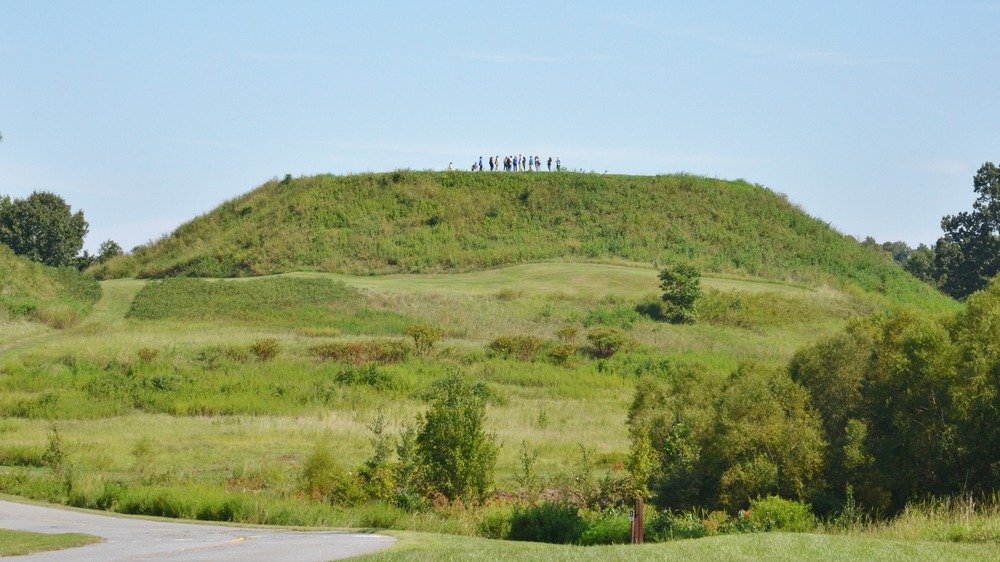
The National Park Service identifies four construction stages in the Great Temple Mound, with clay steps on its northern slope. Its roughly 55-foot height was the accumulated result of separate building episodes. The park’s mound-complex account describes flat-topped forms raised at intervals over many years. A mound was therefore a changing architectural project rather than necessarily a single uninterrupted building campaign.
In practical terms, enlarging such a platform meant coordinating the placement of fill while preserving a usable summit and routes upward. That is an engineering interpretation of its staged form; it does not establish the precise sequence followed by every work crew. Archaeology can reveal construction episodes without preserving the builders’ spoken instructions.
Earth, carrying containers and organized labor
An NPS historical overview describes alternating layers of earth and plant material in the Great and Lesser Temple Mounds. Layers matter because they show that a mound is an assembled structure. They should not automatically be assigned a specific drainage function: demonstrating that requires evidence about the particular soils and their arrangement.
The park interprets the Great Temple Mound’s construction in terms of millions of basket loads. Such totals are estimates, not surviving work records. Their value is to make the logistics visible: material had to be obtained, carried, placed and shaped repeatedly. Carrying technology and coordination were as necessary to the undertaking as the earth itself.
Agriculture also formed part of this technological setting. The park’s Mississippian culture account describes cultivation with wood, bone and stone tools, and food stored in pottery and baskets. These practices supported settled communities. The exact recruitment of mound workers, work schedules and division of tasks remain harder to reconstruct than the finished earthworks.
Platforms, buildings and different purposes
A broad summit created space for wooden architecture. Platform mounds at Ocmulgee supported buildings, while other mounds served different purposes. The Funeral Mound, for example, was a burial place. An explanation of construction must retain these distinctions: a building platform and a burial mound cannot be assigned the same function merely because both contain earth.
Water and erosion are practical concerns for any exposed earthen structure. Slopes, surfaces and access routes affect how rainfall moves, but this general physical principle is not proof of a particular ancient drainage system. The surviving mound demonstrates successful earth construction; attributing hidden drains or standardized soil recipes would go beyond the sources consulted here.
What visitors see—and what is reconstructed
The nearby Earth Lodge provides an especially useful distinction. Its enclosing structure is reconstructed, while portions of its clay floor are ancient. It offers an interpretation of an enclosed gathering space, not an untouched ancient roof. Likewise, the modern visitor stairway visible in the featured photograph should not be mistaken for the original clay steps.
Our account rests principally on archaeological interpretation published by the park and on a Smithsonian resource conveying Muscogee history. It does not use a colonial eyewitness description as a construction manual, or a modern reconstruction as direct evidence for every ancient building detail.
A careful Maya comparison
A flat-topped mound supporting a building invites comparison with elevated Maya architecture. The useful comparison here is the architectural problem—creating a raised setting for important activities—not an assertion that the builders shared one tradition. Ocmulgee’s earth construction must be understood through its own evidence. Similar silhouettes alone cannot establish contact, a common origin or identical methods.
Ocmulgee’s achievement is substantial on its own terms: Indigenous people transformed locally available materials into enduring community architecture. Recognizing the Muscogee relationship to this homeland keeps the discussion connected to living people rather than presenting the builders as a vanished mystery.
Sources and photograph
National Park Service: Great Temple Mound Complex; Mississippian Culture; Ocmulgee historical overview. Smithsonian National Museum of the American Indian: Before Muscogee Removal.
Featured photograph: visitors on the Great Temple Mound, Ocmulgee Mounds National Historical Park. Credit: NPS Photo. NPGallery original and rights record, explicitly designated public domain. Photograph shows the present-day site, including modern visitor access.