

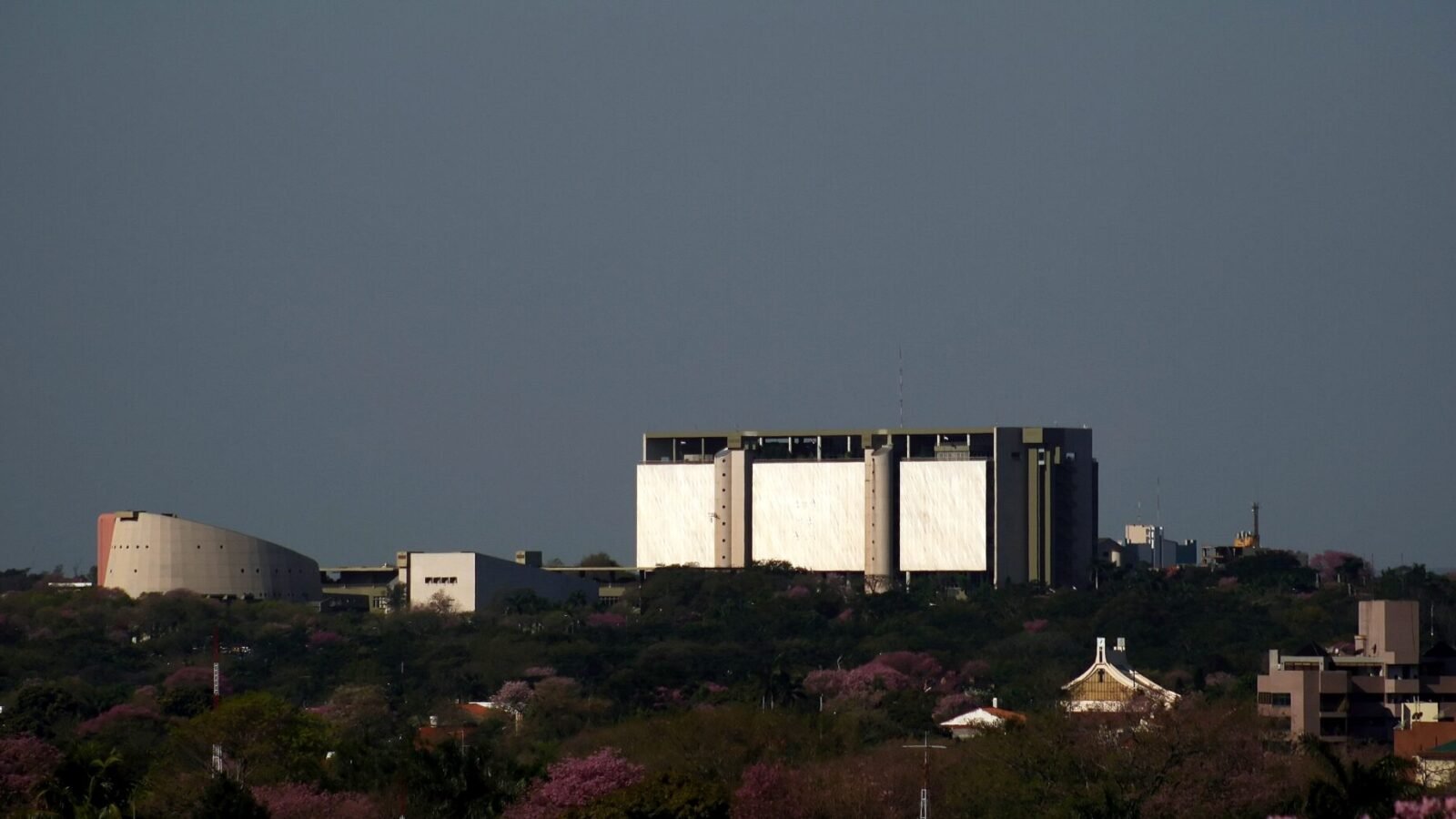
Featured image: Banco Central del Paraguay headquarters in Asunción, photographed September 1, 2009 (archival). Photo: Cmasi / Wikimedia Commons, CC BY-SA 4.0. The building photograph is not an image of the bank seizure.
ASUNCIÓN, Paraguay — November 5, 2026. Paraguay’s central bank took control of Ueno Bank after regulators found its solvency ratio had fallen below half the legally required minimum. The failure disrupted access to accounts for a digital lender serving roughly three million customers and set off an extraordinary political crisis: President Santiago Peña announced his resignation Thursday, and Paraguay’s lower house voted to advance impeachment proceedings.
The full financial losses, timing of customer reimbursements and criminal responsibility have not yet been established. But official records already expose major questions about loans involving related companies, the independence of banking supervision, and the placement of public funds in an institution linked to the president’s former business interests. The central bank’s November 3 notice and Associated Press reporting on November 5 establish the immediate timeline.
For Americans, the case has important parallels with Silicon Valley Bank’s 2023 failure and the 2024 Synapse technology-bank intermediary collapse. Those incidents had different causes, but each exposed the dangerous gap between seeing an account balance on a screen and being able to use the money behind it.
How a digital banking success story turned into a crisis
Ueno grew from the Financiera Ueno business into a prominent digital lender, gaining a banking license in 2023 and expanding through app-based services, rewards and extensive marketing. Its customers represented an estimated 60% of the country’s adult population. That customer figure measures the lender’s reported reach; it does not mean all three million customers permanently lost every dollar they held.
On November 2, the board of the Banco Central del Paraguay (BCP) voted unanimously to begin a statutory resolution procedure. The bank announced the decision publicly on November 3. It said adjustments made during a regulatory regularization process had reduced Ueno’s capital adequacy below 50% of the minimum required. Resolution officers were to examine the bank’s condition, preserve assets and implement the procedures available under Law 2334/03. The BCP called Ueno’s situation an isolated institutional case, not evidence that all Paraguayan banks were failing. BCP announcement.
Rating agency FIX SCR subsequently downgraded Ueno to its Dpy category and reported that regulatory work had identified loans involving companies connected to Ueno’s controlling group that were not previously properly disclosed. Its report also discussed asset-quality weaknesses and deficiencies in credit documentation. A downgrade is an assessment of credit risk, not a criminal verdict. FIX SCR rating report hosted by BCP.
What prosecutors allege about the money trail
On November 4, Paraguay’s Public Prosecutor’s Office announced charges against 27 people connected with Ueno and associated companies. Prosecutors said they were examining loans and overdrafts issued in 2025 and 2026 to businesses related to the bank’s broader corporate group. They described suspected weak collateral, insufficient documentation, unusually large credit exposure compared with some borrowers’ financial capacity, and movements of loan proceeds among companies in the same group.
One especially significant transaction involved a credit portfolio of approximately US$74.4 million. Prosecutors suspect the acquiring company may have used money originating indirectly from Ueno itself. They also identified approximately US$166.98 million and ₲343.16 billion in outstanding amounts associated with the examined transactions, whose recovery could be at risk. These are amounts identified by investigators—not a final accounting of stolen money or unrecoverable losses.
The suspected offenses include breach of trust, improper conduct in a financial crisis, attempted fraud and commercial-bookkeeping violations. Prosecutors sought protective measures involving defendants’ assets. Those accused remain presumed innocent, and the requests and charges must not be confused with convictions. Public Prosecutor’s Office, November 4; ABC Color court coverage.
Federico Miguel Vázquez Villasanti, a senior Ueno executive, is among the defendants named by Paraguayan reporting. The fact that a bank may lend to affiliated businesses is not by itself proof of illegality; the investigation must establish whether transactions breached relevant rules, involved conflicts and caused quantifiable losses.

The political connections and Peña’s resignation
President Santiago Peña previously held shares in Grupo Vázquez, the business group associated with Ueno, until March 2025, according to Reuters. Carlos Carvallo, who later became president of Paraguay’s central bank, had previously led Financiera Ueno. Carvallo resigned at Peña’s request on November 3 as questions grew about how the bank had been supervised. Reuters, November 3.
These documented connections establish a substantial conflict-of-interest question; they do not establish that Peña personally ordered illegal loans, profited from fraud or dictated regulatory findings. Those possibilities would require records and proof beyond shared business history. Opposition lawmakers alleged conflicts involving public funds and supervisory failures. Peña said those responsible for financial wrongdoing should face justice.
On November 5, as demonstrations continued and members of his Colorado Party withdrew support, Peña announced that he would resign. Paraguay’s Chamber of Deputies subsequently voted 78–0 to advance impeachment charges. AP reported that the Senate would still need to consider the impeachment case and that formal acceptance of the resignation and succession arrangements were pending at the time of its report. These constitutional developments should not be described as a court finding of personal criminal culpability. Reuters, November 5; AP, November 5.

Why public pensions and healthcare funds are central to the scandal
International reporting indicates Ueno held or administered roughly $800 million–$850 million in public funds, including exposure tied to Paraguay’s state pension and health institution, the Instituto de Previsión Social (IPS). The size of this concentration raises questions about who authorized the placements, what risk reviews were conducted, whether conflicts were disclosed, and how balances will be recovered. The cited sums are estimates and should not be conflated with money definitively lost. AP’s initial report; Reuters, November 4.
Pension liabilities, deposits and debt securities may have different claims in a resolution. A statement that the bank held public funds does not establish the liquidation value of those assets, the amount covered by statutory guarantees or the eventual taxpayer cost. A reliable accounting must distinguish those categories.
What depositors can actually recover
Viral posts claim every Ueno customer lost everything. That is not supported by the official deposit-guarantee announcements. The BCP says eligible deposits are guaranteed up to 75 monthly minimum wages, currently ₲228.3 million, per depositor per institution, rather than per account. Funds above the limit may be treated differently under the resolution process. BCP guarantee explanation.
On November 5, the central bank announced the first stage of guarantee payments for customers whose total deposits did not exceed ₲10 million, who owed no debts to Ueno and who had an active account with another participating financial institution. It said further groups would be announced. This is a plan for staged payments, not proof that every account has already been fully restored. The BCP cautioned that certain related parties were excluded from guarantee coverage by law. BCP, November 5 guarantee update; official payment information.
In the meantime, even households whose deposits qualify for protection can face severe practical hardship if they cannot pay rent, buy food or access wages. Cash-flow disruption is a genuine form of financial harm even when the final insured balance may eventually be paid.
Paraguay already suffered a similar banking crisis in the 1990s
The most revealing historical comparison is inside Paraguay itself. An International Monetary Fund retrospective describes how a crisis starting in 1995 led to 15 of 19 locally owned banks being closed or absorbed over four years. The IMF identified weak supervision and governance, connected lending and delayed interventions among important vulnerabilities. It estimated losses equivalent to about ten percentage points of GDP, borne largely by the public sector.
There is no evidence here that the same people orchestrated that historical episode and the 2026 Ueno collapse. The meaningful resemblance is institutional: lending related to ownership groups, weak oversight and a public forced to deal with the financial fallout. Technology can change how a bank acquires customers without eliminating conflicts embedded in credit and governance decisions.
Banking failures worldwide: similarities without a conspiracy
Argentina, 2001 — A nationwide restriction on access to deposits
During Argentina’s sovereign, currency and banking crisis, the government restricted cash withdrawals and transfers under what became known as the corralito. Depositors suddenly faced limits on using money shown in their bank accounts, while the country entered political upheaval. Unlike Ueno, this was a broad macroeconomic crisis, not one institution’s resolution. Its relevance lies in how rapidly financial access can change under emergency policy. IMF review.
Iceland, 2008 — Expansion beyond a nation’s rescue capacity
Three leading Icelandic banks collapsed amid the global crisis after relying on substantial cross-border funding. Domestic and foreign depositors faced different rescue arrangements. The case demonstrates the danger of financing rapid bank growth through liabilities that cannot be supported under stress. Iceland’s crisis did not establish insider-lending allegations identical to those under investigation in Paraguay. Bank for International Settlements case study.
Cyprus, 2013 — Uninsured depositors absorbed losses
During Cyprus’s bank resolutions, insured deposits were protected but certain uninsured balances above €100,000 were exposed to losses or conversion into bank equity. The lesson for high-balance customers is the importance of knowing the limits and legal ranking of deposit guarantees. Central Bank of Cyprus.
Lebanon, 2019 onward — Restrictions can become prolonged
As Lebanon’s sovereign-financial crisis intensified, restrictions on foreign-currency withdrawals and transfers continued for years. The comparison warns against assuming that every interruption is resolved within days. But Lebanon’s currency, public-debt and banking predicament is materially different from the resolution of one Paraguayan bank.
United States, 2023 — Silicon Valley Bank
Silicon Valley Bank failed after interest-rate risk, concentrated uninsured deposits and rapid withdrawals overwhelmed the institution. U.S. authorities transferred all its deposits, including uninsured balances, to a bridge bank, and customers regained access when it opened on March 13, 2023. That extraordinary action does not mean all uninsured deposits at every future failed American bank are automatically guaranteed. FDIC resolution record.
United States, 2024 — Synapse and missing records
Synapse, a financial-technology intermediary connecting consumer applications to partner banks, entered bankruptcy in April 2024. The Consumer Financial Protection Bureau later alleged it had failed to maintain reliable records matching customers’ balances to the money held at banks. Regulators described a $60 million–$90 million reconciliation shortfall and customers without access to funds for weeks or months. This was not a conventional bank insolvency, but it shows how modern interfaces can conceal important dependencies on the accounting systems behind them. CFPB enforcement record.
Are the same people behind crises across countries?
The available records do not support the claim that an identical group of financiers, politicians or a secret international organization engineered the crises in Paraguay, Argentina, Iceland, Cyprus, Lebanon and the United States. They involve different institutions, periods, regulatory failures and economic conditions. Viral references to President Javier Milei or an alleged “Epstein class” as the masterminds of Ueno’s failure lack substantiation in the documents examined and are not asserted here.
A rigorous money-trail investigation should instead establish company ownership, related-party loan contracts, collateral, supervisory warnings, public-deposit authorizations, auditor findings and any independently documented cross-border transfers. Shared structural weaknesses deserve scrutiny; speculative connections should not be presented as proven crimes.
What the Ueno crisis means for U.S. financial security
U.S. customers typically have FDIC insurance up to $250,000 per depositor, per insured bank, per ownership category, with comparable federal share insurance for qualifying credit-union accounts administered by the NCUA. Different types of accounts, companies or investment products may not be covered the same way. FDIC deposit insurance guide; NCUA share-insurance guide.
Digital-banking customers should confirm the legal name of the institution holding their money and understand whether a fintech app merely provides an interface for a partner bank. Deposit insurance protects eligible balances in certain circumstances; it is not a guarantee that every app, brokerage product, payment platform or internal ledger will continue operating without interruption.
- Confirm where funds are legally held. Use official bank and credit-union insurance resources rather than relying on an app’s marketing.
- Understand insurance aggregation. Multiple accounts at the same insured bank and in the same ownership category may count together toward a coverage limit.
- Maintain a workable backup. When feasible, a second insured account can preserve access to payroll, bills and emergency payments if one institution’s services stop.
- Keep records. Statements and confirmations help establish balances if a provider’s accounting records are disputed.
- Diversify based on risk, not panic. Cash, insured deposits, investments and physical precious metals have different risks and functions. Gold and silver are not insured bank deposits, do not normally pay interest and can fluctuate in price.
- Watch for scams during a failure. Use official regulator channels, not unsolicited account-recovery links or callers claiming to accelerate reimbursement.
Physical gold and silver can reduce dependence on an individual financial intermediary, but they introduce custody, theft, transaction-cost and price risks. The evidence from these cases does not establish that converting all savings into metals is the safest choice for every family.
What remains unknown — and what accountability requires
As of November 5, investigators had not established the ultimate recoverable asset value, final losses to taxpayers or uninsured creditors, or criminal responsibility for every suspicious transaction. Congress still faced constitutional steps after Peña’s resignation announcement and lower-house vote. Official deposit repayments were proceeding in stages. Public agencies, auditors and courts must distinguish allegations from proof, and announcements from completed recovery.
Ueno’s story is a warning not about the inevitable failure of all digital banking, but about the importance of independent regulators, clear conflict-of-interest rules, dependable accounting, deposit safeguards and contingency access for households. Paraguay’s own financial history shows why those lessons must be implemented rather than merely repeated after the fact.
Original video reporting
Watch: Al Jazeera NewsFeed — Paraguay bank collapses with half of population’s savings (November 5, 2026). Original broadcaster’s video page. ABC Color — depositors demonstrate for access to their savings (November 4). Original publisher video/report. These links credit the video creators; video files have not been downloaded or reuploaded.
Primary documents and further reading
- Central Bank of Paraguay: Ueno resolution, November 3, 2026
- Central Bank: November 5 staged deposit-guarantee payments
- Public Prosecutor’s Office: 27 people charged, November 4
- FIX SCR: Ueno credit-rating assessment
- Associated Press: Peña’s resignation and impeachment developments
- Reuters: Carlos Carvallo resigns
- IMF: Paraguay’s 1995–1999 bank crisis
- FDIC: Silicon Valley Bank resolution
- CFPB: Synapse enforcement and recordkeeping failures
- Featured-photo source: Cmasi, CC BY-SA 4.0 (archival, 2009)
Reporting note: This article synthesizes documentary records and attributed news coverage. Khemetic.News has not independently interviewed bank executives, regulators, protesters or prosecutors for this story. Individuals charged with offenses are presumed innocent unless proven guilty. Updated November 5, 2026.