By Lotta Goddess | Khemetic.News | November 6, 2026
Living human-derived neural cells are now part of experimental computers and robots. Meanwhile, scientists are reconstructing animal brain circuits in software. These advances raise important questions about medical research, energy use, ownership of human cells and the limits of consciousness research—but no human mind has been uploaded.
Living Neurons Are Becoming Components of Computers
For decades, computer scientists tried to engineer machines that behave more like biological brains. Now several research teams are moving in the opposite direction: connecting living human-derived neurons to silicon hardware so that biological electrical activity can participate in computing tasks.
In March 2026, Australian firm Cortical Labs introduced a prototype biological data center with 120 CL1 units. In August, the National University of Singapore announced a 20-unit experimental installation developed with Cortical Labs and data-center company DayOne. Separately, scientists described a humanoid robot whose high-level controller included a brain organoid, and other researchers used detailed fruit-fly neural maps to simulate selected behaviors in a virtual animal.
All are meaningful advances. They are not interchangeable. One technology cultures cells on chips, another uses organoids in machine-control feedback loops, and a third models mapped neural circuits entirely in software. None has demonstrated a digital upload of human memory, identity or consciousness.
What Is a Human Brain Organoid?
Organoids are three-dimensional cultures derived from stem cells and grown to reproduce selected features of biological tissues. Brain organoids contain human-derived neural cells that can develop networks and measurable electrical activity. Researchers can sometimes produce them by reprogramming a donor’s blood or skin cells into induced pluripotent stem cells and guiding their development into neural tissue.
These structures offer valuable models of brain development, but the term “mini-brain” can mislead. An organoid is not a complete adult human brain: it generally lacks the full range of brain regions, blood supply, bodily sensation, mature connectivity and environmental experiences of a person. Its electrical activity cannot be treated as evidence of humanlike thought.
A 2023 research program in Frontiers in Science, involving Johns Hopkins scientists and collaborators, proposed “organoid intelligence” as a field combining neural tissue, bioengineering and computation. The ambition includes better disease models and unconventional processors, not a proven new kind of sentient computer.
Cortical Labs and the Biological Data Center
Cortical Labs’ CL1 system cultures human-derived neurons on an array of microelectrodes connected to electronics. Software converts digital events into electrical stimulation; the neurons produce electrical responses recorded through the same interface. A life-support system controls nutrients, gases, temperature and other culture conditions.
Australian Computer Society’s Information Age reported a Melbourne prototype containing 120 CL1 units in March 2026. On August 17, the National University of Singapore announced that a 20-unit installation had been demonstrated with Cortical Labs and DayOne.
These systems show that living neural cultures can be integrated into programmable, network-connected laboratory equipment. They do not show that the resulting facilities can replace conventional commercial cloud centers, train large AI models efficiently, or sustain standard computing workloads at an industrial scale.
Could Living Neurons Reduce Data Center Electricity Use?
The adult human brain uses on the order of 20 watts of metabolic power, which inspires comparisons with power-hungry computers. But using brain cells in a data center does not automatically reproduce the brain’s efficiency.
Calculations must include the entire system: electrode electronics, pumps, nutrient manufacturing and replenishment, temperature control, sensors, culture replacements, server networking and software. Fair measurements require matching the task, accuracy, speed and energy consumed. Claimed dramatic savings remain projections until independent whole-system comparisons are available.
For now, the strongest opportunities may lie in research on neural adaptation, drug effects and specialized biohybrid information processing, rather than direct competition with silicon processors.
The Pong Experiment and Later Video-Game Demonstrations
In 2022, researchers reported DishBrain in Neuron, an experiment connecting cultured human-derived and mouse neurons with a simplified Pong simulation. Electrical signals represented the game state; the cells’ responses influenced the paddle. Under certain feedback arrangements, neural activity changed in ways interpreted as adaptive behavior.
Cortical Labs subsequently showed CL1 cultures interacting with the game Doom. These experiments are striking because living neurons are receiving and responding to digital feedback. They do not demonstrate that the culture understands video games, possesses feelings or learns with the breadth of a living person.
Indiana University’s Brainoware: Processing With 3D Neural Tissue
In December 2023, researchers led by Feng Guo at Indiana University Bloomington published Brainoware in Nature Electronics. Their system used an organoid interfaced with a high-density microelectrode array. In “reservoir computing,” incoming stimulation perturbs a dynamic network and a separate digital layer learns to interpret the resulting response.
The team tested limited speech-recognition and mathematical prediction tasks. Brainoware offered proof that the complex electrical activity of living organoids can participate in engineered computation. It did not demonstrate speech comprehension or general-purpose intelligence in a dish.
Brainobot: Human Brain Organoid Activity Helps Guide a Humanoid Robot
In September 2026, a research team including Indiana University scientists posted a preprint describing Brainobot. The platform integrates a laboratory-grown brain organoid into a high-level decision-making system for a humanoid robot. Sensors and ordinary electronics encode information into electrical stimulation sent to the organoid; recorded neural responses help determine commands; conventional controllers operate the robot’s motors.
The paper reported proof-of-concept tasks involving grasping objects and tracking a laser target. It discussed adaptive processing and potential energy advantages. Importantly, the paper was a preprint that had not undergone journal peer review as of November 6, 2026. Independent replication and careful comparisons with nonbiological controllers remain necessary.
It would be inaccurate to describe this as a human brain waking up inside a robot. The organoid was one component of a designed engineering loop; much of the sensing, decoding and motor control remained electronic.
China’s MetaBOC Work and Other Biohybrid Robotics
Researchers at Tianjin University described MetaBOC, a brain-on-chip interface intended to connect neural tissue with virtual and physical robotic tasks. University reports in 2024 discussed navigation, obstacle avoidance, tracking and gripping through neural-signal interfaces. Their work underscores that scientists in several countries are testing different ways to translate activity in living neural tissue into machine commands.
For the United States, such international research matters to medical engineering, research standards, competitive intellectual property and safety oversight. But none of the demonstrations supplies evidence of autonomous humanlike reasoning.
FinalSpark: Laboratory Organoids Reach Researchers Through the Internet
Swiss company FinalSpark described its Neuroplatform in a 2024 peer-reviewed article. The platform connects neural organoids to stimulation and recording equipment and makes experiments accessible remotely through programming interfaces. Researchers reported substantial datasets from cultures that survived for weeks to months and introduced configurations allowing parallel investigation of multiple organoids.
This is a remotely usable research system. It should not be confused with a profitable or independently benchmarked alternative to ordinary cloud processors.
How Microelectrode Arrays Connect Biology and Electronics
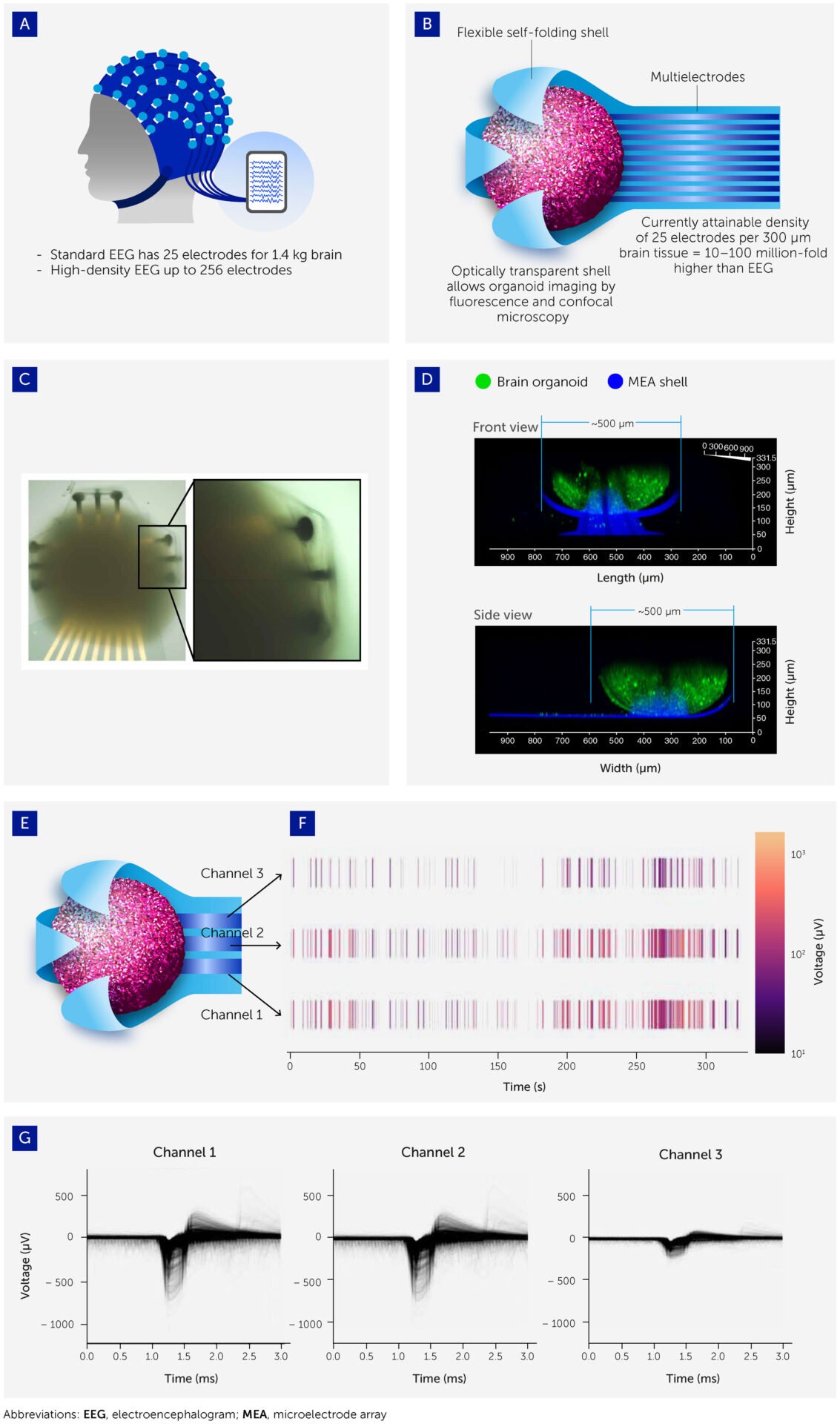
Microelectrode arrays provide the physical link: electrodes deliver small electrical signals and record changes produced by cells. Some experiments use flexible or three-dimensional interfaces to make closer contact with organoid surfaces. The patterns can reveal neural activity and adaptation under controlled laboratory conditions. However, decoding those signals is an active research problem, and biological cultures vary.
Illustrated research method: a peer-reviewed figure by Smirnova and colleagues (2023) shows actual organoid microscopy, electrical recording results and explanatory diagrams. Its use in this article will follow CC BY 4.0 attribution once imported.
Has a Fruit-Fly Brain Actually Been Uploaded?
Connectomics, the reconstruction of neural wiring, has advanced dramatically through electron microscopy, machine learning and painstaking human verification. In 2024 the FlyWire collaboration mapped an adult female fruit-fly brain containing approximately 139,000 neurons and more than 50 million synapses. In September 2026, a separate study in Cell mapped an adult male fruit-fly central nervous system including its brain and ventral nerve cord, identifying roughly 166,700 neurons and 124 million synaptic connections.
In March 2026, San Francisco firm Eon Systems demonstrated a simulated fruit fly driven partly by a computer model based on the earlier fly brain map. The virtual insect walked and showed selected fly-like behaviors, including grooming and responses to simulated food cues.
The company used the language of uploading an animal, but its own technical account explains major limitations. The virtual body already used engineered movement-control systems, the reconstruction did not reproduce all molecular and synaptic states, and it was not shown to preserve the memories or subjective experience of the source animal. The male-fly map published in September is a different project from the earlier connectome underlying Eon’s March demonstration.
A structural wiring diagram contains critical information about circuitry, but not necessarily the changing chemistry, connection strengths, developmental state or life history needed to reproduce a particular individual. The scientific result is a major neural reconstruction and preliminary embodied simulation—not demonstrated transfer of a conscious mind.
The Enormous Challenge of Mapping Human Brain Tissue
In 2024, Harvard and Google scientists published a reconstruction of about one cubic millimeter of human cerebral cortex in Science, identifying tens of thousands of cells and around 150 million synapses. Processing that tiny specimen produced roughly 1.4 petabytes of data. It illustrates why a comparable reconstruction of an entire human brain would require immense imaging, computing and verification resources.
Structure is also not the whole story. Learning and behavior depend on neuronal firing, changes in synaptic strengths, chemicals, metabolic processes and interactions with the body. A map, however precise, does not automatically reproduce a person’s thoughts.
Medical Research May Be the Most Important Early Application
Organoids allow researchers to study aspects of human brain development that cannot be inspected directly in living people. They can be used to investigate genetic variants associated with neurodevelopmental conditions, cellular mechanisms relevant to Alzheimer’s and other disorders, infections, and how candidate treatments or toxic compounds affect neural cells.
Organoids are not substitutes for human clinical studies: they lack important components of mature brains and bodies and may behave differently from patients. Still, better models could aid discovery and reduce some animal experiments. In 2025 the NIH announced a Standardized Organoid Modeling Center intended to improve reliability and reduce reliance on animal models. Separate NIH-reported research in 2026 explored maturation of unusually long-lived organoid cultures.
Researchers are also testing how transplanted neural tissue functions in living animals. In Nature in 2022, scientists reported that human cortical organoids transplanted into newborn rats matured, integrated with host neural circuits and participated in experiments involving sensory responses and behavior. This was not the implantation of a complete human brain; it was an approach to studying neural development and disease.
Brain–Computer Interfaces Are Related, But Different
Brain–computer interfaces typically record signals from a living person’s brain and translate them into actions, such as operating a cursor, communication device or assistive robot. This is distinct from using donated, cultured cells as part of a processor. Both rely on decoding neural signals, but one interfaces with the patient’s functioning brain while the other engineers new networks of human-derived cells.
Can Brain Organoids Be Conscious?
No experiment described here has demonstrated humanlike consciousness in an organoid or uploaded an individual mind. Yet there is no universally accepted test for subjective awareness in every possible biological configuration. As research becomes more complex, questions about possible capacities, animal welfare and responsible limits deserve serious attention rather than certainty unsupported by evidence.
The National Academies’ 2021 report on neural organoids, transplants and chimeras outlined governance and ethical concerns. The MIT McGovern Institute examined mind-uploading questions in September 2026, emphasizing how much remains unresolved.
Who Owns the Human Cells in a Commercial Biological Computer?
As donated human-derived cell lines move from medical research into commercial products, questions about consent, ownership, secondary uses and privacy become more urgent. Donors should be told how biological materials may be stored and used; firms and universities should maintain clear provenance, research oversight and transparent attribution. Genetic information requires responsible handling.
These concerns should not be treated as evidence that particular researchers are exploiting donors without consent. They are governance questions worth resolving before commercial systems become more widely used. The history of medical research conducted without adequate consent makes clear why transparency matters to the American public.
What Could This Mean for American Science and Industry?
U.S. institutions—including Johns Hopkins, Indiana University, Harvard, Google and NIH—are important contributors to organoid intelligence, connectomics and neural research. If reliable, scalable systems emerge, they could support specialized computing, robotics control, biomedical screening and more individualized models of neurological diseases. But cost, lifespan, reproducibility, energy consumption and safety remain formidable engineering challenges.
There is no credible basis to claim that living-neuron computers are ready to replace conventional AI data centers, that organoid robots possess personal identities, or that Eon’s fruit fly proves a person could live forever in a server.
The Breakthrough Is Real—and It Deserves Accurate Reporting
Scientists are learning to make living neurons and electronics exchange information in increasingly useful ways. Others are turning unprecedented maps of nervous systems into computational models. The progress matters for medicine, research, robotics and the future of information processing.
The responsible conclusion is neither that these machines are “just science fiction” nor that consciousness has already been transferred into computers. The documented advance is narrower and powerful enough on its own: living human-derived neural tissue is becoming a functional component of experimental computing and robotics, while digital brain simulations offer new tools for understanding behavior. The scientific, ethical and practical questions are far from settled.
Watch: The First Brain Was Just Uploaded To A Computer
The video below discusses Eon’s virtual-fly demonstration and related neuroscience. It is commentary rather than proof of a successfully transferred mind.

Primary Research and References
- Smirnova et al., Organoid intelligence, Frontiers in Science (2023).
- Kagan et al., neuronal cultures in a simulated game, Neuron (2022).
- Cai et al., Brainoware, Nature Electronics (2023).
- Jordan et al., Neuroplatform, Frontiers in Artificial Intelligence (2024).
- NUS Medicine, biological data center demonstration (2026).
- Cai et al., Brainobot preprint, bioRxiv (September 2026).
- Adult male fruit-fly nervous system connectome, Cell (2026).
- Eon Systems, embodied virtual-fly technical explanation (2026).
- Harvard–Google human cortex reconstruction, Science (2024).
- Revah et al., human cortical organoid integration in rats, Nature (2022).
- NIH Standardized Organoid Modeling Center announcement (2025).
- National Academies, Ethical Issues in Human Neural Organoids and Chimeras (2021).
- MIT McGovern Institute, mind uploading discussion (2026).