Deep-dive analysis | Science / Khemetic Biotech | November 14, 2026
A low-cost American laboratory bioprinter has built living bacterial structures more than 100 layers tall. The achievement could widen access to biotechnology, but its implications for healthcare, the environment, biosecurity and ownership are far bigger—and far less certain—than the price tag.
ROCHESTER, New York — Researchers from the University of Rochester and Cornell University have developed an approximately $450 bioprinter capable of fabricating complex structures containing living bacteria, according to a peer-reviewed paper in ACS Applied Polymer Materials and a November 13 university announcement.
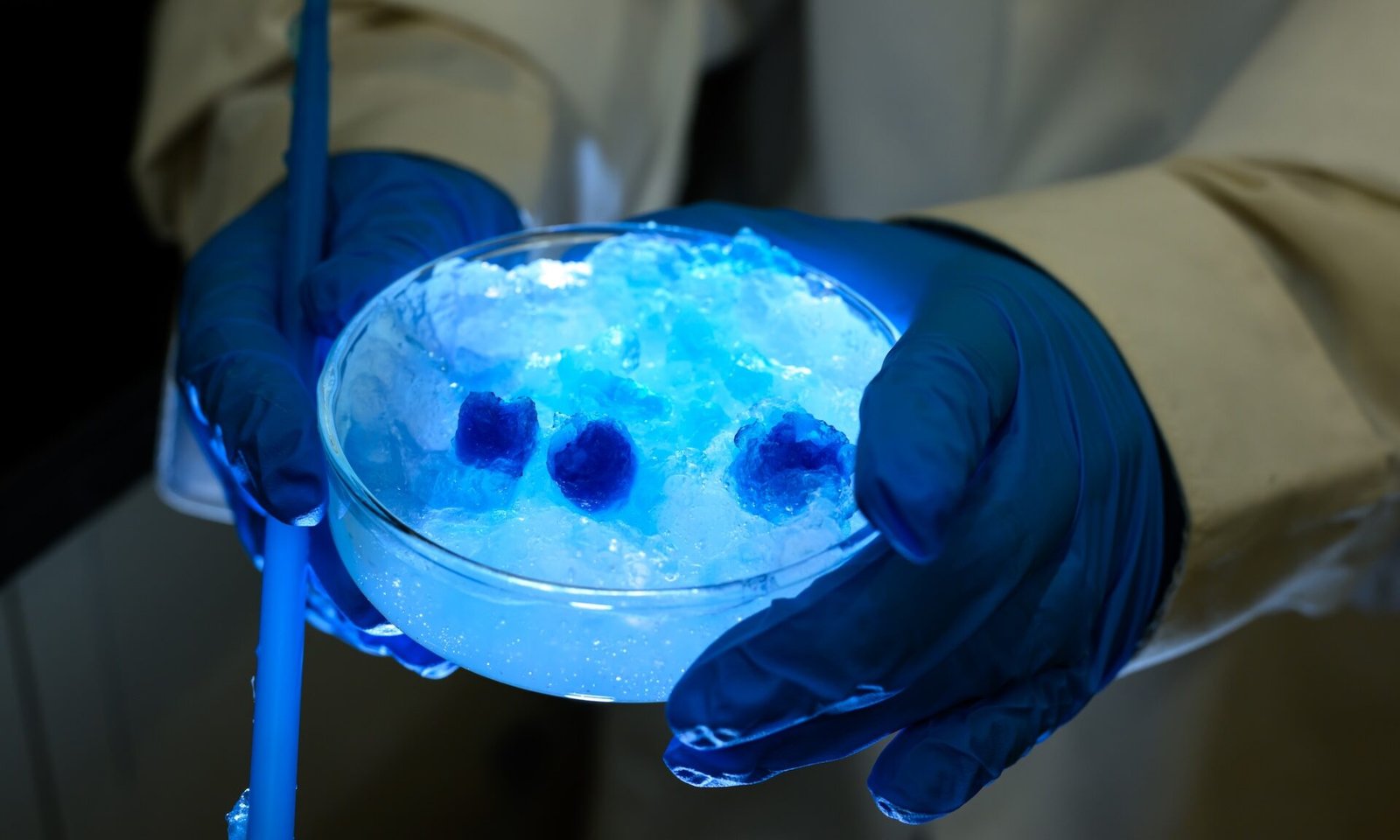
The modified desktop printer can create intricate geometries with hollow spaces and internal channels, including structures exceeding 100 layers. Under particular nutrient-supported laboratory conditions, bacteria embedded in the structures remained viable for at least 28 days.
What it did not do is print a transplantable human organ. The research concerns living bacterial materials, not replacement kidneys, hearts or lungs. Its importance lies in making experimental biological manufacturing more accessible, potentially helping smaller laboratories explore technologies once limited by expensive equipment.
How a $450 machine became a bioprinter
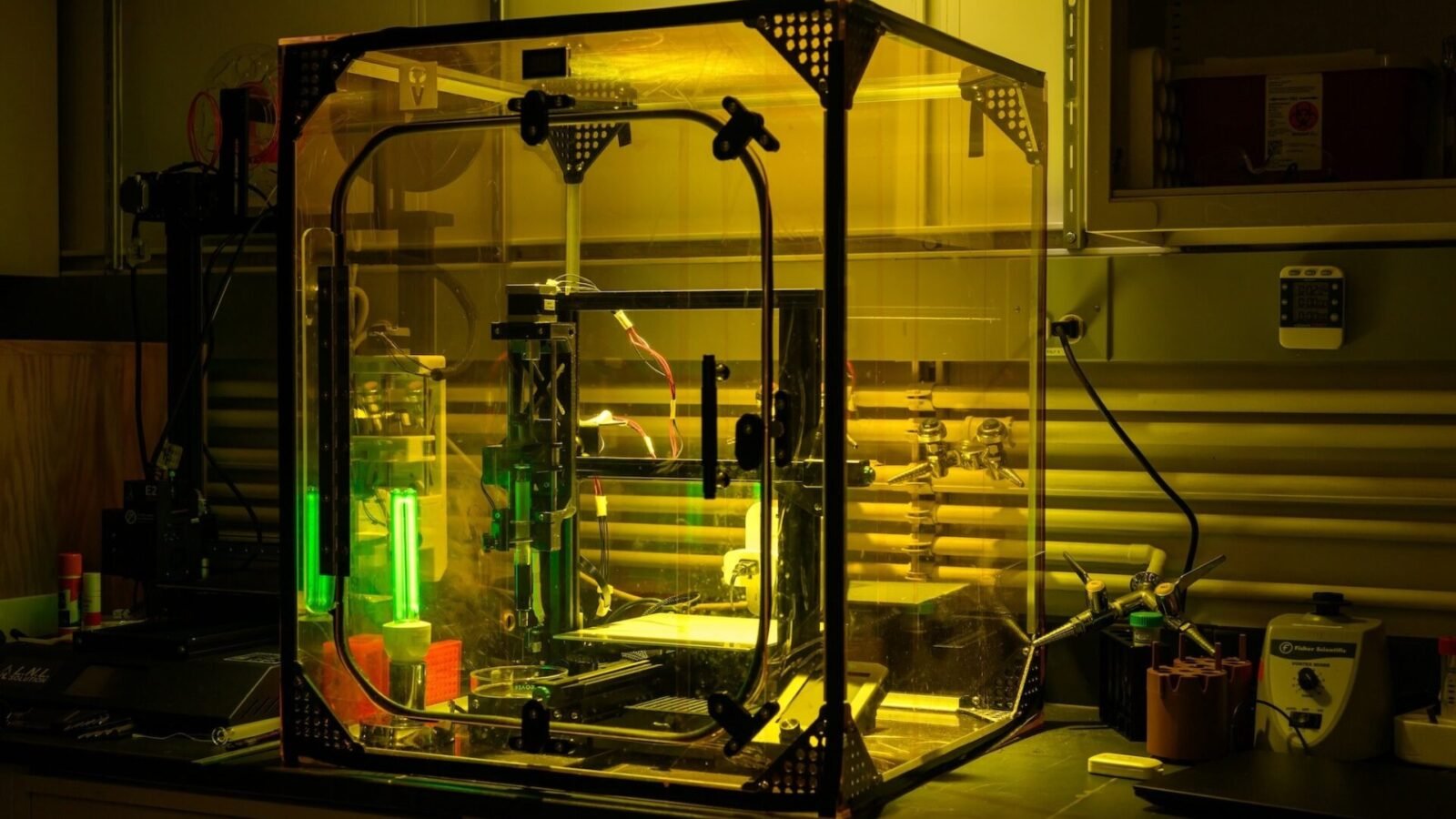
The team adapted a conventional Creality Ender 3 3D printer. Instead of melting plastic filament, a custom syringe pump delivers a mixture of living cells and polymer solution called bio-ink. Calcium ions in the support material cause the alginate-based bio-ink to form a gel, holding the cells in a designed three-dimensional shape.
The scientists developed gelatin- and agarose-based support slurries that hold delicate prints in place as new layers are deposited. The syringe mechanism can both extrude and retract bio-ink, reducing unwanted leakage between features. The study documented feature sizes near 260 micrometers, high aspect ratios approaching 8:1 and a substantial reduction in misplaced bacterial material.
The hardware design is available publicly on GitHub. But the $450 figure describes the printer and its modifications, not the cost of establishing a complete biological laboratory, including equipment for sterilization, training, biological materials, waste handling and safety oversight.
Why keeping the bacteria alive is a breakthrough—and a limitation
Manufacturing an inert object is fundamentally different from constructing a material whose function depends on living organisms. Bacteria need compatible environmental conditions and, for long survival, access to essential nutrients. The research team demonstrated that its slurry approach could maintain bacterial viability for at least four weeks when nutrients were supplied.
This result is important because living materials may eventually work as biological sensors, filtration components, experimental infection models or factories for useful compounds. But surviving for 28 days in a controlled experiment does not prove a material will work reliably for years in a river, medical facility or factory.
The medical future: better research now, possible treatments much later
Biofilms and antibiotic research
Bacteria often form biofilms—three-dimensional communities attached to surfaces and surrounded by a protective matrix. Some biofilms contribute to difficult-to-treat infections, while others are environmentally useful. Printing reproducible bacterial structures could help researchers examine how microorganisms organize themselves and respond to antimicrobial treatments.
In principle, standardized printed bacterial communities could make particular laboratory experiments easier to compare. Yet a laboratory biofilm is not the same as a complex infection inside a person. Any proposed medical benefit must be evaluated through independent experiments and, where appropriate, clinical studies.
Skin models and wound care
A separate branch of bioprinting seeks to arrange human cells into tissue-like structures. Researchers discussing Mayo Clinic’s 2026 work on printed human skin describe possible applications in wound research and regenerative medicine. Such models could help scientists investigate severe burns, ulcers and drug responses. That work is distinct from the Rochester bacterial printer and should not be presented as a product of the $450 system.
For a careful video introduction to this related medical field, see Mayo Clinic’s Tomorrow’s Cure presentation on 3D-bioprinted skin. It is a contextual medical video, not footage of the Rochester experiment.
The promise—and difficulty—of replacing organs
There is an urgent human reason to pursue organ-engineering research: as the U.S. Health Resources and Services Administration reported in 2026, more than 100,000 Americans have been awaiting organ transplants. Future tissue engineering might contribute to better treatments and, over a much longer horizon, replacement biological structures.
But a working human kidney or heart is not simply a recognizable shape. It requires specialized cells, blood vessels, functional tissue organization and dependable integration with the patient’s body. Researchers must also address immune responses, sterility and sustained performance. Whole-organ bioprinting remains an early research ambition, not a demonstrated clinical capability of this system.
The U.S. Food and Drug Administration’s overview of 3D printing in medicine distinguishes existing medical-device uses from emerging biological and tissue-based applications. Readers should not interpret this story as evidence that low-cost human organ printing is available or imminent.
Could living materials clean America’s water and industrial waste?
Microorganisms already perform important functions in wastewater treatment and natural nutrient cycles. A technology that positions particular bacteria in precisely designed geometries might eventually enable specialized filters, water-quality sensors or biological structures that help process certain pollutants.
For example, an engineered structure containing microorganisms could potentially expose more useful biological surface area to flowing water. Other research efforts investigate microbes that help break down selected polymers. The actual performance and safety of each application would depend on its organism, chemical conditions, surrounding ecosystem and containment design.
The Rochester paper does not establish that its printed structures can clean an entire waterway or eliminate general plastic pollution. Those are possible research directions, not measured outcomes.
Environmental justice matters here. Communities affected by industrial contamination—including Indigenous nations and underserved U.S. neighborhoods—deserve meaningful participation in decisions about experimental cleanup methods. A promise of remediation does not justify exposing people or ecosystems to poorly evaluated biological releases.
A scientific opportunity for community colleges and smaller labs
Traditional bioprinters can cost thousands or, for highly specialized commercial equipment, considerably more. Lowering the hardware price to approximately $450 may put one kind of biological fabrication within reach of institutions that cannot afford advanced commercial machinery.
Public universities, community colleges and independent researchers could use accessible systems for teaching and controlled laboratory experiments. Open hardware can also permit technical improvements to be shared rather than locked inside a proprietary platform.
But democratization is not automatic. A basic printer cannot replace trained laboratory personnel, biosafety infrastructure, biological reagents or institutional oversight. Funding disparities may persist even if the machine itself becomes affordable.
The next industrial frontier: products that remain biologically active
Conventional manufacturing transforms metals, plastics, wood or other inert materials into finished products. Engineered living materials offer another possibility: a product that contains cells capable of reacting to a chemical signal, producing a substance or changing behavior when its environment changes.
Scientists envision potential biological sensors, responsive materials and carefully controlled production systems. These applications remain at varying stages of research; the newly developed printer is an enabling tool, not proof that those industries are already operating at scale.
What makes living manufacturing unusual also makes it difficult. A material can grow, weaken, mutate, lose activity or die. Its behavior may depend on nutrients, moisture, temperature and time. Predictable manufacturing will require ways to measure and control those changes.
A crucial trade-off: More biological growth does not always mean a stronger product
One of the paper’s most revealing findings involved the relationship between bacterial activity and material strength. In some tests, nutrient-rich conditions promoted more extracellular matrix production while leaving printed structures mechanically softer or weaker. The authors discussed a tension between biological output and structural integrity. The published experiments show why this is more than a minor engineering detail.
For a future living filter or industrial component, the conditions that keep microbes productive may also degrade the supporting structure. Engineers may need to balance competing goals rather than simply maximize biological growth.
Who will own living manufacturing technology?
If engineered living materials become economically valuable, questions of patents, licensing and public benefit will grow. Intellectual-property rights may attach to specific microbes, manufacturing processes, biological formulations and applications.
The Rochester team’s public hardware instructions offer one model for sharing knowledge. Yet open printer plans do not automatically make every biological invention, specialized material or later commercial product free of restrictions.
Publicly funded research also raises a policy question: should basic tools and vital discoveries remain widely accessible, or will future products depend on restrictive licensing arrangements? The answer could affect who benefits from medical, environmental and industrial applications.
Access to biological resources, community consent and benefit-sharing may be particularly important when inventions draw upon organisms or ecological knowledge associated with Indigenous homelands. The existence of a low-cost printer does not settle those questions.
Biosecurity, ecological risks and the need for oversight
Affordable manufacturing equipment is not inherently dangerous. The Rochester experiment is not evidence of an uncontrolled biological organism or a biological weapon. Nevertheless, wider use of microbial engineering makes training, risk assessment, containment and safe waste disposal more important.
The CDC and NIH biosafety guidance emphasizes evaluating the organisms, procedures and laboratory conditions involved. Different microbes and experiments require different safeguards. Devices used outside controlled research settings raise separate questions about accidental releases, ecological effects and long-term maintenance.
For certain engineered microorganisms, the Environmental Protection Agency’s biotechnology regulations under the Toxic Substances Control Act establish review requirements. Regulatory pathways may need to evolve as living materials move from laboratory demonstrations into commercial applications.
A useful general rule is that a living product should have a safe failure mode. A system should be designed so that loss of nutrients, power, containment or performance does not create a new risk for patients, workers or the environment.
What could happen over the next 50 years?
Any timeline for biotechnology requires caution. Equipment can become cheap long before a particular application becomes safe, effective and economically viable. The following scenarios outline conceivable directions; they are not forecasts made by the Rochester researchers.
| Period | Plausible developments—not predictions | Critical barriers |
|---|---|---|
| 2026–2030 | Wider laboratory adoption, biofilm experiments and teaching applications | Training, independent replication and safe handling |
| 2030–2040 | Possible niche biological filters, biosensors and industrial prototypes | Containment, durability and cost-effectiveness |
| 2040–2050 | Potential specialized living-material products and better disease models | Long-term reliability, regulation and equitable access |
| 2050–2075 | Further integration of engineered living materials into some manufacturing sectors | Ecological safety, governance and biological variability |
Even over several decades, successful fabrication of complex bacterial materials will not automatically lead to printable transplant organs. Human tissue manufacturing is a separate, much more biologically demanding development path.
Would reliance on living technology create new vulnerabilities?
A future factory or treatment plant that relies on engineered living material may depend on nutrient supply, environmental conditions and regular checks for biological changes. This could introduce vulnerabilities unfamiliar to conventional industrial equipment.
Technical standards may therefore need to cover biological stability, safe replacement, detection of unexpected changes and secure disposal. Redundant mechanical systems and continuous monitoring could become important where failure would affect public health or essential services.
Does printing life change our moral obligations?
The Rochester team printed structures containing bacteria, not conscious humans. There is no scientific basis for claiming that its bacterial constructs possess personhood or awareness.
Other branches of biotechnology may eventually create increasingly complex human tissues, including nervous-system models. Such work raises different questions involving consent, biological material sourcing, research oversight and, if evidence warrants it in the future, possible moral status. Those debates should not be projected backward onto this bacterial study.
What must be proven before real-world use
The next scientific priorities include independent replication, better understanding of long-term survival, comparison across strains and materials, and measurement of real-world performance. Each prospective application will require its own safety and cost-effectiveness evidence.
Clinical products need appropriate medical validation. Environmental products need ecological evaluation. Commercial manufacturing systems need stable, reproducible processes. Public institutions also must decide how to distribute access and ensure affected communities have a voice.
The long view: Humanity may learn to manufacture with life
The $450 printer is a relatively modest piece of machinery. Its significance lies in a larger shift: the possibility of making biological materials whose functions depend on living organisms, and enabling more researchers to explore that possibility.
That future could contribute to better disease models, specialized cleanup systems and new manufacturing methods. It could also create challenges involving ecosystem protection, unequal access, biological reliability and ownership of inventions.
The central question is not simply whether humanity can manufacture living structures. It is whether we can make them safe, useful, controllable and broadly beneficial.
Sources and research notes
Primary paper: Ram S. Gona and colleagues, “3D Bioprinting of Engineered Living Materials in Support Slurries for Complex Free-Standing Structures,” ACS Applied Polymer Materials (2026). Published online August 27, 2026; open access under CC BY 4.0.
Original announcement: University of Rochester, “Bioprinting on a budget,” November 13, 2026. Photographs by J. Adam Fenster / University of Rochester, used for news reporting with credit under the university’s photography guidance.
Hardware repository: open-source technical instructions. Related medical context: Mayo Clinic bioprinted skin research and accompanying video; FDA 3D printing applications; HRSA organ transplant needs. Laboratory and environmental safeguards: CDC/NIH biosafety guidance and EPA biotechnology rules.
Editorial note: The peer-reviewed results concern living bacterial materials under laboratory conditions. Discussions of organs, environmental systems, ownership and long-term impacts are contextual analysis and potential future applications, not outcomes demonstrated by this study.