Researchers aboard China’s Tiangong space station have reported an extraordinary low-temperature benchmark: an ultracold atomic gas with an equivalent temperature of 9.7 picokelvins, or just 9.7 trillionths of a kelvin above absolute zero.
The result appears in a peer-reviewed study published November 5, 2026, in Science. The team produced a Bose–Einstein condensate of roughly 20,000 rubidium-87 atoms and tracked the cloud’s free expansion for seven seconds. The experiment may help advance quantum sensing and precision tests of fundamental physics. Read the original Science paper.
The headline comparison is striking: the universe’s cosmic microwave background is about 2.7 kelvins, approximately 280 billion times the measured central value. But this is not the temperature of the space station or everything inside it. The 9.7-picokelvin figure is an equivalent temperature derived from the gas cloud’s extremely slow expansion, rather than a conventional measurement of a room or refrigerator. The Chinese Academy of Sciences explains that distinction.
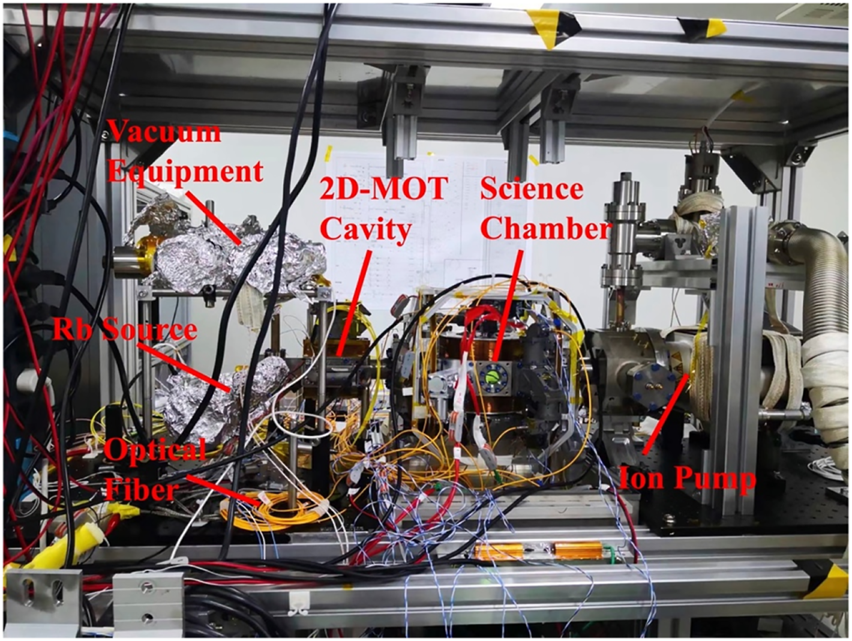
Featured image: A 2022 photograph of the real ground pre-prototype for Tiangong’s Cold Atom Physics Rack, not an image of the 2026 measurement. Credit: Hui Li and coauthors, Frontiers in Physics, Figure 3; CC BY 4.0.
How the researchers made an atomic gas so cold
The experiment used an optical dipole trap: laser beams that confine and manipulate a dilute cloud of atoms. The research group first used laser cooling and evaporative cooling, which remove energy from the atoms, then moved the condensed gas into a wider, weaker optical trap. Controlling magnetic-field gradients and keeping lasers stable also mattered.
Once released, the atomic cloud expanded exceptionally slowly in microgravity. By measuring how its size changed, researchers estimated the equivalent expansion temperature. The central result was 9.7 picokelvins; reported uncertainty puts the temperature at roughly 7.0 to 12.9 picokelvins. Peking University’s November 6 research announcement describes the team and experimental system.
What is a Bose–Einstein condensate?
A Bose–Einstein condensate forms when certain atoms are cooled to extraordinarily low energies and begin behaving collectively as a single quantum system. Scientists use condensates to investigate wave-like properties of matter that are usually difficult to observe at larger scales.
Absolute zero is 0 kelvin, or −273.15 degrees Celsius. It is a fundamental temperature limit; researchers are not claiming to have reached or crossed it. A picokelvin is one trillionth of a kelvin.
How does the new result compare with the previous record?
The study identifies a previous equivalent-temperature benchmark of 38 picokelvins, obtained in an atom-chip experiment under microgravity, with roughly two seconds of free expansion. The new central value is about four times lower, while the observation interval extended to seven seconds. The difference is important because longer observation times can improve some quantum-measurement techniques. Research abstract indexed by the U.S. National Library of Medicine.
The American connection: NASA’s Cold Atom Laboratory
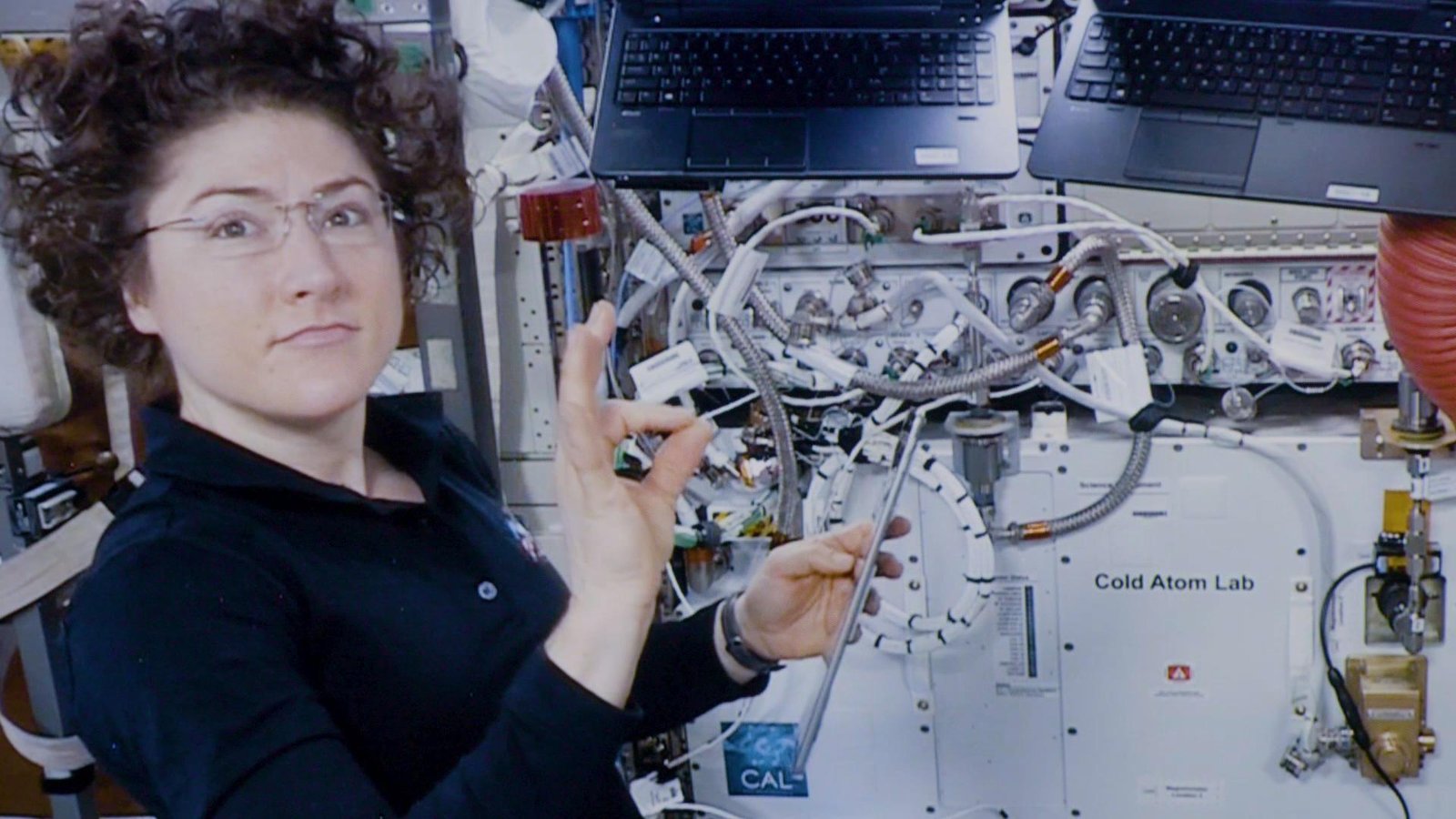
The technology has a direct U.S. counterpart. NASA’s Cold Atom Laboratory has operated aboard the International Space Station since 2018 and was the first facility to create Bose–Einstein condensates in Earth orbit. NASA uses it to explore quantum behavior in microgravity, including potential future sensors for gravity, acceleration and navigation.
In June 2026, NASA reported upgrades to the Cold Atom Laboratory intended to broaden the measurements the experiment can perform. Its system is separate from the Chinese experiment and should not be confused with the Tiangong record.
What could scientists learn next?
Ultracold gases may support more sensitive matter-wave interferometers and tests of the equivalence principle, a basic idea behind Einstein’s theory of gravity. Scientists also hope to use these platforms to examine unfamiliar states of quantum matter.
Those are research prospects, not technologies already demonstrated by this temperature record. Engineering a reliable sensor involves controlling the atoms, shielding experiments from noise and repeatedly obtaining accurate measurements. The new result opens possibilities rather than proving all of them.
Video: NASA explains why ultracold atoms belong in space
NASA’s Jet Propulsion Laboratory published the following educational video in August 2024. It explains Bose–Einstein condensates and microgravity research aboard the ISS; it is not footage of the Chinese record experiment.
Video: “How Atoms Are Defying Gravity in NASA’s Cold Atom Lab” — NASA/JPL (2024).
Sources and further reading
- Science (Nov. 5, 2026): Quantum gases below 10 picokelvin in space.
- Peking University: Official research announcement (Nov. 6, 2026).
- Chinese Academy of Sciences: Record-low atomic cooling explained (Nov. 6, 2026).
- Science News: Independent coverage (Nov. 5, 2026).
- Frontiers in Physics (2022): Research team’s ground prototype, Figure 3 (CC BY 4.0).
- NASA: Cold Atom Laboratory mission.
- NASA: June 2026 lab upgrade.