Khemetic Nation News Network | Science / Khemetic Biotech Desk | October 13, 2026
A brief flash of radio energy from the early universe has become an unusually powerful scientific clue. An international research team used South Africa’s MeerKAT radio telescope and NASA’s James Webb Space Telescope to identify the host galaxy of the most distant fast radio burst located so far. The peer-reviewed findings were published in Science on October 8, 2026.
A 2024 signal explained by new 2026 analysis
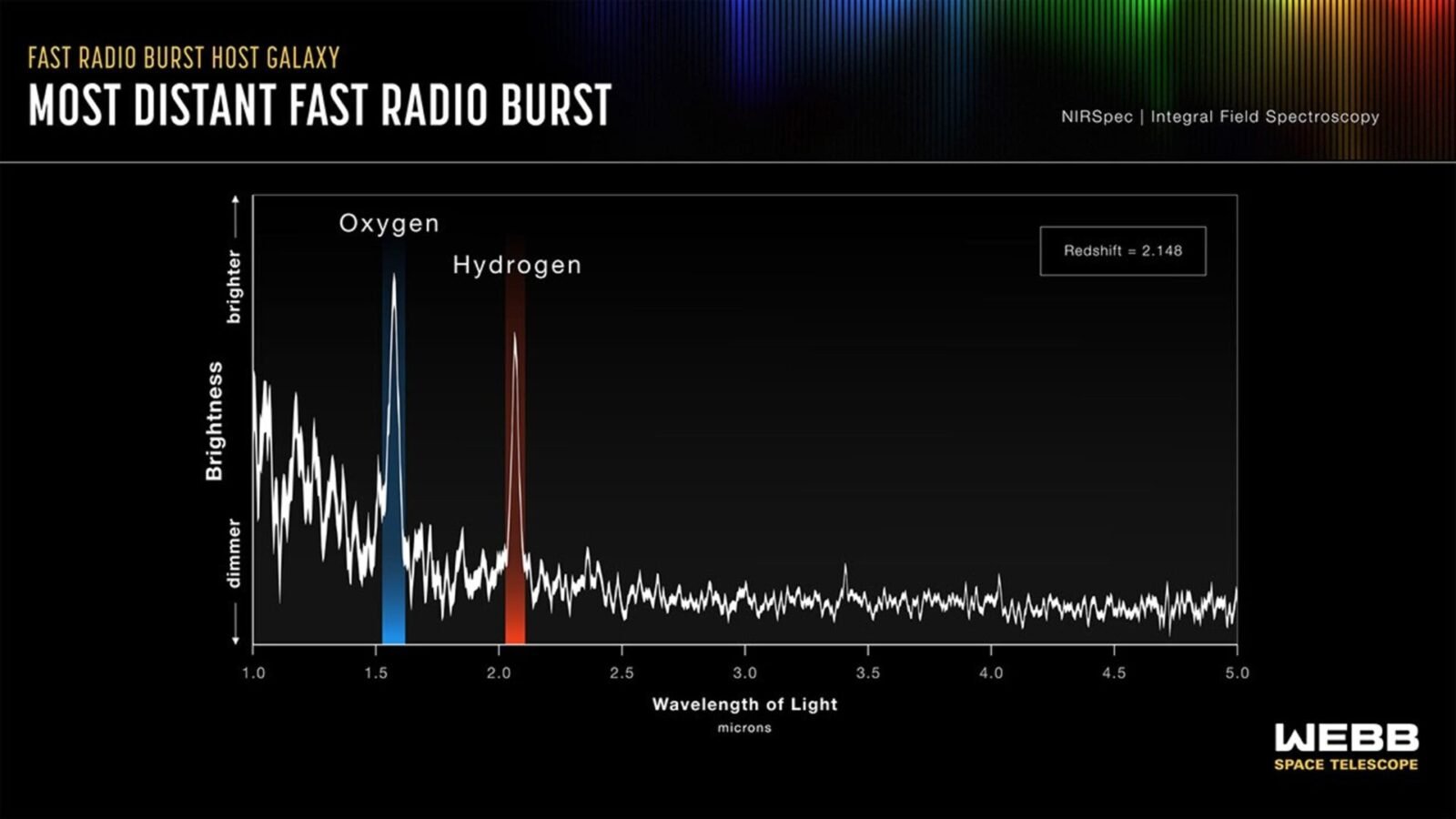
The radio signal, designated FRB 20240304B, was detected March 4, 2024. Its study is news in 2026 because researchers have now confirmed the host galaxy’s distance using Webb’s near-infrared imaging and spectroscopy. The galaxy has a measured redshift of 2.148, placing the burst at a time when the universe was only about three billion years old, according to NASA’s October 8 explanation.
Fast radio bursts are millisecond-long pulses whose precise causes are still under investigation. The surprising detail is the host: rather than the large galaxy the team expected, Webb revealed a small, actively star-forming dwarf galaxy. The researchers report that it is much less massive than the typical hosts previously examined.
Why the galaxy changes the question
Some FRB theories involve collisions between neutron stars, which may require a long interval to develop. Others involve young magnetars—highly magnetic neutron stars that can form after massive stellar explosions. Finding a burst in a young, active galaxy is more consistent with some rapid-formation scenarios, including magnetars, but it does not conclusively establish the source of every fast radio burst.
Scientists can also use the journey of a radio signal to probe matter between galaxies. This particular burst showed signatures associated with structures along its path, including the Virgo Cluster. That makes such signals tools not only for investigating their origins but also for mapping material that is otherwise difficult to see.
A careful comparison with the Book of Maat
The Book of Maat (2018 edition) includes The Pyramid Text, where stars and the heavens form part of the spiritual language of endurance and cosmic order (printed pages 28–29). That literature reflects a philosophical and religious approach to humanity’s relationship with the sky. Webb’s result is different: it rests on radio measurements, infrared observations, spectroscopy and testable theories about stellar remnants.
The parallel is curiosity about the heavens, not scientific prediction. Ancient Khemetic writings provide a meaningful cultural lens for looking upward, while modern astronomy explains what a particular signal reveals—and where uncertainty remains.
Sources and context
Caleb and colleagues, Science, October 8, 2026; NASA Webb science release, October 8, 2026; Research preprint first posted August 2025.
Editorial note: The Book of Maat section is a clearly marked philosophical comparison; it does not imply ancient texts predicted this astrophysical finding.