An independent musician’s struggle to recover her own recording from YouTube has raised new questions about copyright enforcement, artificial intelligence and how creators can challenge ownership claims.
Writer and musician Samantha Shokin recorded a roughly 50-second a cappella performance of the Bulgarian folk song Bre Petrunko during the COVID-19 pandemic. After she posted the recording on YouTube, it accumulated about 125,000 views and was sampled by electronic-music producers. In October 2026, she discovered that YouTube had removed the video following a copyright complaint from Media Nov Records, according to reporting published by 404 Media on November 16.
The recording was ultimately restored after the company withdrew its removal request following inquiries from 404 Media. That resolution did not settle all questions about the rights the company asserted or the way YouTube reviews contested takedowns.
Featured image: YouTube’s San Bruno, California sign photographed in 2012, used as a contextual image of the platform (not Shokin). Photo: jm3 / Flickr, CC BY-SA 2.0.
From a home recording to a widely sampled voice
Shokin first shared her solo performance on SoundCloud and later uploaded it to YouTube. She told 404 Media that an increase in comments led her to discover that DJs and electronic artists had incorporated her voice into numerous recordings, including tracks with millions of listens.
She traced some of those uses to a sample package sold through Loopmasters. According to Shokin’s account to 404 Media, the distributor apologized and arranged for her to receive royalties from the sample package. That earlier dispute was separate from the YouTube removal.
What Media Nov Records told investigators
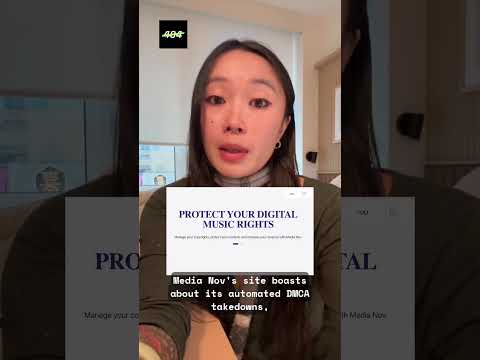
Media Nov Records markets music distribution and rights-management services, including automated Digital Millennium Copyright Act enforcement, Content ID management and AI-assisted detection. 404 Media said it identified four YouTube channels managed by the company, with hundreds of videos featuring electronic music and, in many cases, AI-generated artwork.
The company told 404 Media that it operates 500 YouTube channels. That number is the company’s statement, not an independently verified count of all its channels. Media Nov also said it works with various musicians and other creators.
Shokin said she struggled to contact the company or resolve the removal through YouTube’s counter-notification process. Media Nov later said messages from Shokin and Loopmasters had been diverted to its spam folder. Asked by 404 Media which specific work in its catalog triggered the notice, the company did not provide an answer in the published account.
Traditional songs, arrangements and sound recordings are different rights

Bre Petrunko is a traditional folk song with no known original composer. Bulgarian composer Philip Koutev popularized a twentieth-century arrangement. The existence of rights in an arrangement or a particular recording does not automatically establish ownership of another person’s separate performance.
The U.S. Copyright Office explains the distinction between a musical work and a sound recording. Whether a specific performance infringes any protected arrangement depends on the facts; the published record here does not establish that Media Nov owned Shokin’s vocal recording.
Media Nov told Shokin and 404 Media that its claimed rights related to musical content associated with the song. It also said that retracting the removal notice would not waive any rights it might have and indicated it intended to pursue legal proceedings. The original investigation did not establish a court ruling on the dispute.
Why a removal request is not the same as Content ID
YouTube distinguishes automated Content ID claims from formal copyright removal requests. A Content ID claim may affect monetization, tracking or access, but a removal request that appears legally valid may result in a video being taken down and a strike against the uploader. See YouTube’s explanation of copyright removal requests and its counter-notification procedure.
YouTube says it uses automated systems and human reviewers in evaluating takedown requests. Shokin told 404 Media that two counter-notification attempts did not succeed. Her experience raises questions about how readily small creators can obtain a meaningful review when a claimant does not respond.
The video returns after journalists intervene
After 404 Media contacted Media Nov, the company asked Shokin to provide documentation supporting her ownership of the recording. Soon afterward, it notified her and the publication that it was retracting the copyright removal request. Roughly 24 hours later, her original recording returned to YouTube.
A YouTube spokesperson confirmed to 404 Media that the video was reinstated after the claimant withdrew its complaint. Shokin said she felt vindicated, while expressing frustration that journalistic inquiries appeared necessary to get a response.
Her case illustrates a continuing challenge for independent U.S. musicians, educators and video creators: effective copyright protection must also include accessible ways to correct mistaken ownership assertions. The immediate takedown was reversed, but the specific basis for the original complaint remained unanswered in the published investigation.
Original reporting, video and references
Watch: 404 Media explains the copyright dispute
- 404 Media, Matthew Gault, November 16, 2026 — original interviews, investigation and company response
- Watch 404 Media’s source video on YouTube Shorts
- Samantha Shokin’s Bre Petrunko performance on YouTube
- YouTube Help — copyright removal requests
- YouTube Help — counter notifications
- U.S. Copyright Office — musical works and sound recordings
Reporting note: This article draws on 404 Media’s original reporting and official copyright guidance. Khemetic.News did not independently interview the parties. The 500-channel figure is attributed to Media Nov Records and has not been independently audited here.