Khemetic Nation News Network | Science / Khemetic Biotech Desk
Science update | October 14, 2026
Scientists investigating one of the universe’s biggest mysteries have reported a major technical advance: the Canadian Hydrogen Intensity Mapping Experiment, known as CHIME, has detected the collective radio glow of distant hydrogen using its own measurements, without needing to match the signal with a separate galaxy survey. Yale highlighted the work on October 12, following its earlier announcement by the research collaborators.
Why invisible hydrogen matters
Scientists cannot watch dark energy directly. Instead, they study how matter is distributed across immense distances and how cosmic expansion changes over time. CHIME’s technique, called hydrogen intensity mapping, measures overlapping radio emission from neutral hydrogen rather than requiring a photograph or individual position measurement of every distant galaxy.
The team recovered a signal corresponding to an era when the universe was roughly five billion years old. Researchers applied data-processing methods to radio observations to extract an exceedingly faint astronomical signal from much stronger foregrounds and instrumental effects. Their studies appear in The Astrophysical Journal.
What the discovery does—and does not—prove
The breakthrough is a new way to measure cosmic structure, not a direct discovery of the nature of dark energy. Yale physicist Laura Newburgh, a co-author, emphasized that this particular result does not yet make a measurement of cosmic expansion itself. The longer-term goal is to use the technique over a wider sweep of cosmic history to test competing explanations of the universe’s acceleration.
That distinction matters amid other recent research, including results from the Dark Energy Spectroscopic Instrument (DESI), which show why alternative models need careful scrutiny. Measuring more accurately is not the same as having the final answer.
A measured connection to the Book of Maat
In the 2018 Book of Maat, The Seven Principles of Maat (printed page 156) includes the Principle of Correspondence, which explores relationships between what is known and what is hidden. This offers a philosophical parallel to the use of measurable signals to investigate an unseen cosmic history. It does not establish a scientific prediction of CHIME’s radio measurement, nor does it demonstrate that dark energy is a spiritual force.
What to watch next
The next test is whether enlarged and more precise hydrogen maps can meaningfully constrain the universe’s expansion rate and competing dark-energy models. The signal is newly accessible; its cosmological implications remain under investigation.
Sources
Yale Department of Physics — CHIME’s time to shine (Oct. 12, 2026)
MIT Kavli Institute / University of British Columbia — CHIME research announcement (Sep. 28, 2026)
DESI collaboration — related dark-energy measurements (July 2026)
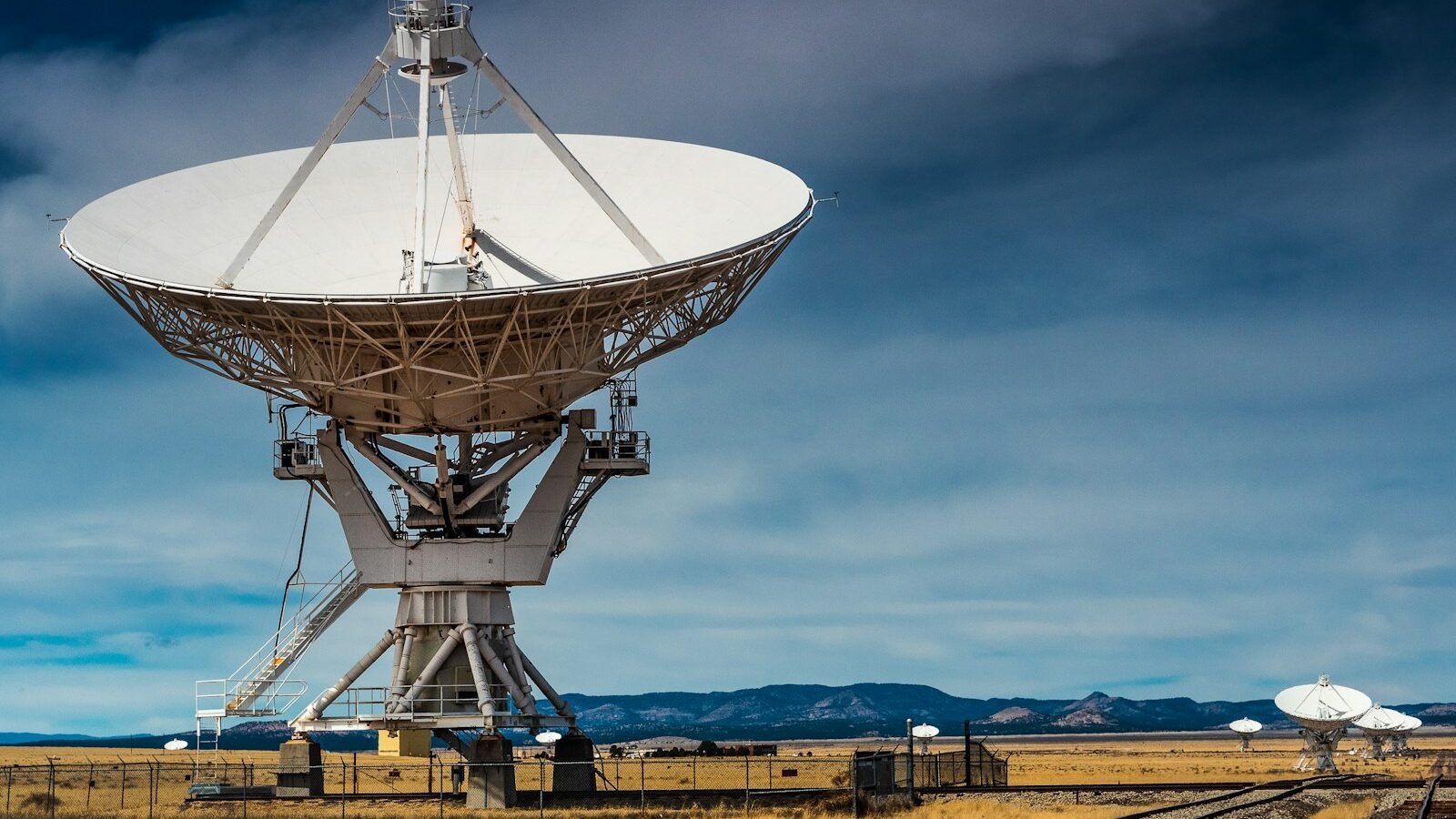
Featured photo: Raychel Sanner / Unsplash, showing New Mexico’s Very Large Array as an illustrative radio-astronomy image. It is not a photo of CHIME.