Khemetic Nation News Network | Science Desk | October 14, 2026
At the center of the Perseus galaxy cluster, astronomers have identified a remarkable sequence: an intense X-ray flare near a supermassive black hole, followed roughly 300 days later by a rise in radio emission. The finding could help scientists investigate how matter falling toward a black hole is connected to the immense jets it launches into space. But researchers have not yet established that the two events share a single cause.
What astronomers observed
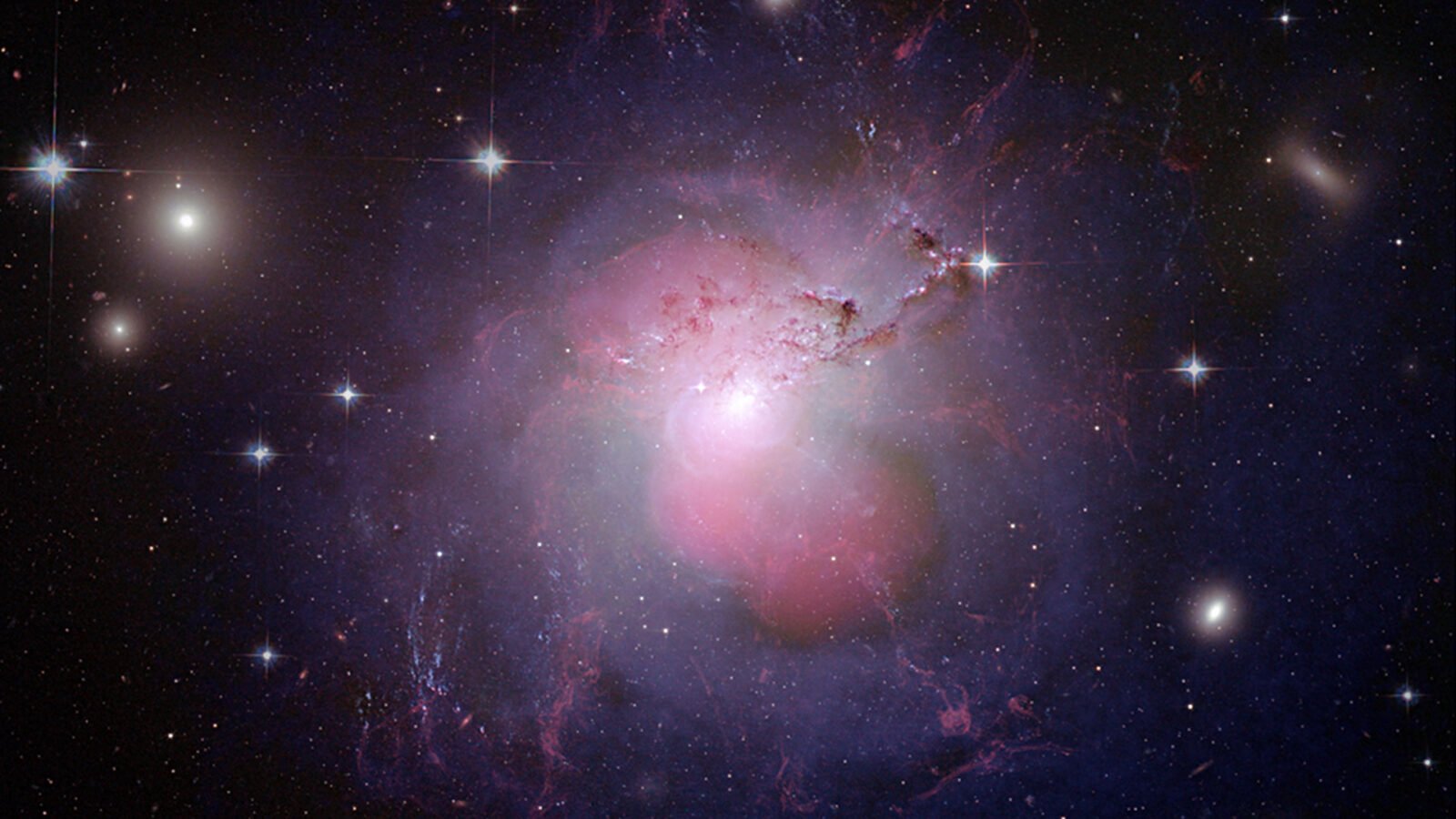
The galaxy NGC 1275, also called Perseus A, contains an active galactic nucleus powered by a supermassive black hole. Its jets interact with hot gas throughout the surrounding galaxy cluster, making the system a useful place to study how energetic black holes influence their environments.
In a study submitted in August 2026 and accepted for publication in The Astrophysical Journal Letters, Sarah Ketchum and colleagues analyzed roughly two decades of observations from NASA’s Neil Gehrels Swift Observatory, together with radio monitoring. They found that the X-ray emission brightened by about a factor of two over a period of days beginning on February 21, 2023. Radio observations at 43 gigahertz showed enhanced emission about 300 days later.
The researchers modeled the persistent glow of hot gas in the Perseus cluster so they could more reliably isolate changes in radiation from NGC 1275’s active center. Their result appears in the original research paper, “X-ray Flaring and Variability in NGC 1275, the Heart of the Perseus Cluster.”
Is the delay a message from the black hole?
One possibility is that changes near the black hole take time to become visible farther along a jet. If future observations support that interpretation, the delay could offer clues about how energy moves from the accretion flow around a black hole into its radio-emitting outflows.
For now, the approximately 300-day interval is a possible connection, not a confirmed travel time. The observations were not continuous enough to establish a causal chain, and other activity could have occurred between measurements. The X-ray flare’s behavior also did not match simple predictions for a star being torn apart in a tidal disruption event. More coordinated observations will be needed to distinguish among explanations.
Why scientists are interested
Radio jets from active galaxies do more than produce spectacular astronomical images. Their energy can inflate enormous cavities in surrounding hot gas and influence how galaxy clusters evolve. Learning how the accretion flow and jets communicate could improve models of black-hole activity, galaxy growth, and the wider cosmic environment.
A perspective from the Book of Maat
The Book of Maat (2018 edition, printed p. 156, “The Seven Principles of Maat”) discusses the Principle of Vibration, describing a worldview in which motion and vibration are fundamental features of existence. The same section’s Principle of Correspondence encourages readers to examine relationships across different levels of nature.
As a philosophical comparison, the observation of X-ray changes and later radio activity invites questions about how apparently separate phenomena might be connected. The distinction matters: the Book of Maat offers a spiritual and philosophical interpretation of reality, while the NGC 1275 study measures electromagnetic radiation and tests physical explanations. The observed signals do not constitute scientific confirmation of the book’s spiritual claims.
The broader lesson is the value of careful observation. A pattern may prompt a hypothesis, but evidence must determine whether the connection is real.
Sources and image credit
Ketchum and colleagues, original research preprint (August 13, 2026); Space.com science report (October 2026); ESA/Hubble: NGC 1275 multi-wavelength composite.
Featured image: archival multi-wavelength composite of NGC 1275, not a photograph of the 2023 flare. Image credit: NASA, ESA, NRAO and L. Frattare (STScI). Science Credit: X-ray: NASA/CXC/IoA/A.Fabian et al.; Radio: NRAO/VLA/G. Taylor; Optical: NASA, ESA, the Hubble Heritage (STScI/AURA)-ESA/Hubble Collaboration, and A. Fabian (Institute of Astronomy, University of Cambridge, UK).
Editorial note: The Book of Maat comparison is cultural and philosophical commentary presented separately from the scientific findings.