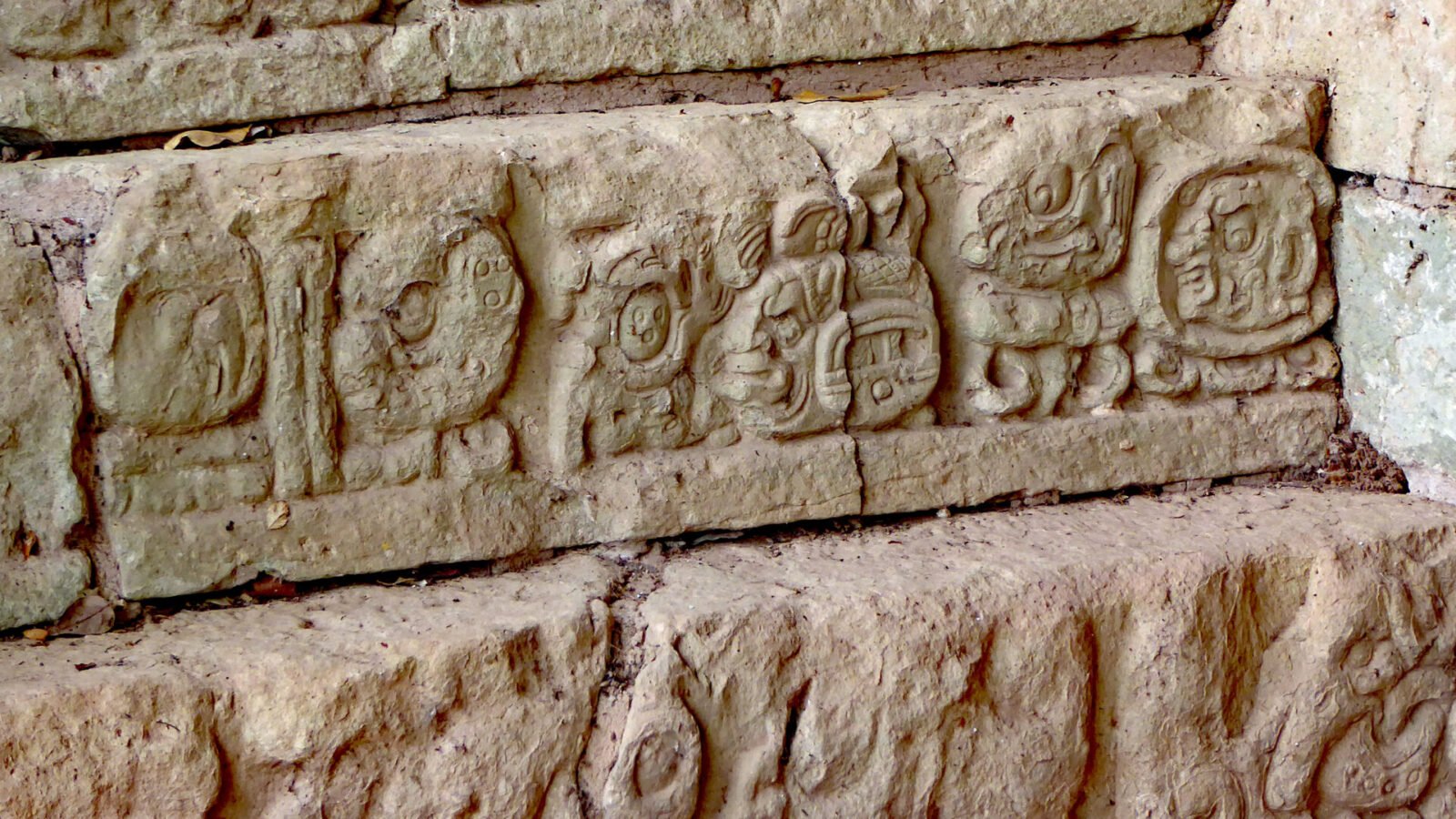
At Copán in western Honduras, a monumental staircase preserves a royal history in carved signs. Reading it requires attention to both ancient writing and modern reconstruction: the stones are original, but much of their present arrangement was assembled after collapse.
By KNN History & Restoration Desk
A Central American center of Maya writing
Near Guatemala’s border, Copán was a major political and ceremonial center in the southeastern Maya region. Its plazas, temples, ballcourt and sculptured monuments place the stairway within a much larger urban setting. UNESCO’s World Heritage account identifies the inscription as a defining achievement of the site, recognized on the World Heritage List in 1980.
UNESCO traces the dynasty to Yax K’uk’ Mo’ in the fifth century and describes a succession of sixteen rulers. The stairway therefore belongs to a particular kingdom’s historical tradition. It should not be treated as a single narrative representing every Maya community across Mexico and Central America.
Royal remembrance, carved into architecture
The Getty Conservation Institute’s project account describes an eighth-century monument built in two stages, whose inscription spans roughly four centuries of dynastic history. Writing on stair risers made the record part of the architecture itself.
According to Harvard’s Peabody Museum research summary, an earlier, shorter inscription commemorated Copán’s twelfth ruler and referred to his burial; additions were dedicated in 756 CE. The museum counts more than 1,100 glyph blocks across 63 steps. These are blocks of writing, not an equivalent number of alphabetic letters.
A royal inscription is evidence of how a court presented its past. It deserves to be read alongside excavated buildings, burials and other monuments rather than assumed to provide an impartial account of everyone who lived in the valley.
Original stones, reconstructed order
Getty reports that only the bottom fifteen steps remained in their original positions when archaeologists investigated the staircase. Fallen blocks were reinstalled in a twentieth-century reconstruction. Getty dates that work to 1937–1940; Harvard gives the broader interval 1937–1942. Both accounts establish the essential distinction: today’s staircase combines surviving ancient placement with later reassembly.
The visible sequence cannot simply be read as though every block still occupies its ancient location. That is a problem of archaeological context as well as decipherment. An identifiable sign may survive on a displaced stone while its relationship to neighboring passages remains uncertain.
Decipherment meets digital archaeology
Harvard reports that specialists can read about 80 percent of the text, while work continues on restoring its reading order. That estimate is an institutional research assessment, not a claim that the entire inscription has been securely reconstructed.
High-resolution scanning undertaken in 2008–2012 supports drawings, comparison and a small physical model for testing arrangements. Early glass-plate photographs also preserve details subsequently eroded. Excavations beneath Structure 26, the stairway’s supporting pyramid, revealed earlier buildings and royal monuments, providing independent architectural context for the written history.
Conservation protects the ability to read
Getty and the Honduran Institute of Anthropology and History investigated the stone’s condition through archival comparisons, material analysis and environmental monitoring. They examined biological growth, moisture and repair materials, then tested stabilization and mortar treatments. Protective sheltering is part of that preventive approach: preserving a carved surface also preserves evidence for future readings.
The institutions’ published project histories document work over many years. They are not announcements of a new discovery, nor do they establish that every proposed conservation measure has now been completed.
For a complementary view of archaeological methods, read KNN’s explanation of LiDAR mapping in Maya landscapes. More regional coverage appears in History & Restoration.
Sources and photograph
- UNESCO: Maya Site of Copan — regional significance and World Heritage context.
- Peabody Museum: Copan’s Hieroglyphic Stairway — inscriptions, archaeology and digital documentation.
- Getty: Hieroglyphic Stairway at Copán — reconstruction and conservation research.
Featured photograph: Hans Birger Nilsen, “Hieroglyphic Stairway of Copán,” November 16, 2017, via Wikimedia Commons, CC BY-SA 2.0. No editorial alterations; display sizes may vary. Photograph license applies to the image. Sources checked October 22, 2026.