
Research retrospective | Original study published January 24, 2024
At a depth where sunlight never reaches the seafloor, scientists recovered tiny, jet-black spheres from rocks in the northwestern Pacific Ocean. They looked like eggs of an unknown animal. Laboratory study revealed that they were protective capsules containing developing flatworms—and offered an unusually clear look at reproduction in one of the ocean’s least accessible environments.
The capsules were recovered at depths of 6,176 to 6,200 meters (roughly 3.8 miles) on the slope of the Kuril–Kamchatka Trench. Japanese researchers Keiichi Kakui and Aoi Tsuyuki documented the finding in a study published January 24, 2024, in the peer-reviewed journal Biology Letters. The report is being recirculated online, but the research is not a new discovery from November 2026.
What scientists recovered from the seafloor
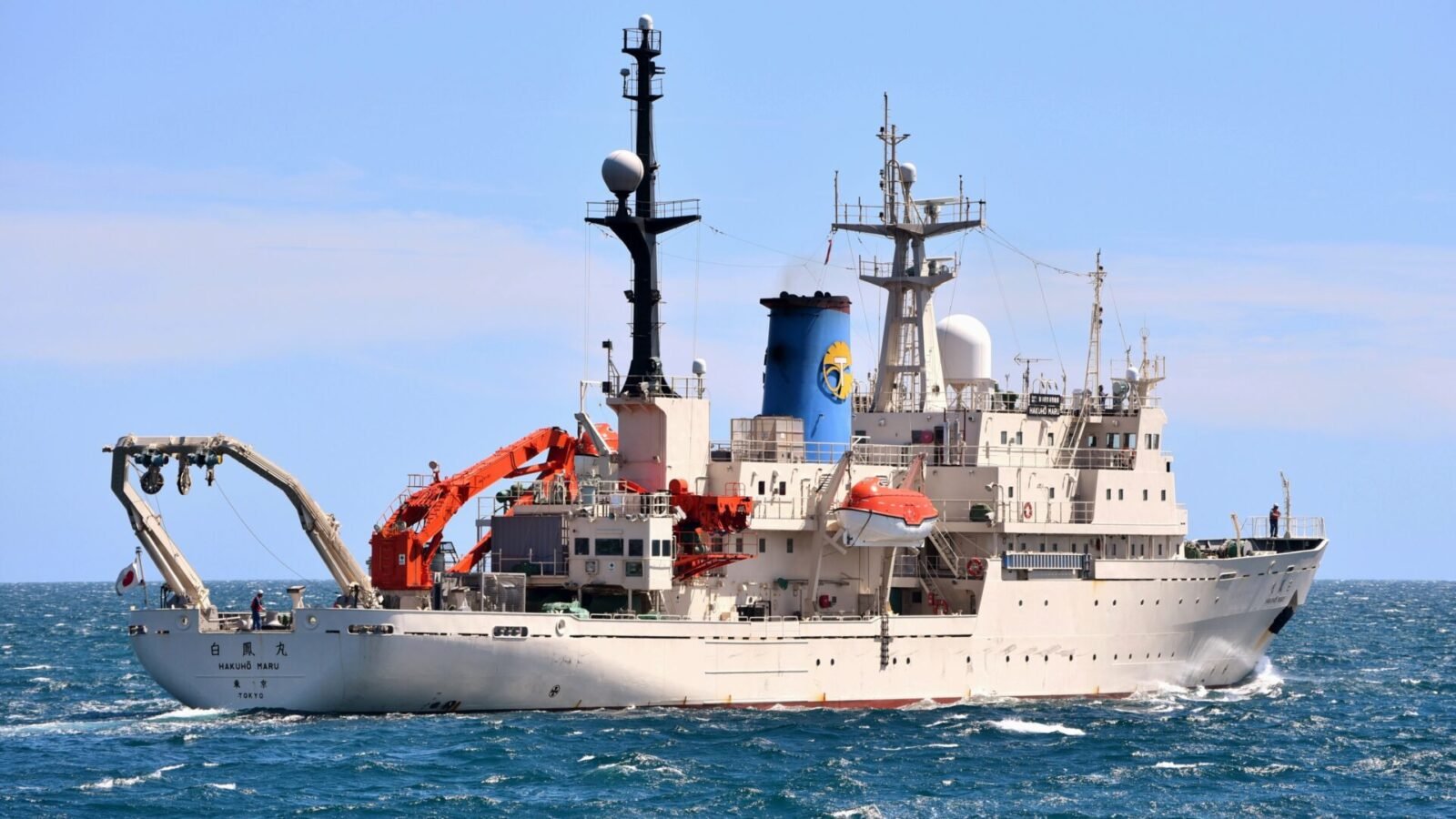
During a September 21, 2023, survey aboard the Japanese research vessel Hakuho-maru, rock fragments with attached capsules were collected using a beam trawl, according to the published study. University of Tokyo researcher Yasunori Kano drew the research team’s attention to the unusual objects. The nearly spherical black capsules were about three millimeters across, and four intact capsules were examined at Hokkaido University.
When the capsules were opened, they contained delicate, developing flatworms suspended in fluid. Each held between three and seven individuals, at either an earlier rounded stage or a later worm-shaped stage. Their appearance explained why the black objects were more accurately described as egg capsules or cocoons, rather than eggs of a fish or another large sea animal.
The researchers documented both the capsule structure and the developing organisms. Scientific photographs of the actual specimens appear in the original Biology Letters study.
DNA provided the crucial identification
Visual inspection alone could not establish which animals had produced the capsules. The researchers therefore analyzed ribosomal RNA gene sequences, including the 18S and 28S regions, from specimens recovered inside.
The molecular evidence placed them within Maricola, a suborder of marine flatworms in the order Tricladida. The team reported that the finding represented the deepest documented occurrence of free-living flatworms at the time of publication, as well as the first description of their early developmental stages from this abyssal setting.
Importantly, the research did not formally name a new species or establish every aspect of the animals’ life cycle. The identification and evolutionary relationships remain subjects for further study.
What the cocoons reveal about life under pressure
More than six kilometers beneath the surface, animals must contend with immense water pressure, darkness, cold temperatures and limited food. Those conditions make it difficult to observe how small species grow and reproduce.
Yet the flatworms inside the recovered cocoons showed developmental stages broadly similar to those known in relatives from shallower waters. Kakui and Tsuyuki suggested this resemblance could mean that the major evolutionary challenges of living in the abyss involved physiology or ecology more than an entirely different developmental plan.
That conclusion is an interpretation of the evidence, not proof that scientists have solved the animals’ biological adaptations. The study established what was inside the capsules and where they were found; it did not directly measure every mechanism that enables embryos to develop at such great depths.
Why the finding matters for ocean science
Deep-sea research often discovers animals whose adult forms or early life stages have never been documented. This finding connects a tiny, recognizable reproductive structure to molecular evidence of an animal group that scientists had rarely encountered at such depths.
For marine science, the bigger question is how small, soft-bodied animals establish viable populations in the deep ocean. More sampling, DNA comparisons and observations of living animals would help scientists test whether these flatworms evolved from shallower-water ancestors and determine how they reproduce and survive over time.
The discovery also illustrates why researchers need to collect and study specimens rather than identify unfamiliar objects by appearance alone. In this case, black spheres that seemed mysterious on camera turned out to contain a documented branch of animal life.
What remains unknown
The exact species, details of its adult habitat, food sources and full reproductive cycle are not settled by the four intact capsules. The find adds an important data point to deep-ocean biology without implying that the scientists uncovered alien life or a newly proven medical technology.
In the Pacific abyss, one of the smallest specimens can still answer a significant scientific question—and raise several more.
Ethical lens — Ma’at: The principles of Truth and Balance encourage an evidence-led account: distinguish what the samples and molecular testing actually demonstrate from unanswered questions. This is a philosophical comparison, not additional scientific evidence.
Sources
- Kakui, K., and Tsuyuki, A. (2024). Flatworm cocoons in the abyss: same plan under pressure, Biology Letters, 20(1), 20230506.
- U.S. National Library of Medicine / PubMed record and study abstract.
- Indy100: Mystery jet-black eggs discovered in the depths of the Pacific (secondary reporting).
- IFLScience: researcher comments and original reporting.
Featured image credit: The Hakuho Maru research vessel photographed in Fremantle in 2019 by Bahnfrend, CC BY-SA 4.0. Archival photograph of the research ship, not an image of the deep-sea cocoons.