Liquid mercury beneath Teotihuacan’s Temple of the Feathered Serpent offers a remarkable glimpse into ancient ceremonial space. Reported in 2015, the find continues to invite questions about how the city’s inhabitants gave physical form to their understanding of the cosmos.
A discovery beneath a specific temple
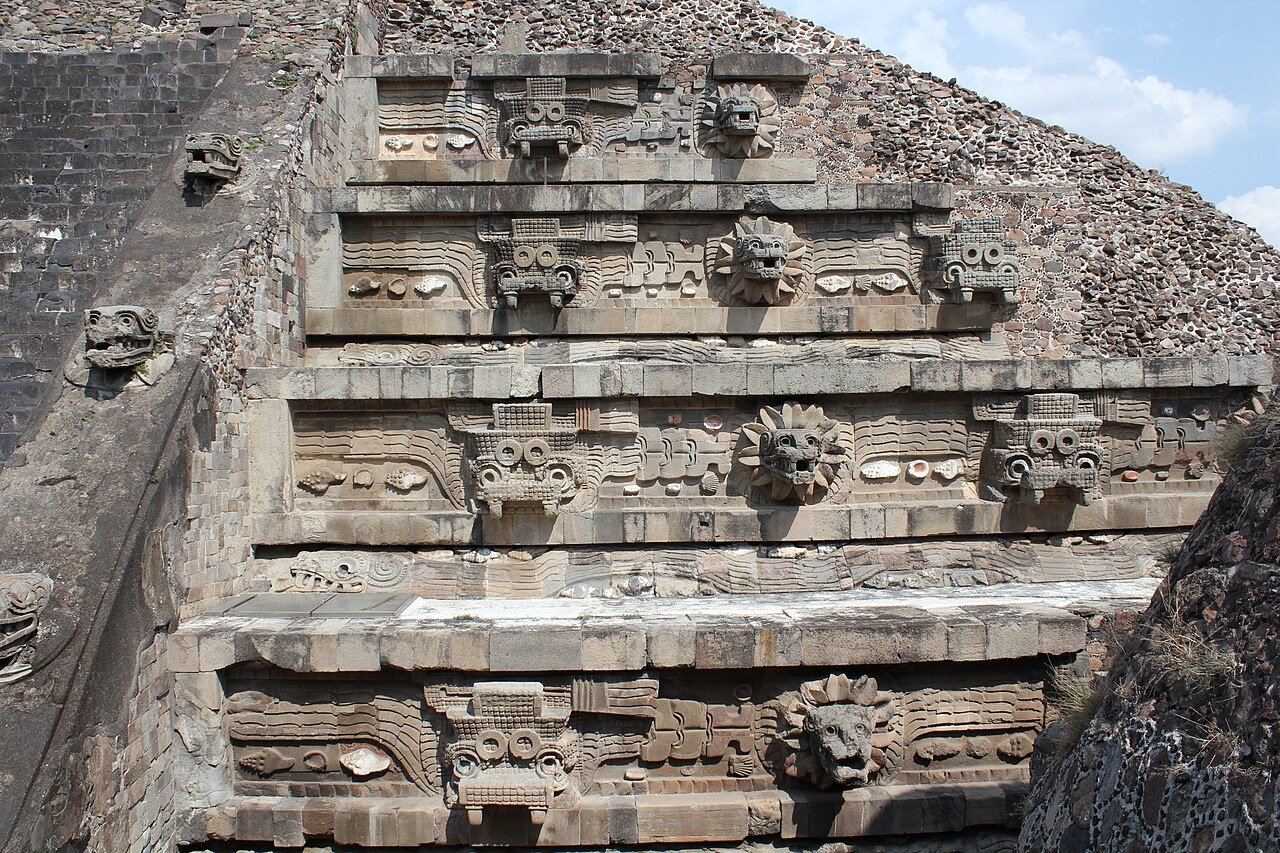
The setting is the tunnel beneath the Temple of the Feathered Serpent, also called the Temple of Quetzalcoatl, in Teotihuacan’s Ciudadela complex in central Mexico. This is not a discovery beneath every Mexican pyramid, nor is Teotihuacan a Maya city. Its archaeological history must be understood separately from the traditions of Maya communities farther south.
Excavation director Sergio Gómez Chávez dates the tunnel’s modern discovery to October 2, 2003, when rain exposed a narrow opening. Exploration resumed in 2009 after interruptions. His account describes a passage approximately 103 meters long, ending in three large chambers, with mercury droplets recovered in depressions in its southern section.
What was reported—and when
A Reuters report published by Excélsior on April 25, 2015 said Gómez had encountered liquid mercury that month near the tunnel’s end. The dates distinguish the discovery of the tunnel from the later mercury report. This article revisits an established archaeological finding; it does not announce a new mercury discovery.
Early descriptions of a substantial quantity encouraged dramatic images of underground pools. However, contemporary reporting carrying Gómez’s clarification described tiny droplets, roughly one or two millimeters across, mixed with earth—not liters of metal. INAH’s official visitor account likewise acknowledges liquid mercury in very small quantities.
Liquid mercury is different from cinnabar
Elemental mercury, written chemically as Hg, is the silvery liquid metal. Cinnabar is mercury sulfide, HgS, a mineral used as a red pigment. Archaeological references to these materials should not be treated as interchangeable. The Teotihuacan reports identify liquid mercury, while contemporary coverage also mentions associated cinnabar. Red pigment alone would not establish the presence of liquid metal.
A possible landscape of the underworld
Gómez interprets the tunnel’s shaped floor, depressions and reflective minerals as a constructed sacred landscape. In his account, mercury represented water, while sparkling pyrite helped evoke stars beneath the earth. INAH similarly presents the subterranean setting as a recreation of the underworld.
This is an archaeological interpretation of materials and spatial relationships, rather than a direct written explanation left by the builders. A proposed symbolic river or lake should not be mistaken for proof of a large physical reservoir. The cited findings provide no evidence that mercury powered the pyramid. Nor did the mercury report itself demonstrate that a royal tomb had been found.
A careful comparison with the Maya world
A 2022 review by Duncan E. Cook and colleagues distinguishes widespread Maya use of cinnabar from much rarer finds of elemental mercury. At Lamanai in Belize, a cache beneath the ballcourt, dated to approximately AD 900, included both cinnabar and a small amount of liquid mercury in a vessel. The comparison shows that both materials entered ceremonial contexts across Mesoamerica, without establishing identical meanings or a single shared practice.
Teotihuacan’s tunnel deserves attention on its own terms: as a deliberately arranged underground environment whose objects, surfaces and architecture help researchers investigate ancient ritual experience. Its significance rests in the relationship between those elements, while the exact intentions behind the mercury remain a subject of interpretation.
Featured photograph: Arian Zwegers / Wikimedia Commons, CC BY 2.0. Resized; no editorial alterations. The photograph shows the temple exterior, not the mercury deposit.