Khemetic Nation News Network | Science / Khemetic Biotech Desk
Consciousness research | October 14, 2026
Why do some people who survive cardiac arrest recall vivid experiences of light, separation from the body, or encounters with familiar figures? A new research paper published online on October 11, 2026, proposes a way to test whether a brief transition in brain chemistry could help explain these experiences.
The article, The chemistry of the dying-brain transition: A testable neurochemical hypothesis for near-death experiences, appears as a journal pre-proof in Medical Hypotheses. It is a theoretical proposal, not a new experiment involving patients and not confirmation of a spiritual realm.
A narrow window between crisis and recovery
The author suggests that during a severe reduction in blood flow, falling cellular energy levels and changes in brain chemistry could temporarily disrupt the normal balance between inhibitory and excitatory activity. The paper discusses ATP depletion, changing ion concentrations, glutamate signaling, and other physiological processes that may briefly reorganize neural networks.
Under the proposed model, unusual perceptions or memory fragments could arise during a reversible stage of the crisis and be recalled following successful resuscitation. If neural networks irreversibly cease functioning, the same model would not predict continued experience. The article proposes synchronized brain and physiological monitoring during resuscitation as one way to evaluate its predictions.
What remains unknown
Researchers have not established exactly when every reported near-death experience forms, how memory is encoded during serious medical emergencies, or whether one biological explanation accounts for all accounts. This paper supplies no original patient measurements, and its predictions still require careful testing. Near-death narratives are meaningful personal reports, but they are not on their own proof of survival after irreversible death.
The Book of Maat and the question of the soul
The 2018 Book of Maat brings a different perspective. In The Book of Coming Forth by Day, particularly its passages about the Duat, spirit-body, and spirit-soul (around printed pages 223–224), a person’s passage beyond bodily death is explored through spiritual tradition and symbolic narrative. The new medical hypothesis instead asks a narrower, measurable question about brain activity during a potentially reversible emergency.
These perspectives can be placed in dialogue without treating them as equivalent evidence: the text expresses a philosophical and spiritual understanding of existence, while neuroscience develops explanations that must survive empirical testing. Neither the new hypothesis nor the ancient spiritual material establishes the other’s conclusions.
Why this matters
Consciousness at the edges of life remains a serious research question. The value of the latest paper is that it proposes mechanisms and observations that might be checked—not that it settles what happens after death.
Sources
Medical Hypotheses — research paper available online Oct. 11, 2026
Nature Reviews Neurology — neuroscientific review of near-death experiences (2025)
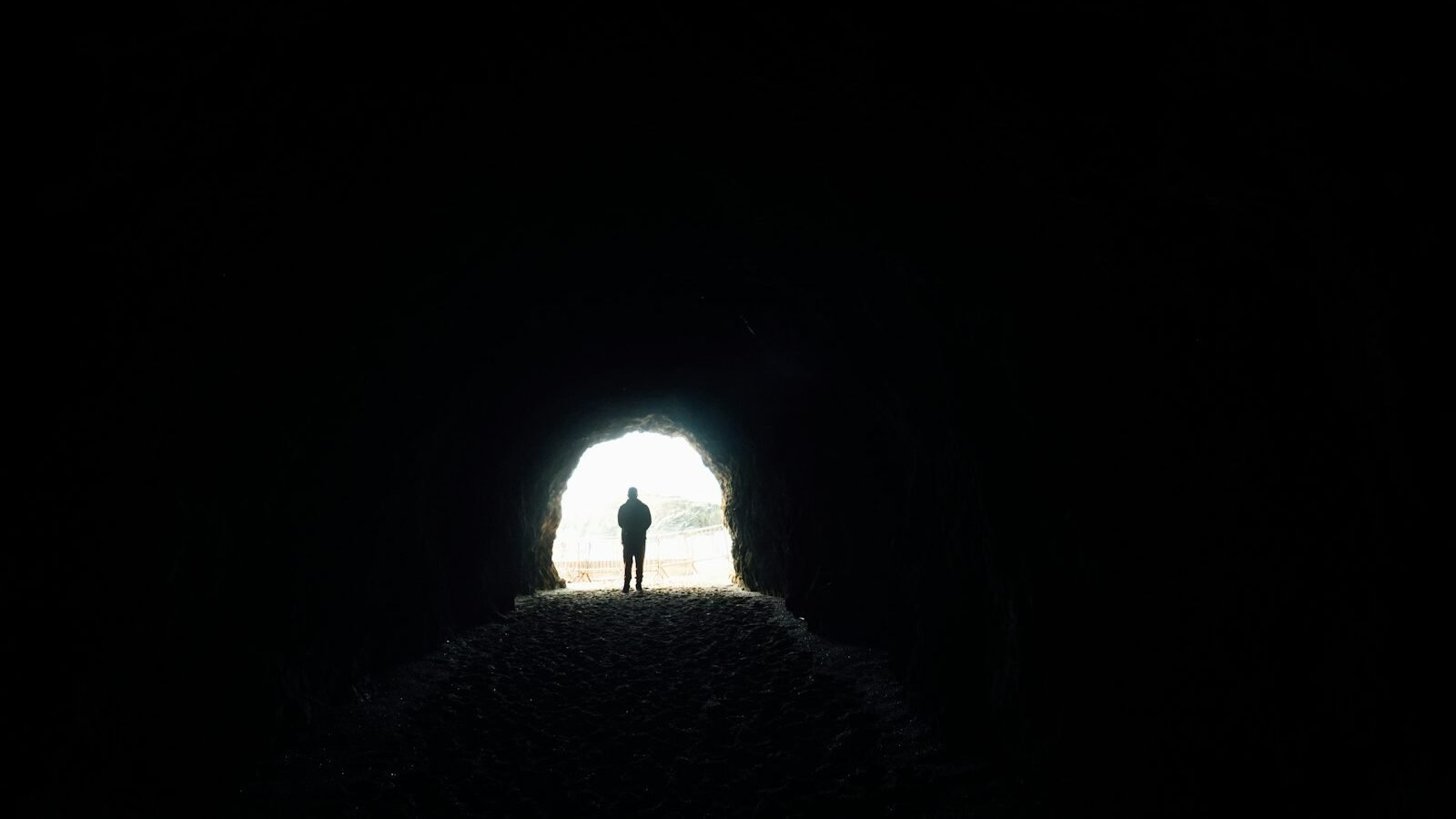
Featured photo: Tim Foster / Unsplash. A conceptual light-and-tunnel image; it is not documentary evidence of a reported near-death experience.