Khemetic Nation News Network | Science / Khemetic Biotech | November 9, 2026
An international group of physicists has reported an unusual quantum state that forms at ordinary temperatures and shows features associated with both a crystal and a fluid. The research, published October 16 in Science Advances, does not mean an everyday beam of light has turned into a solid. Instead, researchers engineered a miniature device where light and matter combine into short-lived quasiparticles that organize in a remarkable way.
What the researchers actually built
The collaboration included the University of Warsaw, Poland’s Military University of Technology, IBM Research Zurich and France’s CNRS. Inside an optical microcavity, scientists paired a controllable liquid crystal with an organic semiconductor. Their setup coupled photons to electronic excitations, creating exciton polaritons—hybrid quasiparticles possessing light-like and matter-like properties.
When excited by a laser, polaritons formed a collective Bose–Einstein condensate. In the regime the scientists studied, the emitted light developed repeating stripes: a telltale sign of crystal-like spatial order. Other observations, including the changing positions of the stripes across laser pulses and occasional quantum vortices, supported the interpretation that the state also possessed superfluid-like characteristics. Such a combination is called a supersolid.
The researchers’ system operated at room temperature, unlike many classic supersolid experiments that use atoms cooled almost to absolute zero. The team could also alter the device’s optical properties with an applied voltage.
The unexpected clues in the light
In the recorded emission patterns, bright bands appeared in different locations during repeated laser pulses. Because the positions shifted from one measurement to the next, the patterns were less likely to be simply imprinted by an imperfection in the sample. The team interpreted the behavior as evidence of spontaneous symmetry breaking—a transition in which a physical system selects one of several equivalent configurations.
The scientists also identified an ordered structure in the emitted light’s polarization, called a persistent spin helix. The combination of repeating intensity and polarization patterns helped them characterize the unusual state.
Important qualifications remain. The original paper reported quantized vortices in roughly one-tenth of condensate realizations, and the authors acknowledged that further quantitative analysis would strengthen the superfluid interpretation. Their samples also degraded because the semiconductor reacted with the liquid crystal, leaving a limited period for measurements.
Why this could matter for technology
Operating at room temperature could make studies of these quantum phases more accessible than experiments dependent on extensive cryogenic equipment. The ability to tune the system electrically is also notable. Possible future applications include optical computing components, neuromorphic information processing and sensors sensitive to changes in light polarization.
None of these devices has been demonstrated as a commercial product by this study. Scalability, stability and technical performance will require further testing.
Not the first room-temperature supersolid report
To place the news in context, researchers at Rensselaer Polytechnic Institute announced a separate room-temperature supersolid platform in March 2026. The newly reported study should therefore not be described as the first time any room-temperature supersolid-like quantum state has been observed. Its specific contribution is a light–matter supersolid involving a spin-orbit-coupled condensate in an electrically controllable liquid-crystal microcavity.
Where the Book of Maat enters the conversation
The Book of Maat, 2018 edition, discusses a “Principle of Vibration” and a “Principle of Opposition” in its section “The Seven Principles of Maat” (printed page 156). Its philosophical treatment of motion and apparently contrasting qualities invites a comparison with a quantum phase showing both patterned order and fluid-like behavior.
That comparison is interpretive, not experimental evidence for a spiritual proposition. The physicists measured the behavior of engineered quasiparticles; they did not investigate consciousness or validate the historical origin of the book’s teachings. Scientific results and the philosophy of Maat can be considered alongside one another without pretending that they answer the same kinds of questions.
Sources and image credit
- Muszyński and colleagues, Science Advances, October 16, 2026 — original peer-reviewed research.
- University of Warsaw Faculty of Physics, November 3, 2026 — institutional research announcement.
- Rensselaer Polytechnic Institute, March 17, 2026 — related earlier room-temperature result.
- ScienceDaily, November 9, 2026 — follow-up report.
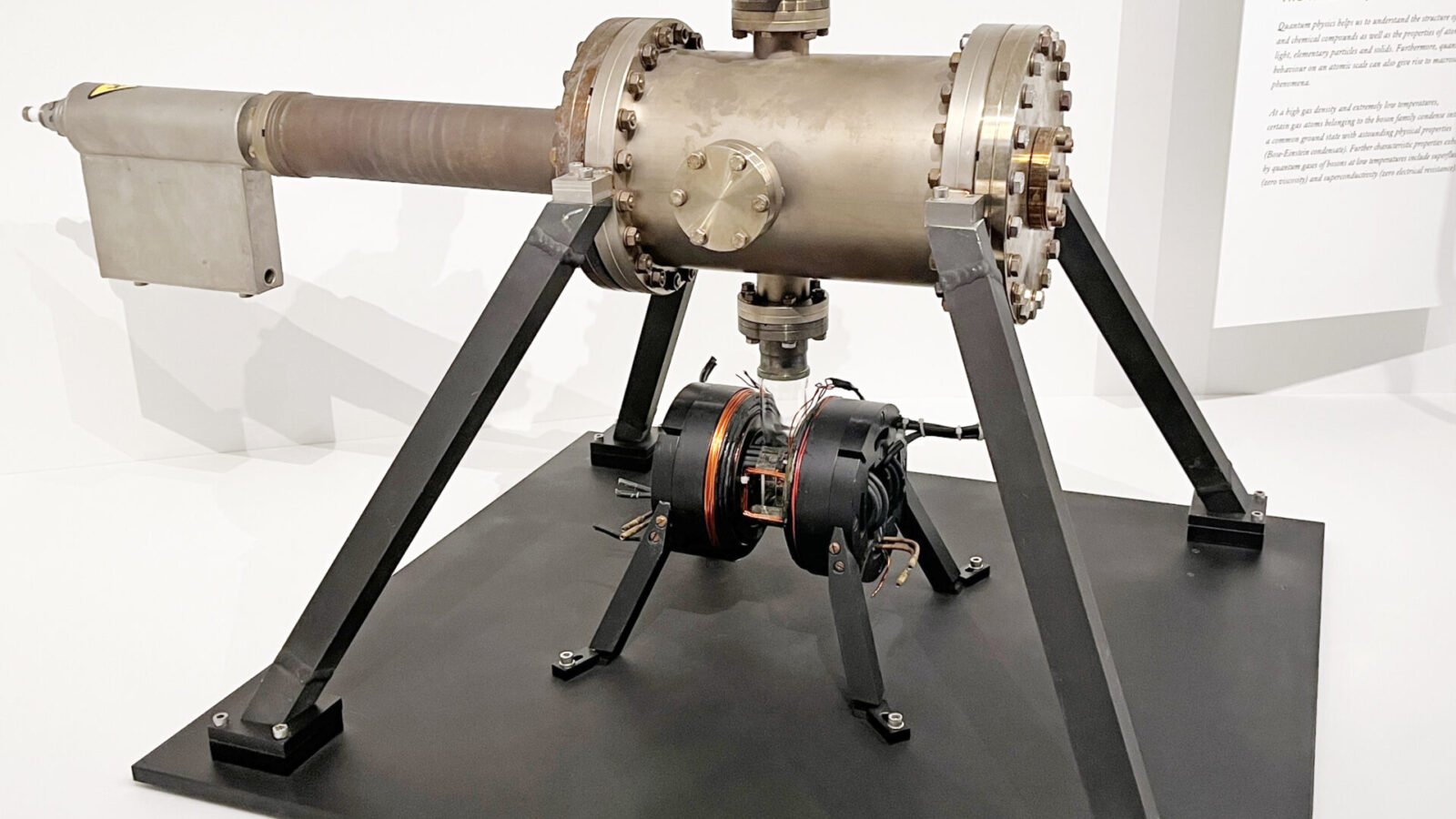
Featured image note: The photograph shows actual apparatus built in 1997 to create a Bose–Einstein condensate and now displayed at the Deutsches Museum. It illustrates the history of related quantum research, not the 2026 Warsaw-led experimental device. Photo by Tiia Monto, CC BY 4.0, unmodified original photograph. The Book of Maat discussion reflects KNN’s independent philosophical comparison, not a claim by the research authors.