The automaker is developing a smaller 1.5-liter gasoline-electric system, while the reported 2027 timing and $1.7 billion outside-sales goal remain projections rather than completed results.
Toyota is developing a new generation of hybrid powertrains centered on compact 1.5-liter four-cylinder engines, with a goal of improving fuel economy by more than 15%. The company detailed the system on October 28, 2026, saying it is designing the engine, motors and power electronics together rather than adapting an existing gasoline engine. Toyota’s official announcement describes the improvement as a target, not a certified result from a production vehicle.
For American drivers, that could eventually mean fewer gallons purchased during daily commuting and long-distance travel. But Toyota has not announced final U.S. EPA fuel-economy ratings, confirmed pricing or an exact American launch date for this new powertrain.
How the New Hybrid System Is Different
The centerpiece is a new family of naturally aspirated and turbocharged 1.5-liter four-cylinder gasoline engines, designed specifically to work with electric propulsion. Toyota says the naturally aspirated version is intended to cover the hybrid performance range now served by its 1.8-liter engine and current 1.5-liter three-cylinder engine.
The company is combining smaller and lighter electric motors with more compact power control units and inverters. Its stated engineering goals include lower engine friction, improved thermal management, reduced electrical losses and less aerodynamic drag. Together, those changes could improve fuel use across the complete vehicle, not just within the engine itself.
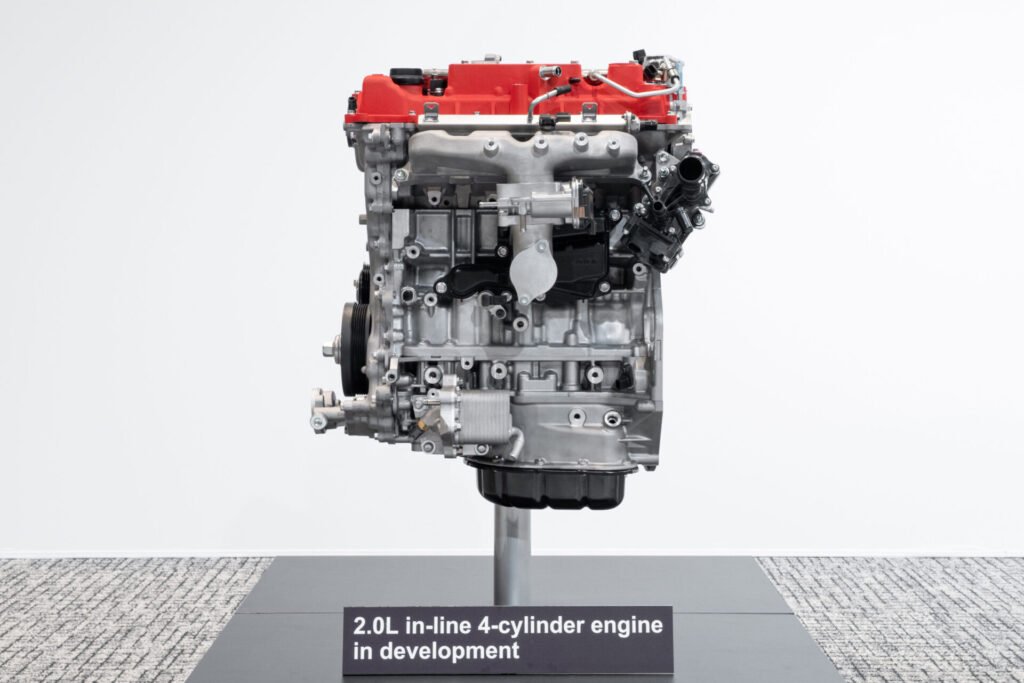
The effort builds on Toyota’s May 2024 engine-development presentation alongside Subaru and Mazda. At that event, Toyota displayed prototypes of both a 1.5-liter inline-four and a more powerful 2.0-liter turbocharged inline-four. The older development photos shown with this report are archival images of those prototypes, not pictures of a finalized production vehicle.
A Smaller Engine Could Also Change Vehicle Design
Toyota is pairing the new powertrain with what it calls a multi-pathway platform: a shared vehicle architecture intended for battery-electric, plug-in hybrid and conventional hybrid variants. The smaller engine compartment could allow lower hoods and more aerodynamic shapes while preserving cabin space.
Common engineering and manufacturing elements could also make it easier for Toyota to adjust the proportion of different vehicle types it builds as regional customer demand changes. Those benefits are manufacturer objectives and will need to be assessed in actual production models.
The Larger 2.0-Liter Engine Remains Part of the Development Program
Toyota has separately presented a new 2.0-liter turbocharged four-cylinder engine aimed at applications requiring greater output. It is part of the broader engine family, but the October 2026 fuel-economy announcement centers on the 1.5-liter hybrid system.
What a Fuel-Economy Improvement Could Mean at the Pump
A vehicle that travels farther on a gallon of gasoline would generally require less fuel for the same driving distance, all else equal. The size of the eventual savings depends on the actual certified mileage, driving conditions, gas prices and the cost of the vehicle.
A 15% increase in miles per gallon is not mathematically identical to a 15% cut in fuel spending. For example, raising fuel economy from 40 to 46 mpg would use about 13% less gasoline over the same distance. This is an illustration, not a Toyota test result.
Toyota Also Wants to Supply Other Automakers
Toyota says it plans to increase sales of engines and hybrid technologies to outside manufacturers. According to Motor1, citing Automotive News, the company is targeting about €1.5 billion (approximately $1.7 billion) in annual external powertrain revenue by 2032. The report says deliveries of next-generation systems could begin as early as 2027.
Neither the outside-sales forecast nor that delivery window should be mistaken for confirmed U.S. retail availability. Specific customer agreements, commercial volumes and final launch schedules remain to be established.
Why the News Matters in the United States
Toyota’s U.S. operations are part of its broader electrification plans. At a November 11, 2026, technology showcase at its North American research and development headquarters in Saline, Michigan, Toyota discussed next-generation hybrid and battery technology, emphasizing improved efficiency and smaller vehicle components. The presentation did not identify a U.S. launch model or on-sale date for the new 1.5-liter engine.
Automotive reporting has suggested the next Corolla could eventually adopt the system, but Car and Driver notes that Toyota’s October 2026 announcement did not explicitly assign the system to that model. That distinction matters for shoppers deciding whether to buy a current car or wait for future technology.
Hybrid vehicles still use gasoline and produce tailpipe emissions, although improved efficiency can reduce fuel consumption. Toyota also says the new engine family is being developed with compatibility for some renewable and lower-carbon fuels; their real-world availability and lifecycle benefits depend on how those fuels are produced.
What Is Still Unknown
Toyota has not yet established the final U.S. fuel-economy ratings, production price, full model lineup or dealer availability for the newly described system. Independent test results will ultimately determine whether the promised efficiency improvement holds up for American drivers.
Watch Toyota’s Original Development Presentation
Toyota’s ENGINE ReBORN official manufacturer video documents its May 2024 prototype-engine presentation. It is archival context for the current engineering program, not a demonstration of a finished 2027 production hybrid.
Sources
- Toyota Motor Europe — next-generation hybrid announcement, October 28, 2026
- Toyota Motor Corporation — multipathway engine development, May 28, 2024
- Toyota USA — next-generation mobility research showcase, November 11, 2026
- Motor1 — external powertrain revenue forecast, October 28, 2026
- Car and Driver — analysis of new hybrid technology and possible Corolla application, October 29, 2026
- Toyota Global Newsroom — original manufacturer prototype image gallery
Photo note: Both Toyota prototype photographs originated with the company’s 2024 engine-development presentation and are used as historical technical illustrations of actual development hardware. They do not depict completed production engines.