U.S. food technology | November 10, 2026
A British developer has commercialized a banana designed to resist browning after peeling. Its U.S. consumer rollout, food-waste benefits and possible labeling are drawing attention—but regulatory clearance is not the same as confirmed supermarket availability.
A banana that stays yellow longer after it is sliced is moving toward U.S. consumers. Norwich-based agricultural biotechnology company Tropic Biosciences says its gene-edited non-browning variety entered commercial distribution to growers in 2025 and was expected to reach U.S. and Canadian consumers in new products during 2026. However, as of November 10, publicly available company materials reviewed for this report did not establish a specific U.S. supermarket chain, on-shelf date or nationally available packaged product.
Tropic’s work is genuine, and the U.S. Department of Agriculture has issued a determination that certain reduced-browning banana edits are exempt from its plant-biotechnology regulation. But several claims circulating online—including that the banana will never turn brown or that shoppers are guaranteed to find it in stores without identifying information—go beyond the evidence available so far.
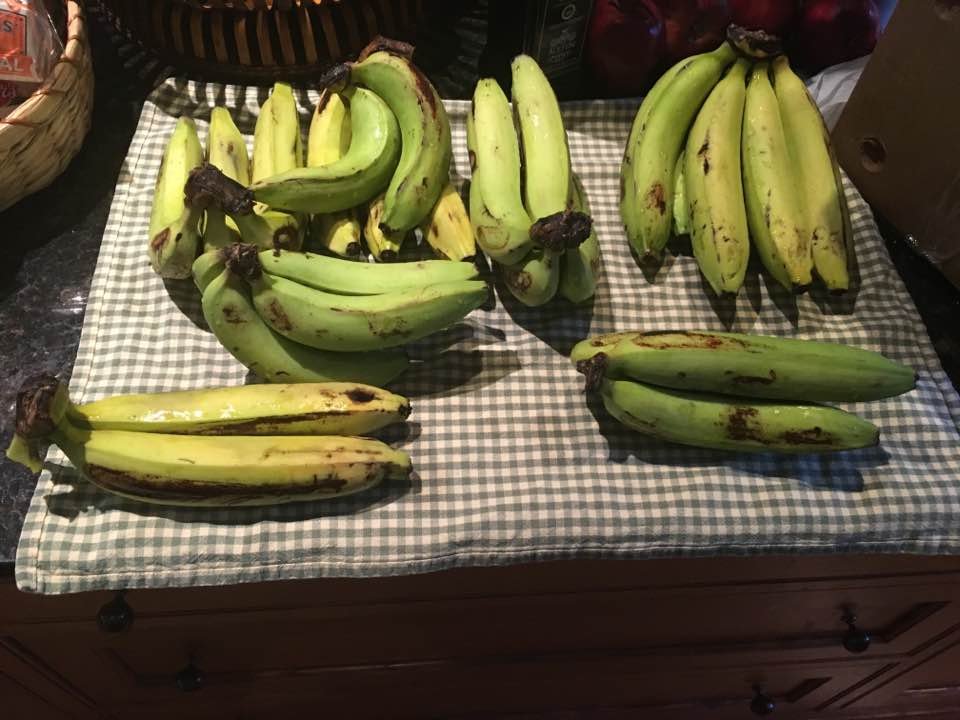
Featured photo: Conventional Gros Michel bananas at different ripeness stages, showing natural differences in peel color and spotting. These are not Tropic’s gene-edited bananas, and the photograph should not be used as evidence of how that product looks. Photograph: Zwifree, Wikimedia Commons, CC BY 4.0.
What scientists actually changed
Tropic used CRISPR-based gene editing to interfere with a banana gene involved in producing polyphenol oxidase (PPO), an enzyme that helps cause the brown color seen when fruit tissues are cut or damaged. The company’s U.S. regulatory submission describes a targeted change associated with a reduction in this enzyme’s activity. The edited variety is also identified as Pomona in a 2026 plant-patent application and a Singapore government listing.
This is a change to the plant’s own DNA, not a banana made in a laboratory from cells. The USDA’s 2022 determination describes the use of transient external genetic material during the editing process and the developer’s screening intended to establish that no such DNA remained integrated in the final plant. It is more precise to say the product is gene-edited without retained foreign DNA than to suggest nothing genetic happened.
Tropic has described flesh that remains attractive for at least 12 hours after peeling, with potential to stay visually appealing longer under certain conditions. An industry report featuring Tropic-supplied photographs described slices that remained yellow for up to 48 hours. Those descriptions do not prove that browning can never occur or that the fruit cannot ripen, soften, become contaminated or spoil.
There is another distinction: Tropic is also marketing a separate extended-green-life banana intended to delay ripening during transport. Claims that bananas can remain green for around 12 additional days concern that separate product, not necessarily the cut-flesh browning trait.
Why fruit processors are interested
Conventional sliced bananas darken rapidly, making them difficult to use in packaged fruit cups, breakfast bowls, retail fruit salads and ready-to-eat snacks. Tropic says reduced browning could create new uses for bananas while lowering food waste throughout distribution. Prepared-food manufacturers and retailers may therefore be among the first commercial customers.
Those commercial applications are plausible, but no specific U.S. grocery placement or finished-product label has been independently established for this article. The company has projected substantial reductions in waste and related emissions; actual savings will depend on real-world losses, production and shipping conditions, consumer behavior, and whether the fruit merely looks fresher or is actually discarded less often. A slower-browning banana must still be stored and handled safely.
How does the United States regulate gene-edited foods?
American oversight involves three federal agencies, and each answers a different question. FDA enforces food-safety and labeling requirements under the Federal Food, Drug, and Cosmetic Act. USDA’s Animal and Plant Health Inspection Service (APHIS) evaluates certain engineered plants under plant-pest laws. EPA oversees certain pesticidal substances produced by plants (plant-incorporated protectants). A plant’s exclusion from one agency’s particular oversight is not proof that it underwent, passed, or was required to undergo every other agency’s product review. See FDA’s overview of federal GMO regulation and FDA’s February 2024 genome-editing guidance.
Under the food-safety provisions of the federal law—including its prohibitions against adulterated and misleadingly labeled food—developers and sellers are legally responsible for selling safe and lawful products. For many genome-edited plants, FDA recommends but does not universally mandate a voluntary premarket consultation or meeting. A voluntary meeting in FDA’s database is not the same thing as FDA independently approving the finished product or endorsing its manufacturer’s safety assessment. Some product characteristics can trigger additional safety or food-additive requirements. See FDA’s explanation of premarket meetings.
APHIS’s regulations have changed substantially. On December 2, 2024, a federal court vacated USDA’s 2020 SECURE biotechnology rule. APHIS resumed processes under the earlier regulatory framework in 2025. Crucially, the agency says that confirmation and regulatory-status-review responses issued before the court’s order remain valid. That includes the relevance of Tropic’s earlier USDA paperwork, but does not transform it into a finding about every possible consumer-health outcome or actual retail placement. See APHIS’s January 2026 status notice and current APHIS guidance.
Are gene-edited foods legally required to carry labels?
Sometimes—not automatically. Congress enacted the National Bioengineered Food Disclosure Law in 2016; the USDA’s National Bioengineered Food Disclosure Standard is codified at 7 CFR Part 66. Mandatory compliance generally began January 1, 2022. The standard uses a technical definition: food containing modified genetic material produced through specified in vitro recombinant-DNA techniques, where the modification could not otherwise be achieved through conventional breeding or found in nature. As the rule currently describes it, modified DNA must also be detectable under its criteria. Foods that fall outside that definition may not require a federal bioengineered-food disclosure, even if their developers used modern gene editing. USDA’s official FAQ explains the distinction.
For food that does meet the requirements, the regulation provides disclosure methods including words such as “Bioengineered Food”, a USDA symbol, or specified electronic and text-message methods. Food manufacturers, importers and certain retailers generally have responsibilities, but the law excludes restaurant meals and very small food manufacturers, among other specific exemptions. Unpackaged bulk-food displays may use nearby signs. The exact requirements depend on the product, seller and the current state of the regulations. See USDA’s industry fact sheet.
For a banana like Tropic’s, the legally relevant question is not whether someone edited a gene, but whether its precise technique and final food satisfy the law’s bioengineered definition. The video’s suggestion that there may be no mandatory U.S. bioengineered label is plausible under the current framework, but the actual label for a specific U.S. commercial Tropic banana package has not been verified here. The lack of a required USDA symbol would not establish that the fruit is unmodified.
Important distinction about “non-GMO”: Tropic describes its approach as avoiding retained foreign DNA. That is different from proving that a gene-edited banana is “not genetically modified” in ordinary-language terms. USDA explicitly warns that a product cannot be described as “non-GMO” solely because it is exempt from the federal bioengineered-food disclosure. Such voluntary claims must comply with other applicable federal rules against misleading labeling. See the USDA FAQ on non-GMO claims.
A major federal court decision is reshaping the label debate
On October 31, 2025, the U.S. Court of Appeals for the Ninth Circuit ruled in Natural Grocers v. Rollins that USDA had committed legal error in its broad exclusion of highly refined foods whose modified genetic material was undetectable. The court also directed the district court to order prospective vacatur of regulatory options for QR-code and text-message-only disclosures after further proceedings. The appeals court did not require USDA to replace its chosen legal term “bioengineered” with “GMO.”
The court did not itself announce that every refined ingredient must immediately carry a new label, or that every QR-code label already on shelves was suddenly invalid. It remanded key questions for additional proceedings and agency consideration. USDA’s public consumer guidance still describes digital and text-message options; therefore retailers’ obligations during implementation should not be oversimplified without an updated order applicable to the particular rule. The judgment highlights a central policy question: should it matter whether modified DNA can be detected in the finished oil or sugar if the underlying crop was genetically engineered?
What could happen to a person who eats a gene-edited banana?
The changes described by Tropic are intended primarily to affect the fruit’s appearance after cutting or bruising. The target is a banana gene involved in polyphenol oxidase activity, not a substance added to every serving. Eating DNA from a plant, including its altered DNA, is not itself evidence that the food will rewrite a person’s genes. Existing regulatory and scientific frameworks evaluate the food’s composition and properties rather than assuming all products made with the same editing tool have the same health effects.
What the evidence supports: There is currently no verified evidence in the sources reviewed for this story that eating Tropic’s particular non-browning banana causes cancer, infertility, genetic changes in the consumer, or any other specific human disease. Nor is there adequate publicly identified human clinical evidence here to declare that every long-term health question about this particular variety has been answered. Its food-safety status and any new publicly available compositional testing should be evaluated on the actual variety and intended use—not the assumption that all gene editing is either dangerous or automatically safe.
What scientists and regulators look for: Whether gene editing produces unexpected changes in a food’s protein or chemical profile; whether known allergens or natural toxins increase; whether important nutrient concentrations change; whether unexpected edits or associated changes matter; and whether a new substance or trait needs additional scrutiny. FDA’s 2024 guidance explicitly identifies changes involving allergens, toxicants, anti-nutrients and meaningful nutritional changes as potential reasons for more substantial premarket engagement. These are hazards to assess, not documented injuries from Tropic’s bananas.
A practical food-safety concern is appearance versus spoilage. Enzymatic browning is not a reliable stand-alone test of microbial safety, but suppressing it can also remove one visual cue consumers have become accustomed to seeing. A banana that looks yellow after slicing is not automatically safe to store for longer than recommended. Sanitary processing, refrigeration when needed, expiration guidance, odor, texture and contamination controls still matter. Claims about longer visual appeal should not be confused with demonstrated extension of microbiological safety.
Potential benefits are also conditional. Fewer visibly browned slices might reduce avoidable waste and make fruit more practical for prepared-food products; altered composition could affect nutritional characteristics in either direction depending on the specific crop. No demonstrated human health advantage from eating Tropic’s edited banana was established from the reviewed sources. Businesses should substantiate any nutritional or medical claims instead of assuming food-waste savings imply a health benefit.
What a human nutrition experiment can—and cannot—tell us: In a 2023 controlled crossover study published in Food & Function, researchers found that high polyphenol oxidase activity in banana-containing smoothies reduced absorption of certain flavan-3-ol compounds from other fruit. This identifies a plausible way that the enzyme can affect a meal’s nutritional chemistry; it does not demonstrate the same effect, a health benefit or an adverse effect after eating Tropic’s gene-edited bananas. Testing the edited variety against conventional bananas would be needed to establish that.
Why might companies avoid highlighting gene editing on food labels?
There is a difference between legal nondisclosure and evidence of deliberate concealment. Congress and USDA adopted a narrower disclosure category than the everyday term “genetically modified.” If a crop does not meet that legal definition, a mandatory bioengineered label may not apply. That can happen without a company breaking the law. The label standard also distinguishes refined ingredients and includes exemptions for some sellers and meals. Industry may emphasize consumer-valued traits such as reduced waste or better taste, while consumers may reasonably want the production method prominently disclosed.
Critics argue that rules tied to detectable modified DNA, technical terminology and digital disclosure methods can leave shoppers with too little usable information. Supporters argue that mandatory warning-style treatment of some gene edits could imply a safety difference that has not been established. Neither perspective proves a conspiracy to conceal products, and the 2025 court ruling shows that the details are subject to legal challenge.
A more transparent approach—regardless of whether it is legally mandated—would be for producers to identify the crop variety, trait, gene-editing method, food-safety assessment and commercial origin in accessible plain language. Consumers should not need a particular opinion about genetic engineering to receive accurate product information.
Gene-edited foods already marketed: what is documented?
High-oleic soybean oil, United States, 2019: Calyxt announced first U.S. commercial sales of its gene-edited Calyno soybean oil to the foodservice industry, for applications such as frying and salad dressing. This is a documented historical commercial launch, not evidence that a particular supermarket bottle remains for sale in November 2026. See Calyxt’s 2019 filing furnished to the SEC.
Milder mustard greens, United States, 2023: Pairwise introduced gene-edited Conscious Greens, designed to be less pungent. They reached limited foodservice and consumer channels, but a 2026 scientific review reports that production was discontinued in 2024. They should not be presented as a product widely available in grocery stores today.
High-GABA tomatoes, Japan: Sanatech’s Sicilian Rouge tomatoes have been marketed in Japan after targeted genome editing to increase gamma-aminobutyric acid. This is a genuine example of an edited food reaching consumers, but its Japanese marketing does not establish U.S. retail availability or that eating it treats high blood pressure. See the 2026 review of gene-edited market introductions.
Do not confuse gene editing with earlier transgenic crops: The USDA’s existing list also includes Arctic non-browning apples, genetically engineered potatoes, papayas, pink-fleshed pineapples and commodity crops such as corn and soybeans. Those varieties can involve a different kind of genetic engineering and are not all CRISPR-edited examples. Inclusion on USDA’s international list does not prove that every variety is stocked at a U.S. store today. See USDA’s List of Bioengineered Foods.
Similarly, cell-cultivated meat, fermentation-derived dairy proteins and genetically engineered salmon are different technological and regulatory categories. A company making a plant gene edit does not mean the fruit was “lab-grown” as a manufactured piece of food.
Which gene-edited foods could arrive next?
The FDA’s public inventory of voluntary genome-edited-plant premarket meetings provides unusually concrete examples of what developers are bringing forward. As of November 10, 2026, the entries include:
- Seedless or reduced-seed, thornless blackberries — Pairwise discussed edits affecting plant architecture, prickles and seed lignification at a July 9, 2026 FDA meeting.
- Non-browning romaine lettuce — GreenVenus held a February 27, 2026 FDA meeting about reduced enzymatic browning.
- Potatoes with more tubers — J.R. Simplot discussed a high-tuber-set trait in February 2026; another 2025 meeting covered edits intended to reduce browning and black spots.
- Fungal-disease-resistant corn — Pioneer discussed a variety targeting resistance to several fungal diseases in February 2026.
- Higher-yield soybeans and high-amylopectin waxy corn — FDA records show meetings with Inari and Pioneer in late 2025.
- Herbicide-tolerant rice and longer-flowering strawberries — FDA records show developers’ meetings in 2025 and 2024, respectively.
These meetings are not approvals or proof of completed commercial launches. FDA says its meeting inventory records developer discussions—not a full independent FDA safety evaluation. Commercial timing will depend on further development, seed production, regulatory questions, distributors and consumer demand. Tropic has separately said it is developing bananas with increased resistance to Panama disease and Black Sigatoka; company targets should be treated as pipeline plans until relevant products reach market.
How can shoppers make informed choices?
Consumers who want more information can look for a USDA bioengineered-food disclosure when applicable, read a company’s specific product disclosures and ask retailers what variety and supplier a prepared fruit product uses. USDA-certified organic production standards prohibit genetic engineering, including gene-editing approaches regarded as excluded methods; organic certification is a distinct production standard, not a guarantee that all food from other production methods is unsafe. An unadorned “non-GMO” marketing claim deserves closer examination: a missing mandatory bioengineered label is not sufficient proof of that claim.
For an informed decision about Tropic’s banana specifically, consumers need a verifiable U.S. retailer and package, a clear variety name, an account of the edit, accessible safety/composition information and storage instructions. Until those are publicly available for a specific U.S. product, predictions that the banana will secretly turn up in every fruit cup or smoothie should be treated as unconfirmed.
What should consumers know before buying?
The strongest verified claim is reduced enzymatic browning, not permanent freshness. The economic case is less visually unappealing produce and potentially less waste; the labeling issue is whether purchasing decisions can be informed by clear, accurate and accessible sourcing information. Neither benefit nor concern should be inflated beyond the evidence.
A 2026 University of Arkansas-led consumer survey involving 1,309 respondents in the Philippines, Japan and China found that perceived food safety strongly influenced willingness to try gene-edited non-browning bananas. Its findings do not establish how U.S. shoppers will respond, but they show why accurate explanations and labeling matter.
For now, consumers should expect company and retailer announcements to clarify which American outlets will sell the product, whether it appears in whole-fruit or prepared-food formats, and what information appears on the packaging. Khemetic.News will not treat an anticipated 2026 launch as a confirmed nationwide supermarket debut without that evidence.
Watch the video that prompted the discussion
Original TikTok video: “It’s official. Gene edited bananas are coming to grocery stores” — @kashkhanofficial on TikTok.
Editor’s note: This article examines claims in the user-provided video transcript against company statements and regulatory records. The linked TikTok could not be independently played during verification; its factual claims are not treated as primary regulatory evidence.
Sources and further reading
- Food & Function (2023) — Controlled study of banana polyphenol oxidase and flavan-3-ol bioavailability in smoothies
- USDA AMS — Which products, sellers and disclosure methods are covered
- United States Code — 7 USC 1639b, mandatory disclosure standard
- 7 CFR 66.1 — Legal definition of bioengineered food
- Natural Grocers v. Rollins — U.S. Ninth Circuit opinion (Oct. 31, 2025)
- USDA APHIS — 2024 biotechnology-rule vacatur and preserved prior decisions
- FDA — What a voluntary premarket meeting does and does not establish
- FDA — 2024–2026 inventory of genome-edited plant developer meetings
- Calyxt SEC release — first U.S. commercial sales of gene-edited soybean oil (2019)
- 2026 scholarly review — commercial and pipeline gene-edited crops
- USDA AMS — Organic labeling and excluded genetic-engineering methods
- USDA AMS — List of bioengineered foods
- Tropic Biosciences — Banana product and development program
- Tropic Biosciences — 2025 commercial progress and anticipated 2026 consumer formats
- Tropic Biosciences — Japan and Brazil regulatory announcement, April 2026
- USDA APHIS — 2022 gene-edited banana exemption confirmation
- USDA APHIS — additional reduced-browning banana regulatory-status review
- FDA — foods derived from genome-edited plants guidance
- USDA Agricultural Marketing Service — bioengineered food disclosure FAQ
- USDA — consumer explanation of the bioengineered disclosure label
- The Guardian — March 2025 reporting on the variety
- The Guardian — September 2026 regulatory update
- Produce Processing — photographs of the actual bananas, courtesy Tropic
- Pittman et al., Discover Food (2026) — consumer acceptance study