PASADENA, California — A mathematics professor at the California Institute of Technology has changed how he grades homework because artificial intelligence can solve many of the problems students are assigned outside the classroom. Professor Yi Ni now awards homework credit for completion rather than mathematical accuracy, according to Business Insider reporting published November 16, 2026.
The change does not mean that Ni has abolished homework or stopped grading it altogether. It means that a completed problem set no longer provides the same assurance that its answers reflect a student’s own work.
Why one professor changed his homework policy
Business Insider reporter Truman Dickerson attended one of Ni’s introductory mathematics lectures. Dickerson described a traditional chalkboard lesson, with Ni working through mathematics without a projector or laptop. He reported seeing students take notes but did not observe students using ChatGPT during class.
Ni told Dickerson that AI tools can handle a large share of college mathematics homework. He also said he cannot reliably determine whether a student submitted independently completed mathematical work or used AI to produce a solution. His response has been to grade assigned problem sets for completion.
This is an account of one professor’s grading practice, not proof that every Caltech student relies on AI or that all Caltech courses follow the same approach. Caltech’s official faculty directory identifies Ni as a professor of mathematics whose research includes geometry and topology.
The student argument for doing the work yourself
For the report, Dickerson also interviewed Sathvik Redrouthu, a Caltech mathematics student who previously took Ni’s class. Redrouthu said he chose not to use AI for his homework because he wanted to learn the concepts and be prepared for examinations completed in person.
The distinction exposes a central issue in higher education: a correct answer and a demonstrated understanding are not necessarily the same thing. Students may use AI to explore explanations and check work, but an AI-generated answer alone does not establish that they can reproduce the underlying reasoning without assistance.
Caltech has separately revised its grading approach
Ni’s experience comes as Caltech pursues a broader review of how academic achievement is evaluated. In an August 30, 2026 announcement, the university said its Faculty Board had approved measures for the 2026–27 academic year, including encouragement of supervised assessments such as seated examinations, oral examinations and in-class presentations.
The same announcement addressed transparency in grade distributions and standards for awarding A+ grades. Caltech presented those changes as part of a wider effort to make grades meaningful and protect academic credibility. It did not describe the reforms simply as a ban on AI-written homework.
Meanwhile, Caltech’s AI in Teaching guidance strongly discourages the use of AI-detection software to judge whether student writing was generated by AI, citing reliability, privacy and fairness concerns. That guidance concerns detection in writing; Ni’s reported problem is assessing authorship of mathematical solutions.
What American schools must decide next
Caltech’s experience illustrates a challenge for colleges and high schools across the United States: how to let students learn with increasingly capable technology without losing a credible way to measure individual skills. Possible approaches include supervised tests, oral explanations, demonstrated problem-solving steps and clear course-specific rules for permitted AI use.
Those are assessment options, not evidence that any one method will solve the problem. Business Insider’s report does not quantify AI use in Ni’s class, and it does not establish whether grading homework for completion improves or harms learning outcomes.
For educators, the central question remains whether a submitted solution shows what a student understands—or only what the tools available to that student can produce.
Sources and photo credits
- Business Insider, Truman Dickerson, November 16, 2026 — original classroom reporting and interviews.
- Caltech, Revised Grading Policies, August 30, 2026 — official grading reforms.
- Caltech, AI in Teaching — guidance on AI in education and AI-detection tools.
- Caltech, Yi Ni faculty profile — academic position and research field.
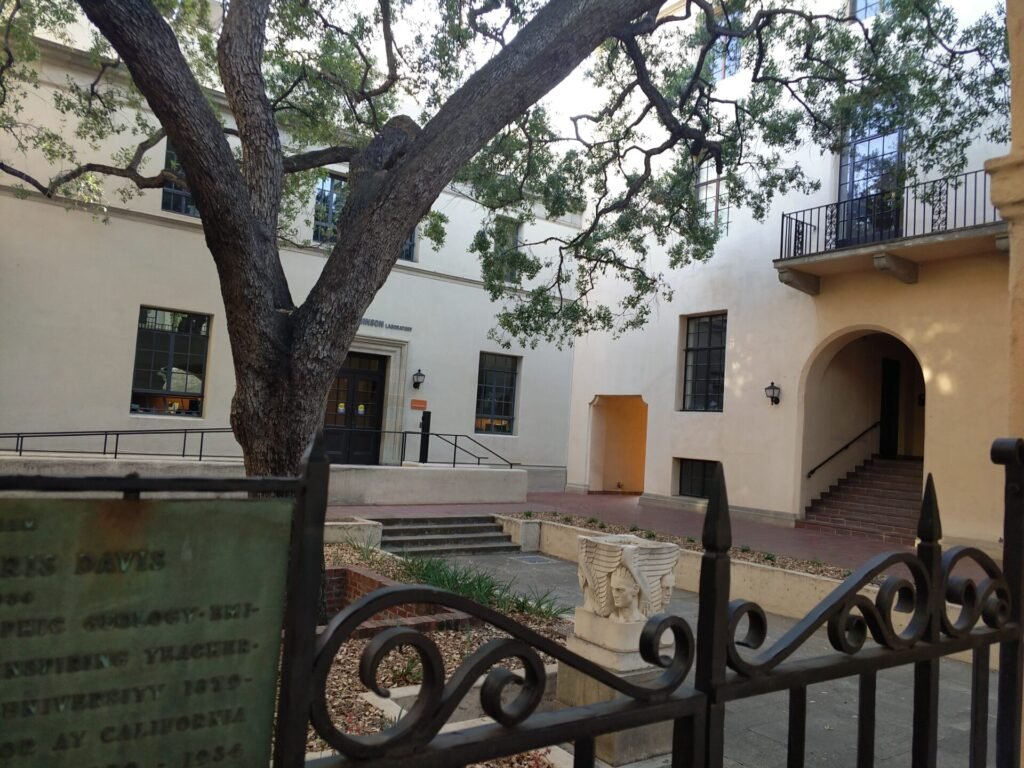
Featured photograph: Alfred P. Sloan Laboratory of Mathematics and Physics at Caltech, photographed May 2009 by Antony-22 / Wikimedia Commons, CC BY-SA 3.0. Archival exterior; not a photograph of the lecture described above.