SACRAMENTO, California — The California Federation of Teachers asked Gov. Gavin Newsom on November 11, 2026, to order a three-year pause on artificial-intelligence technology in public-school classrooms, citing worries about student privacy, teaching quality and oversight. Reporting on the union’s letter describes the requested moratorium more narrowly as a halt to student-facing generative AI in kindergarten through eighth grade. No statewide three-year moratorium has been established by the union’s request.
The union represents about 120,000 teachers, faculty and school employees. In its November 11 announcement, CFT said it wants time for educators and policymakers to review risks before further classroom deployment. The request is a policy proposal from a labor organization, not a state government directive.
What California educators are asking for
CFT argues that schools have adopted AI-enabled tools faster than clear policies have been established for student data, parental choices, teacher training and academic integrity. President Jeff Freitas characterized the problem as urgent in the union’s news release, but that characterization is the union’s position, not a scientific finding that every use of classroom AI causes harm.
The union said AI ranked as its members’ second-highest concern in a recent survey. It did not provide methodology or a sample size in the public news release, so that ranking should not be treated as a representative poll of all California educators.
California already has optional school AI guidance
The request arrives months after the California Department of Education released a model AI-in-education policy. A July 6 letter from state Superintendent Tony Thurmond says the model covers privacy by design, academic integrity, parental review rights, educator discretion and AI literacy. It is designed for local education agencies to adapt; the state explicitly says compliance with that model policy is not mandatory.
Those existing recommendations and the union’s request are distinct approaches. The state model aims to guide safer adoption; CFT wants a temporary interruption in at least some student-facing uses while lawmakers and schools consider stronger safeguards. Neither approach by itself demonstrates whether a particular educational tool improves or reduces learning.
Why families and districts should pay attention
A blanket pause, if adopted, would raise operational questions for districts using tutoring applications, writing assistants or adaptive learning platforms with generative features. The precise scope would depend on any eventual executive order: for example, whether staff-facing planning tools, accessibility services or AI-supported administrative functions were covered. Those details cannot be settled from a union press release alone.
California has also moved separately on student-data protections. CalMatters reported in September that the state enacted legislation restricting the use of student information for AI training. Rules governing data collection are not the same as a moratorium on classroom tools.
What happens next
CFT has asked Newsom to act before his term ends. A decision, the text of any order, exemptions and enforcement plan would determine what actually changes for students and educators. Until then, districts should evaluate the rules already applying to the technology they use, rather than assume a three-year ban is in force.
Sources and image credit
- California Federation of Teachers — November 11 news release.
- California Department of Education — July 6, 2026, model AI policy letter.
- CalMatters — September 2026 student-data protection reporting.
- USA Today Network reporting republished by Courier California — November 13, 2026.
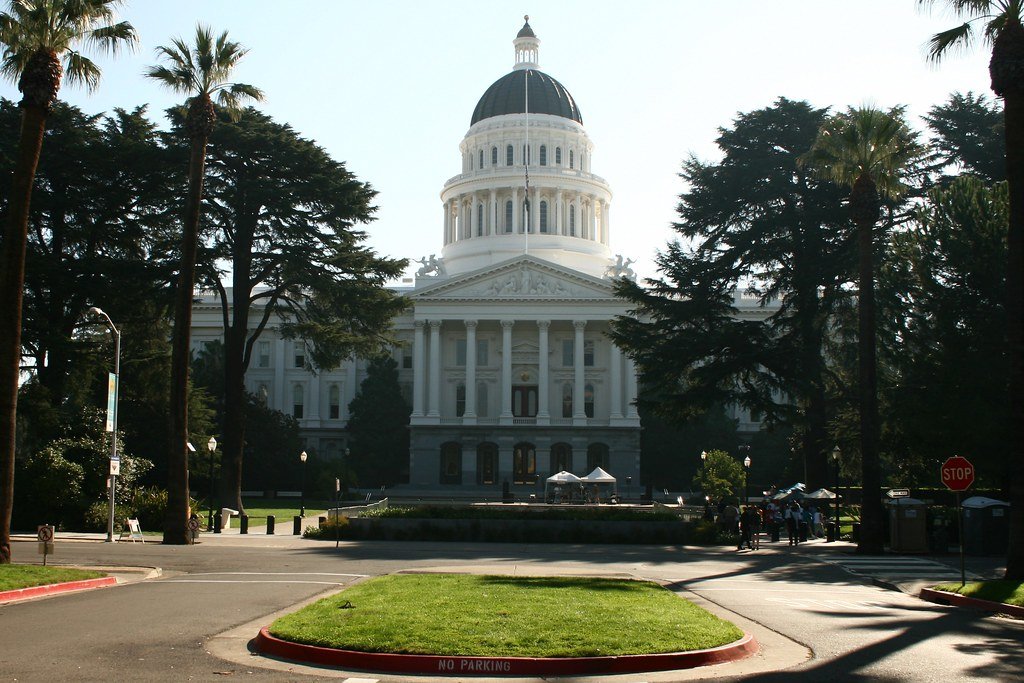
- Featured photograph: California State Capitol Building by Prayitno, CC BY 2.0. The Capitol photograph depicts the site of state government, not the union’s letter delivery.