Archaeologists working at Duurlig Nars in eastern Mongolia have completed the excavation of a monumental Xiongnu burial that contained 413 artifacts, including a glass cup possibly made within the Roman Empire and jade ornaments shaped by Han dynasty funerary traditions. The National Museum of Korea announced the findings on November 6, 2026, after four years of joint fieldwork with the Institute of Archaeology of the Mongolian Academy of Sciences and the National Museum of Mongolia.
The grave, known as Tomb No. 160, is the largest Xiongnu tomb identified in Mongolia, according to the museum. The discoveries offer a rare look at an elite society whose material culture connected the Mongolian steppe with communities across Eurasia. The evidence points to far-reaching exchanges, but it does not prove that Roman travelers directly visited the people buried there.
An immense monument with a surprisingly small burial chamber
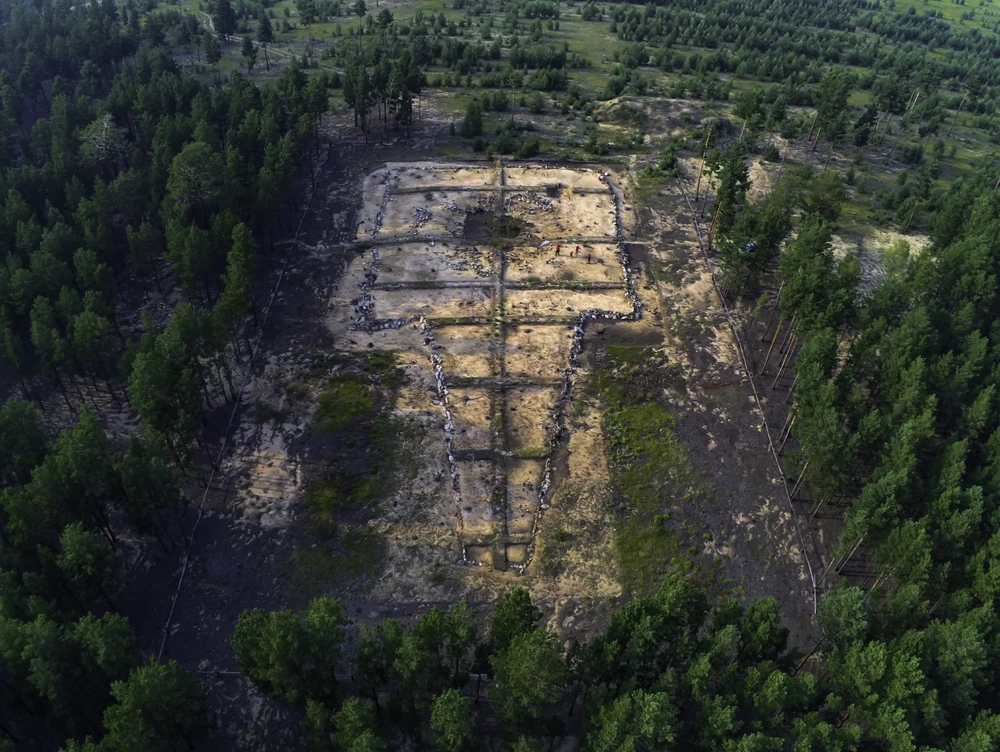
Including the southern entrance passage, Tomb 160 measures about 73 meters, or 240 feet, long. Excavators documented nine successive layers of stone filling descending to about 14.5 meters, or 48 feet. Its size and the labor involved indicate a burial commissioned for someone of considerable social standing.
Yet its central burial chamber, built around a wooden coffin and two enclosing wooden structures, was smaller and shallower than archaeologists expected from such an imposing monument. Above it, the team found a lacquered carriage, another sign of elite status. The museum suggests the unusual layout may reflect changes in Xiongnu society during the late first to second century CE, when the wider political system was under strain. That remains an interpretation rather than a settled explanation.
The glass cup’s Roman connection remains unconfirmed
Among the finds was a transparent glass vessel with a handle. Researchers believe it may have been manufactured somewhere within the Roman Empire, but its chemical composition still needs to be analyzed to investigate its origin. For now, calling it definitively Roman would go beyond the published evidence.
Long-distance goods could pass through multiple traders and communities before arriving in a burial. The cup therefore provides an important research lead into Eurasian exchange networks, not proof of a direct Rome-to-Mongolia trade mission. The National Museum of Korea’s official release identifies future compositional testing as the step needed to narrow down the vessel’s provenance.
Fifteen jade ornaments reveal adaptation, not simple imitation
Excavators recovered 15 flat jade pieces laid in overlapping positions at the bottom of the coffin. They evoke the bi discs associated with Han dynasty burials, but their irregular outlines and intricate decoration differ from the familiar circular form. The finds suggest that Xiongnu elites adopted elements of Han funerary culture while transforming their appearance and meaning.
Other discoveries point eastward to the Korean Peninsula. A gourd-shaped silver ornament inlaid with rock crystal resembles horse-harness decorations known from the ancient Lelang (Nangnang) tombs in the Pyongyang area. A separate gold ornament used materials beneath transparent crystal to create an interplay of light and color. According to the museum, the latter type had not previously been documented in a Xiongnu tomb.
What the burial tells us about nomadic power
The Xiongnu were a major political force based on the Mongolian steppe around the turn of the Common Era. The variety and refinement of these grave goods complicate any account of nomadic societies as culturally isolated or dependent only on neighboring settled empires. Xiongnu elites participated in—and helped shape—networks through which objects, technologies, styles and ideas moved.
Duurlig Nars is also part of the cemetery complexes of the Xiongnu nobility inscribed on UNESCO’s World Heritage List in 2026. Earlier archaeological work at the site is recorded in UNESCO’s archival photograph of Tomb 160. That archival image documents an earlier stage of excavation; it should not be confused with photographs released after the 2026 work.
Important questions remain unanswered
Researchers have not identified the person buried inside Tomb 160. The team recovered teeth and hair that may support DNA studies exploring the individual’s biological profile and possible kinship with people buried in nearby satellite graves. Those analyses have not yet established an identity, and they cannot by themselves reconstruct the person’s role or political power.
The National Museum of Korea says the recovered objects will undergo conservation and scientific study, with Mongolian specialists taking part. The investigation was introduced at the Korean Archaeological Society’s November 6–7 conference, and a fuller excavation report is planned.
Sources and further documentation
- National Museum of Korea, excavation announcement (November 6, 2026; Korean-language primary source).
- Live Science, archaeological reporting (November 18, 2026).
- Archaeology Magazine, independent coverage (November 12, 2026).
- UNESCO World Heritage Centre, Cemetery Complexes of the Xiongnu Nobility.