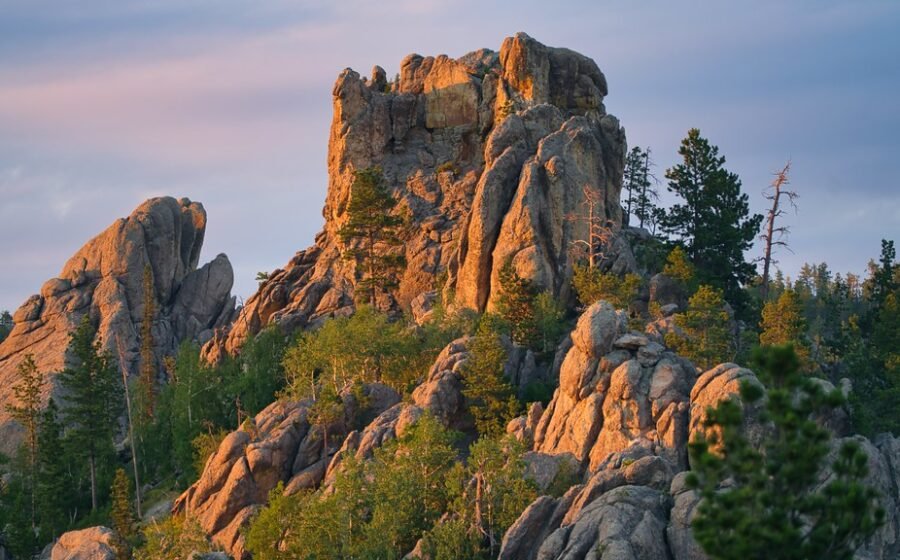
COMFREY, Minn. — An exposed ridge of reddish quartzite surrounded by prairie in southwestern Minnesota holds more than 5,000 carvings created by generations of Native American ancestors. At Jeffers Petroglyphs, some markings may date back roughly 7,000 years, while others were made much later. The sacred landscape remains culturally important to living Indigenous communities.
The Minnesota Historical Society describes Jeffers as one of the world’s oldest continuously used sacred sites. The carvings are not a recent discovery: scholars and residents documented the rock art long before the historical society acquired the property in 1966. New preservation methods have made thousands of previously obscured markings visible.
What the carvings show
The images include bison, turtles, thunderbirds, human figures, hunting equipment and geometric shapes. Some depict atlatls—tools used to propel darts or spears before the bow and arrow became common in the region. The historical society says the images record aspects of ceremony, experience and storytelling across many generations.
But individual symbols are not always straightforward to interpret. Dating is often based on the kinds of objects represented, not a direct date test of each mark. Archaeologists and Native American elders have worked together to understand the carvings, while recognizing that some meanings remain uncertain. Those limits matter: the carvings should not be assigned sensational or unsupported interpretations.
A place shared across Indigenous histories
According to the historical society’s history of the site’s people, the Ioway, Otoe, Cheyenne and Dakota are among the nations with documented ties to this region. The Dakota remain among the geographically closest tribal communities. Indigenous people continue to regard the site as a place of spiritual importance rather than simply an outdoor museum.
The surrounding grassland helps explain how part of the historic landscape survived: shallow soil around the outcrop made much of the native prairie unsuitable for plowing, even as farming transformed neighboring areas.
How conservation revealed thousands more
In 1971, Minnesota Historical Society archaeologist Gordon A. Lothson and colleagues recorded approximately 2,000 petroglyphs. A later conservation initiative carefully addressed lichen growth that was obscuring the rock surface. The effort uncovered roughly 3,000 additional carvings, bringing the identified total to about 5,000.
The site’s preservation history also reflects changing conservation practices. In earlier decades, workers applied marine varnish to make designs easier to see, but the practice ended by the early 1980s. Later projects involved conservators and Native American elders and emphasized protecting the rock while documenting its markings. See the society’s archaeology and conservation account.
A 2026 exhibit connects the past with living artists
A new visitor-center exhibition introduced in 2026 features contemporary Indigenous art and perspectives. MPR News reported in June that the exhibit includes a mural by Dakota artist Holly Young, artwork on buffalo hide by Sisseton Wahpeton Oyate artist Fern Cloud, and a video with Native community members discussing the site’s significance.
That focus adds an important dimension to archaeological interpretation: the knowledge and traditions associated with Jeffers are not confined to a distant past. The site is part of ongoing Indigenous cultural life, and its contemporary interpreters include people whose communities hold longstanding relationships to the land.
Watch: A closer look at Jeffers
Visiting Jeffers: Check the seasonal closure
Jeffers Petroglyphs is at 27160 County Road 2, Comfrey, Minnesota 56019. As of November 15, 2026, the Minnesota Historical Society’s official hours list the site as closed for the season from November 1 through December 31, 2026. Anyone planning a trip should check the current official calendar, rather than rely on older travel-site opening hours.
The historical society asks visitors to treat the landscape as a sacred place and respect ongoing religious and cultural practices. The site’s significance lies not only in the number or age of its markings but also in the Native communities whose history and knowledge they carry.
Sources and image credits
- Minnesota Historical Society — The Rock
- Minnesota Historical Society — Archaeology and Conservation
- Minnesota Historical Society — The People
- MPR News — June 9, 2026 exhibit report
- Minnesota Historical Society — Current Hours
- Featured photo: Travellers & Tinkers / Wikimedia Commons, CC BY-SA 4.0, photographed 2024.
- Inline photo: bhs128 / Wikimedia Commons, CC BY-SA 2.0, photographed 2007.