In-depth investigation | By Lotta Goddess | Khemetic.News | November 21, 2026
A child’s cancer disappeared after measles infection. Scientists later developed experimental treatments using weakened measles viruses. But do these discoveries reveal a suppressed cancer cure, a flaw in vaccination policy, or a promising science still struggling to reach patients?
The Discovery That Started a Controversy
In December 1970, physicians at Mulago Hospital in Uganda encountered a remarkable case. An eight-year-old boy had developed a large tumor behind his right eye. A biopsy confirmed Burkitt’s lymphoma, an aggressive cancer of the immune system. Before chemotherapy began, the child developed measles.
His tumor started shrinking around the time his measles rash appeared. Within approximately two weeks, the visible mass had disappeared. Physicians reported that he remained in remission during a four-month follow-up period, despite receiving no anticancer treatment during that interval.
The findings were published in The Lancet on July 10, 1971, in “Regression of Burkitt’s lymphoma in association with measles infection.”
More than half a century later, the case has returned to public attention through articles, social media and videos asking whether natural infections can protect people against cancer. The medical observation was real. The implications, however, are more complicated.
The crucial distinction is between a virus that sometimes damages cancer cells and an infectious disease that is safe or beneficial to acquire. Researchers have spent decades exploring the first possibility. The second has not been established.
The Forgotten Cancer-Remission Reports
The Ugandan boy was not the only patient whose cancer regressed following measles. Medical publications from the 1970s and 1980s described unusual remissions involving Hodgkin lymphoma, leukemia and other blood cancers.
A 1973 report in the British Medical Journal, “Infantile Hodgkin’s disease: remission after measles,” described a young child whose disease regressed after infection. Such reports attracted scientific interest, but temporary regression is not necessarily a lasting cure: malignant disease can recur and additional treatment may still be required.
These cases offered researchers an important biological clue: under certain circumstances, viral infection might contribute to destruction of malignant cells. That observation helped inspire a field of medicine called oncolytic virotherapy.
How a Virus Can Attack Cancer
Oncolytic viruses can infect and destroy some cancer cells. Depending on the virus and tumor, viral replication can directly injure infected cells; infection can trigger fusion of adjacent cells; and viral proteins may draw immune-system attention to the tumor. In some settings, this produces immune responses against malignant cells.
Researchers have investigated measles-derived viruses partly because certain cancer cells express receptors that facilitate viral entry. Wild-type measles uses receptors including CD150, also called SLAM, on some immune cells. Laboratory-adapted measles vaccine strains can additionally use CD46, a receptor expressed at elevated levels in several tumors.
Scientists have investigated measles-derived viruses in multiple myeloma, lymphoma, ovarian cancer, glioblastoma and other malignancies. The underlying mechanisms are discussed in the peer-reviewed reviews “Measles virus for cancer therapy” and “Measles virus as an oncolytic immunotherapy.”
But the presence of a receptor does not guarantee treatment response. A virus that damages cancer cells in a laboratory may not do the same thing in a human patient. Scientists still must determine whether it can reach enough tumor cells without causing unacceptable harm.
Natural Measles Is Not the Same as an Engineered Cancer Treatment
One of the most significant distinctions missing from some online discussions concerns the virus itself. The virus used in experimental cancer therapy is generally not the same as naturally circulating, disease-causing measles. Researchers commonly use weakened, laboratory-adapted strains derived from vaccine research; some are genetically engineered to improve targeting or allow imaging of viral activity.
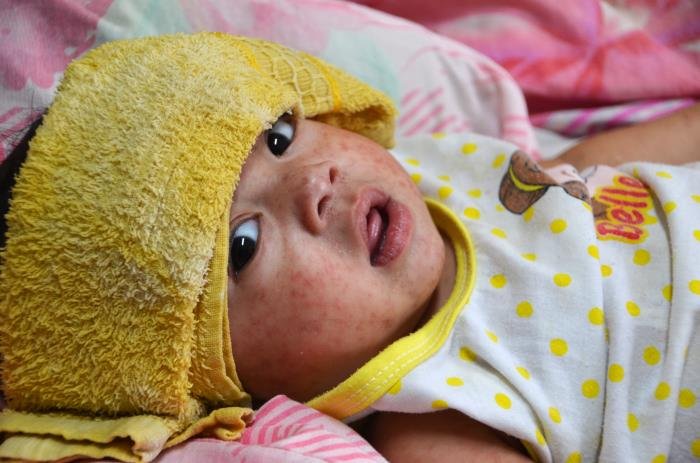
Patients receive measured doses under clinical supervision. Natural measles spreads unpredictably, can harm immune defenses, and can cause serious complications, including pneumonia and encephalitis. A therapeutic virus is intended to exploit selected biological characteristics while reducing risk.
Paradoxically, the same vaccine-development history criticized in some online discussions helped provide the weakened measles strains used in cancer research. The medical question is not whether people should catch measles. It is whether researchers can safely turn part of the virus’s biology into a reliable treatment.
Mayo Clinic’s Breakthrough: Cancer Remission Using a Measles Virus
In May 2014, Mayo Clinic in Rochester, Minnesota, announced a major development. Researchers administered an engineered measles virus called MV-NIS to two patients with treatment-resistant multiple myeloma. The virus was designed to attack malignant plasma cells and carried a gene enabling medical imaging of viral activity.
Both patients demonstrated responses. One patient achieved complete remission at the documented disease sites; the other showed evidence of tumor targeting but a less extensive clinical response. The findings were reported in Mayo Clinic Proceedings, “Remission of disseminated cancer after systemic oncolytic virotherapy.”
Mayo Clinic publicly announced the findings and described the trial. It was a proof of principle that a weakened engineered measles virus could be delivered through the bloodstream and show anticancer activity. It was not proof of a universal myeloma cure or that natural measles produces the same result.
Later research has investigated measles-derived viruses, immune responses, dosing and treatment combinations. A 2025 scientific review describes additional trials and limitations, including small patient samples and inconsistent outcomes. Measles-based virotherapy remains experimental rather than routine, broadly proven cancer care.

Did Childhood Measles Reduce Cancer Deaths Decades Later?
A separate claim concerns whether people who experienced measles as children were less likely to die from cancer as adults. A 2013 study in the European Journal of Epidemiology analyzed data from the Newcastle Thousand Families Study, a cohort of 1,142 people born in Newcastle-upon-Tyne, England, in 1947. Researchers examined childhood infections and later cancer mortality between ages 15 and 60.
Its abstract reported adjusted hazard ratios of 0.39 for childhood measles (an estimated 61% lower cancer-mortality hazard in this analysis), 0.49 for childhood influenza (an estimated 51% lower hazard), and 4.88 for childhood pertussis (a higher hazard). The commonly repeated 51% figure is sometimes attributed to measles, but the published abstract assigns it to influenza.
These are statistical associations, not proof that infection caused cancer protection. Childhood health, socioeconomic conditions, medical histories, life-course exposures and other factors can complicate comparisons. The outcome was cancer mortality, not proof that measles prevented cancer from developing. The study authors called for more research; their results are not grounds to deliberately expose children to measles.
The Other Side of the Immune-System Story: Measles Can Erase Immune Memory
The idea that infections influence the immune system is scientifically legitimate, but measles has another well-documented effect. A 2019 study published in Science examined antibody profiles before and after measles infection. Investigators reported losses in recognition of approximately 11% to 73% of previously recognized antibody targets, varying across infected children.
Researchers call this phenomenon immune amnesia. A child recovering from measles can become more vulnerable to infections the immune system previously recognized. Thus, a temporary immune response capable of damaging some cancer cells can coexist with broader, harmful disruption of immune defenses.
Were Measles Deaths Already Declining Before Vaccination?
The supplied video argues that measles deaths had fallen dramatically before vaccines became available. The underlying historical observation is partly correct: mortality from many infections declined during the twentieth century as nutrition, living conditions and supportive medical care improved.
But declining mortality is not the same as declining infection rates. According to CDC historical estimates, before measles vaccination began in 1963, roughly 3 million to 4 million Americans contracted measles annually. Approximately 48,000 were hospitalized, roughly 1,000 developed encephalitis and 400 to 500 died each year.
Improved care reduced how often infection killed people; it did not eliminate widespread infection and disability. Following vaccine introduction and expansion, infections declined sharply. During the 1989–1991 U.S. resurgence, the CDC documented another substantial wave, including approximately 55,000 cases and 123 deaths. A year with few recorded deaths does not establish that a recurring infectious disease is harmless.
Vaccine Injuries and Claims About MMR Deaths
Vaccines are medical products and can cause adverse reactions. The measles-mumps-rubella vaccine has uncommon but documented risks, including fever-associated seizures, temporary low platelet counts and rare serious allergic reactions. CDC safety information describes these risks and provides context for weighing them against the disease’s complications.
The supplied video promotes a claim that vaccination has been linked to “1,700% more deaths” than measles infection. That comparison does not establish vaccine-caused mortality. The Vaccine Adverse Event Reporting System (VAERS) accepts reports of medical events that occurred after vaccination, including events for which causation is unknown.
To determine causation, investigators examine medical records, alternative causes, background rates, biological plausibility and evidence from more rigorous studies. Comparing unverified post-vaccination reports with confirmed disease deaths—and omitting the infections vaccines prevented—cannot produce a trustworthy causal risk estimate. Vaccine injuries deserve investigation; misleading denominators do not make that investigation stronger.
Vitamin A, Diagnosis and the Limits of Testing
Vitamin A has a legitimate role in some measles-care recommendations, particularly for children whose nutritional status or clinical risk makes complications more likely. The World Health Organization discusses the importance of supportive care. But vitamin A does not replace vaccination, does not prevent infection and can be toxic in excessive doses.
The video also suggests measles death counts may be inflated by false tests or incorrect attribution. Diagnostic uncertainty is a real medical issue; laboratory tests are not infallible. Public-health laboratories use clinical findings, exposure histories, serology and molecular assays such as RT-PCR to investigate suspected cases. Recognizing that limitations exist does not establish a widespread fraud in measles surveillance. See CDC laboratory guidance.
Does MMR Cause Childhood Cancer?
One supplied commentary raises concerns about residual DNA from vaccine manufacturing and possible cancer risks. Those are testable scientific claims, but similarities in timing or manufacturing history do not establish causation.
The measles and mumps components of MMR are propagated in chick-embryo cell culture; the rubella component has historically used established human cell lines. Manufacturing processes must be evaluated for safety, but the use of cell culture does not itself prove that vaccination induces cancer-causing genetic changes.
A major Cochrane systematic review found no evidence that MMR vaccination increases childhood leukemia risk in the studies examined. U.S. measles vaccine history also predates the combined MMR product introduced in 1971: both live attenuated and inactivated measles vaccines were licensed in 1963.
Ongoing pharmacovigilance, manufacturing quality controls and long-term research are appropriate. A claim that MMR vaccination is responsible for increases in childhood cancer requires evidence not established by the supplied commentary.
The Suppression Question: Who Benefits Financially?
The most serious allegation is that pharmaceutical companies and public-health authorities hid evidence of measles-related cancer benefits to protect vaccine revenue. This deserves scrutiny, but the available records do not establish such a coordinated suppression campaign.
The historic cases appeared in medical journals; the oncolytic mechanisms have been discussed in peer-reviewed research; Mayo Clinic publicly promoted its 2014 trial, released video and discussed the findings with journalists. The National Cancer Institute helped fund the Mayo research, alongside charitable support.
There is, however, a documented financial-interest issue. Mayo Clinic disclosed that several investigators and the institution had financial interests in the technology involved in the 2014 study. That is a conflict requiring transparency and oversight; it is not proof that the data were falsified or a cure was concealed.
Financial interests can influence which projects receive investment, how discoveries are patented, what trials are prioritized and what patients ultimately pay. The worthwhile accountability questions are concrete: Who owns the oncolytic-virus patents? How much public money supported development? Are negative trial results available? Who benefits from commercialization? Are prices and access plans transparent?
These questions should be pursued through patent documents, trial registrations, funding records and financial disclosures, rather than assuming answers from the existence of industry profits.
Why Has Measles-Virus Cancer Therapy Not Become Routine?
Exceptional patient responses are not the same as reliable results across many people. Researchers must identify susceptible cancers, predict which patients will respond, improve the delivery of virus to tumors and ensure safety in medically vulnerable patients.
Most adults have antibodies against measles from prior vaccination or infection. Those antibodies can neutralize experimental viral therapy before it reaches its target. Researchers have investigated ways to overcome that barrier, alongside questions about dosing, tumor resistance, manufacturing and combination therapy.
The broader field has already reached regulators: in 2015 the U.S. Food and Drug Administration approved an oncolytic virus treatment for some patients with melanoma using modified herpesvirus rather than measles. See the National Cancer Institute explanation of oncolytic virotherapy.
Federal Litigation and the Limits of Allegations
The video refers to a federal racketeering lawsuit against the American Academy of Pediatrics. A case was filed in January 2026: Shaw et al. v. American Academy of Pediatrics. The plaintiffs allege misleading vaccine-safety representations and financial misconduct. Those allegations are contested; filing a complaint does not establish that a court has found racketeering, vaccine fraud or cancer-research suppression.
The lawsuit also does not scientifically establish that measles infection prevents cancer. Legal allegations and clinical research each require their own standards of proof.
Medical Advertising, Media Narratives and Public Trust
The supplied video contrasts old television stories portraying measles as an ordinary childhood episode with modern programs dramatizing its danger. Entertainment clips demonstrate changing cultural narratives; they are not reliable measures of infectious-disease risk.
Pharmaceutical advertising and sponsorship raise legitimate questions about newsroom independence. News organizations should disclose relevant commercial relationships and investigate healthcare-industry influence. But demonstrating suppression would require documentary evidence, credible testimony or corroborated records tying commercial pressure to specific editorial decisions. Public promotion of experimental measles virotherapy is evidence against the claim that the entire subject was hidden.
What the Evidence Still Cannot Tell Us
Researchers have not established that intentionally acquiring natural measles reduces lifetime cancer risk or that declining MMR vaccination improves cancer outcomes. Historical case reports cannot show how often remission occurs, and the Newcastle cohort does not show causality. Nor is engineered measles virotherapy yet a universally effective cancer treatment.
At the same time, viral cancer therapy is not imaginary. It has documented history, plausible mechanisms, and human clinical evidence. Families facing cancer deserve information that is neither sensationalized nor prematurely dismissed.
What Should Happen Next?
Researchers should continue studying how measles-derived viruses recognize tumors, how they can be delivered safely and whether results are reproducible in controlled studies. Research institutions should disclose patents, grants, financial interests and unfavorable trial outcomes. Treatment developers should face scrutiny over access and pricing. Officials should communicate established vaccine benefits and recognized harms openly. Journalists must distinguish unusual observations from medical recommendations.
Conclusion: A Real Discovery Does Not Require an Invented Cover-Up
The Ugandan boy’s tumor regression was documented. Oncolytic measles research is real. Mayo Clinic’s proof-of-concept clinical result is real. Financial interests in drug development are real and deserve examination.
But the evidence reviewed does not establish that vaccination causes cancer, that deliberate infection prevents cancer or that pharmaceutical companies buried a proven measles-based cure.
The real story is not that everyone should catch measles. It is that scientists discovered a potentially useful property of a dangerous virus—and are working to turn that property into medicine.
Primary Sources and Further Reading
- The Lancet (1971): Regression of Burkitt’s lymphoma in association with measles
- Measles virus for cancer therapy — scientific review
- British Medical Journal (1973): Infantile Hodgkin’s disease, remission after measles
- European Journal of Epidemiology (2013): Childhood infections and cancer mortality
- Mayo Clinic Proceedings (2014): Remission after systemic oncolytic virotherapy
- Mayo Clinic original announcement, funding and financial disclosures
- Measles virus as an oncolytic immunotherapy (2021)
- Review of measles-virus treatment of hematological malignancies (2025)
- Science (2019): Measles and immune amnesia
- CDC: Measles historical burden
- CDC: MMR vaccine safety
- Cochrane review: MMR vaccine evidence
- National Cancer Institute: Oncolytic virus cancer treatment
- Federal court docket: Shaw v. American Academy of Pediatrics
Commentary evaluated: Marcella Piper-Terry, The Focal Points, and the supplied video. Their interpretations are distinguished from original scientific records.
Editorial note: This article draws on published research and documented public statements. No patients or investigators were independently interviewed. It is not medical advice or an endorsement of intentional infection.