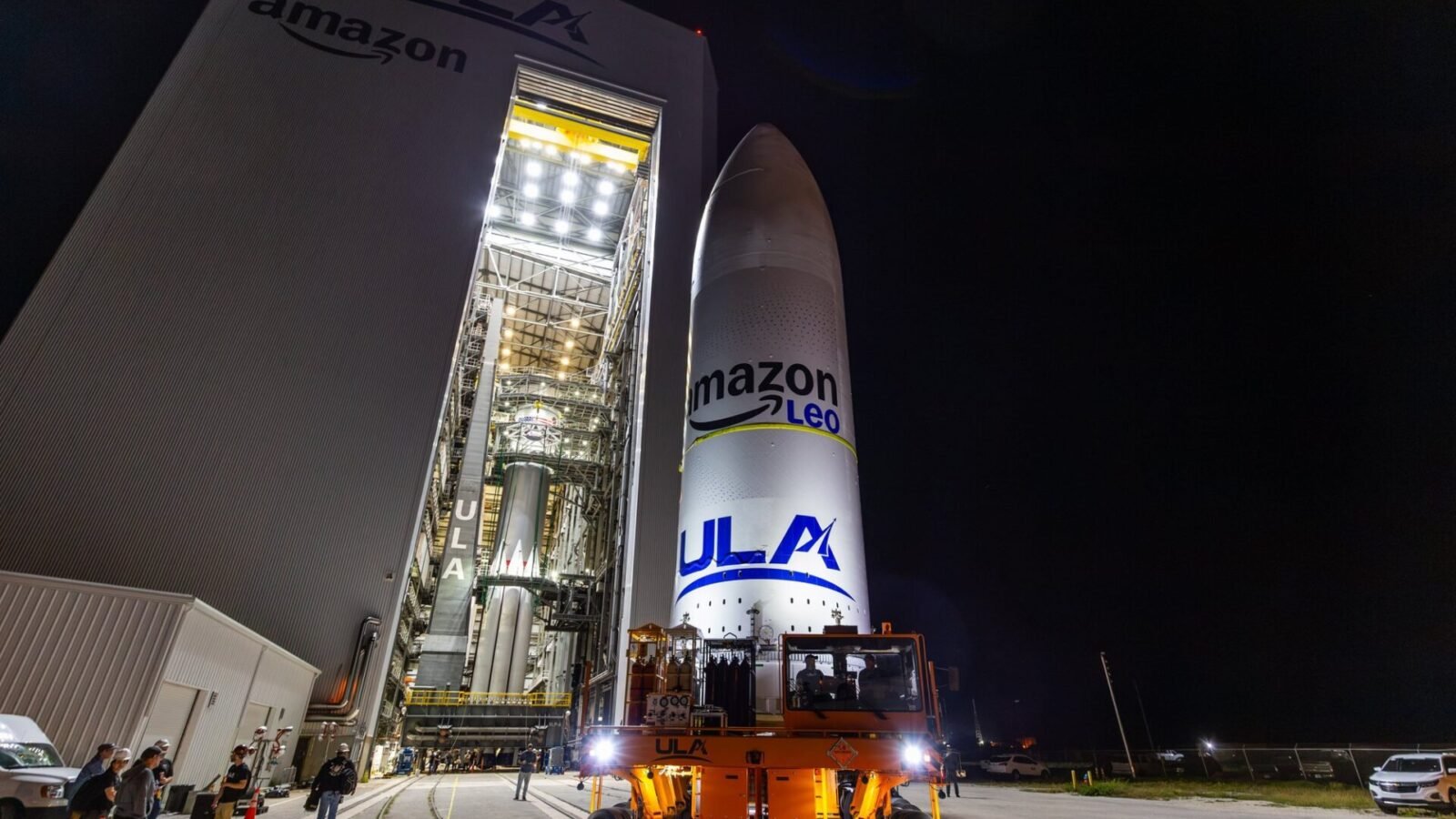
CAPE CANAVERAL, Florida — Amazon’s effort to build a satellite-internet competitor to SpaceX’s Starlink suffered a major setback on Sunday, November 15, 2026, when a United Launch Alliance (ULA) Vulcan rocket failed to deliver 40 Amazon Leo satellites into orbit. The launch from Cape Canaveral Space Force Station began at 12:40 p.m. Eastern. ULA reported that it lost telemetry and the mission about 10 minutes into flight, and Amazon confirmed that the payload was lost.
On Tuesday, November 17, ULA published an early explanation: preliminary data indicate that the rocket suffered lower-than-expected booster performance shortly after liftoff, leaving the vehicle too low and too slow at stage separation to achieve its target orbit. The specific root cause has not been determined, and federal regulators are overseeing a formal investigation.
What ULA’s latest investigation update says
In its November 17 mission update, ULA said the Vulcan rocket’s upper stage appeared to start normally and its two RL10 engines were operating as planned. The upper stage could not overcome the shortfall in the earlier part of the flight.
ULA also reported that the rocket’s six solid rocket boosters appeared to perform normally, following nozzle improvements made before this mission. That distinction matters: the reported low performance was associated with the launch vehicle’s initial boost, but the available evidence does not establish a particular component failure. Assigning blame to an engine, manufacturer or supplier now would go beyond the company’s findings.
The November 15 mission, known as Vulcan Leo 1 (LV-01), was the first Vulcan launch dedicated to Amazon Leo, formerly called Project Kuiper. The rocket carried the largest single Amazon Leo satellite batch planned to that date.
FAA orders a mishap investigation
On November 16, the Federal Aviation Administration announced that it would oversee ULA’s investigation, review the company’s final report and approve any necessary corrective actions. The agency said it had activated two Debris Response Areas during the failure, temporarily slowing or holding some aircraft to keep them clear of falling debris.
The FAA’s return-to-flight review focuses on whether systems, processes or procedures involved in the mishap affect public safety. As of November 17, no final cause or return-to-flight date had been announced.
Why losing 40 satellites matters to broadband competition
Amazon Leo is building a low-Earth-orbit satellite network intended to deliver internet service to households, businesses, schools and other customers, including areas underserved by wired broadband. The company is competing in a market where Starlink already operates a much larger constellation.
ULA has a contract for 38 Vulcan missions supporting Amazon’s network. This flight was the first of those planned Vulcan missions, following multiple successful Amazon Leo launches on ULA’s Atlas V rocket.
The loss eliminates 40 spacecraft that were intended to expand Amazon’s network and leaves uncertainty around Vulcan’s near-term launch availability. It does not, by itself, establish that Amazon Leo’s broadband service or entire deployment program is canceled. The financial and schedule consequences have not been publicly quantified.

Amazon has other routes to orbit
Amazon is not relying on Vulcan alone. Its launch providers include Arianespace, Blue Origin, SpaceX and ULA. According to Amazon’s mission schedule, an Ariane 6 launch is targeted for no earlier than November 23, 2026, to carry 36 more Amazon Leo satellites.
That schedule provides a potential path for continued deployments while ULA works through the Vulcan investigation. Whether the failed launch will delay future commercial rollout, require changes to the launch manifest or affect other Vulcan customers remains unclear.
Watch the official mission coverage
Watch ULA’s original Vulcan Leo 1 launch webcast on YouTube. The official broadcast documents the November 15 flight; the subsequent technical conclusions come from ULA’s November 17 written update. Video credit: United Launch Alliance.
What happens next
Investigators must reconstruct what caused the first stage to deliver insufficient performance and determine whether any design, operational or procedural changes are necessary. ULA and the FAA have not yet published final findings.
For U.S. consumers and policymakers, the outcome matters for two reasons: reliable commercial launch capacity is essential to the nation’s space industry, and additional satellite-broadband competition could expand choices in hard-to-connect communities. Those potential benefits depend on successful future deployments, not on this mission alone.
Sources and documentation
- United Launch Alliance, “Vulcan Leo 1 updates,” November 15 and 17, 2026 — mission loss and preliminary performance findings.
- Federal Aviation Administration, November 16, 2026 statement — investigation and aviation safety response.
- Amazon Leo mission updates — payload loss, launch schedule and next planned Ariane 6 mission.
- ULA Vulcan Leo 1 mission profile — rocket configuration and Amazon launch contract.
- Spaceflight Now, November 15, 2026 — independent account of the mission failure.