SORANO, Italy — Archaeologists excavating a prehistoric cavity at the Terme di Sorano thermal-spring complex in Tuscany have recovered a small, polished greenstone axe with an apparently untouched cutting edge. The discovery, described in reports published November 16, 2026, adds to evidence that people visited the hot-spring site thousands of years before the modern spa existed.
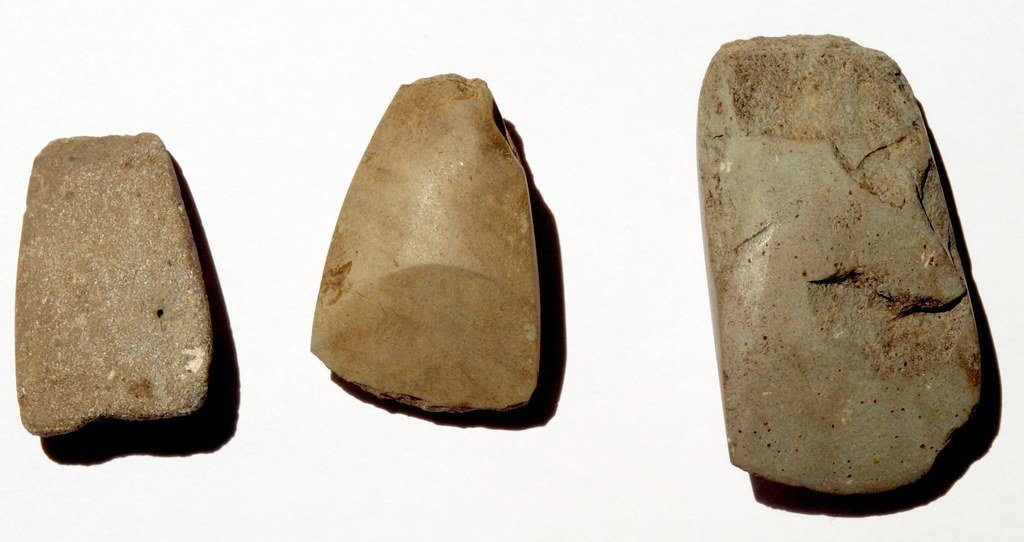
Photo identification: The featured archival photo shows real Stone Age axe heads recovered at Skatestraumen, Bremanger, in western Norway and exhibited in Bergen Museum. Two are greenstone and one is diabase. They are comparable prehistoric artifacts, not the axe excavated at Terme di Sorano. Photo: Arild Finne Nybø (arnybo), Flickr, CC BY-SA 2.0.
The axe is made of eclogite, a hard metamorphic rock whose source was probably in the western Alps, according to the excavation team. That origin raises questions about how stone and finished objects traveled across Neolithic Europe. Its lack of visible wear has also prompted researchers to consider a symbolic or ceremonial purpose, although no specific ritual has been established.
What archaeologists found
Excavations began in July 2024 at a large travertine cavity above the historic Bagno dei Frati pool, which dates to the 15th century. The cavity covers approximately 320 square meters (about 3,440 square feet) and extends to a depth of roughly 3.6 meters (almost 12 feet), according to the Italian Ministry of Culture’s January 2026 announcement.
Early digging identified an entrance with three steps cut into the rock and, lower down, an elliptical structure built from travertine and tuff. Archaeologists also encountered an ancient thermal-water level that had not previously been documented at that spot. Finds include fragments of pottery, stoneworking material, and animal remains.
The polished axe emerged during the third excavation campaign. Reporting from Tuscany’s regional news outlet InToscana describes it as intact, sharp, and showing no sign of use. Optical and scanning-electron microscopy identified its stone as eclogite. The excavation is directed by archaeologist Stefano Giuntoli under a permit from Italy’s Ministry of Culture, with support from the spa operating company and researchers at Italian institutions.
How old is the find?
Radiocarbon analysis of charcoal in contact with the stone structure yielded a date range of approximately 4495–4335 BCE, or roughly 6,400 to 6,500 years before the present. This is evidence for the age of the excavated structure and Neolithic activity at the spring; it is not a direct laboratory date for the axe itself. Its archaeological context supports a Neolithic attribution, but a more exact manufacture or deposition date is not currently established by the cited announcements.
Why an unused axe matters
Polished stone axes were practical technologies, but some examples also served as markers of status or appeared in burials and ritual deposits. The Sorano axe’s pristine cutting edge makes a purely utilitarian explanation less obvious, and archaeologists have suggested that it may have held symbolic importance.
Water is part of that hypothesis. Springs and other watery places sometimes figured in the ritual landscapes of prehistoric communities. The thermal source at Sorano makes such an interpretation plausible, but it would be premature to describe the axe as a confirmed offering or to assign it to any named belief system. Archaeologists have not identified an individual owner or demonstrated precisely how the object was deposited.
What the research still needs to establish
Excavation remains incomplete, and the functions of several stone features are still under investigation. Researchers are documenting the site in three dimensions and examining additional material. The unanswered questions include whether people lived near the spring, how often they visited, whether the axe arrived as a finished object or as raw stone, and whether it was intentionally placed in the cavity.
For archaeology audiences in the United States, the discovery is a useful comparison to the wider challenge of interpreting ancient objects from their context rather than from appearance alone. It does not establish a historical connection between Neolithic Tuscany and ancient American communities.
Sources and original photographs
InToscana, November 16, 2026 — reporting on the third excavation campaign, axe condition and geological identification.
Italian Ministry of Culture, January 16, 2026 — official excavation announcement and the site’s radiocarbon results.
Finestre sull’Arte, November 16, 2026 — details of the excavation, with original photographs credited to Davide Denci / Italian Ministry of Culture. These are linked for readers, not reproduced here pending confirmation of redistribution rights.
Gizmodo, November 17, 2026 — English-language coverage of the announcement.
Image source and licensing: Arild Finne Nybø, “Stone age axe heads,” Flickr (CC BY-SA 2.0). The photograph illustrates comparable museum-held axes, not the Sorano excavation.