MARANHÃO, BRAZIL — Members of an isolated Awá Indigenous group approached a government access-control post and the neighboring Guajajara village of Tawari in Brazil’s Arariboia Indigenous Territory on November 16, 2026. Brazil’s Indigenous affairs agency confirmed the encounter and activated a coordinated response focused on disease prevention, territorial protection and the community’s right to remain isolated.
Indigenous-rights organization Survival International reported that about 20 Awá people requested yams and carried the food back into the forest. The agency’s November 17 official statement confirms a series of sightings and approaches beginning November 16 but cautions that details remain preliminary.
The encounter drew attention because the group has generally avoided regular contact with outsiders. Its reason for approaching the post has not been established. Advocates fear that logging, hunting, fires and encroachment have narrowed access to traditional resources, but the food request alone does not prove starvation or a collapse in food supplies.
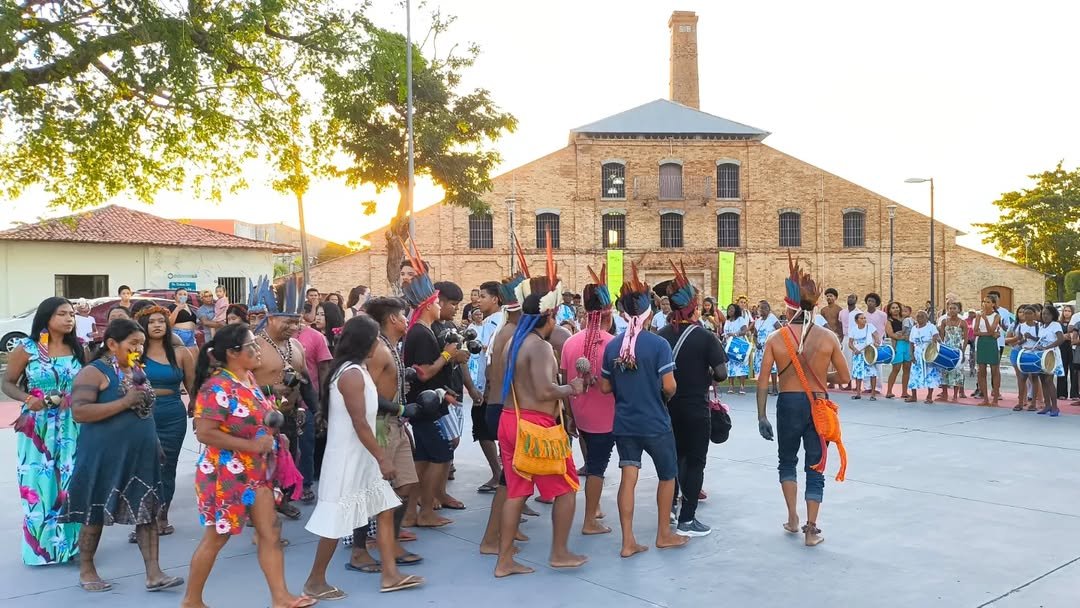
Featured image: Indigenous cultural performers from the Arariboia territory in Maranhão, July 2024. Archival photograph, not the isolated Awá group seen in November 2026. Photo: William Junior Pindaré / Wikimedia Commons, CC BY-SA 4.0. Display-sized thumbnails generated by WordPress.
What officials confirmed
Funai said the Awá group is already recorded in its official database as an isolated Indigenous group and is routinely monitored by a specialized environmental protection team. Brazil’s Indigenous Health Secretariat, known as SESAI, also placed personnel and supplies in the area. Agencies activated an emergency coordination mechanism to assess the situation and reduce the risk of infectious disease.
In an official November 18 interview, Indigenous Peoples Minister Eloy Terena said the purpose of government monitoring is to prevent forced contact. He said the country maintains records of 114 groups in isolation or recent contact, and that health protocols are critical because some isolated communities face unusually serious dangers from pathogens carried by outsiders.
Funai explicitly warned that a brief encounter should not be treated as a decision by the Awá to abandon isolation. Its policy prioritizes non-contact, territorial integrity and the community’s autonomy over whether and when to establish relationships with other groups.
Why the forest is at the center of the story
The Awá depend on access to the forest for hunting, gathering and cultural continuity. The Arariboia territory is also home to the Guajajara, including Indigenous forest defenders who have confronted illegal logging and other incursions. Survival International says these pressures may help explain the encounter, while acknowledging the cause is not yet confirmed.
Territory protection has been an active government concern. Brazil began a coordinated operation in 2025 to remove unauthorized occupants from Arariboia. In 2026, officials said efforts were continuing to consolidate territorial protection and deter renewed invasions. That history establishes a documented threat to the land; it does not establish that any particular incursion caused the November approach.

What the Guajajara have said
Guajajara community members recorded the encounter. Survival International says Indigenous forest defenders asked that images be released to draw attention to threats against the territory. The organization quoted the defenders as calling for prompt action with direct dialogue and respect for the Awá community’s wishes.
Those images carry their own ethical and legal considerations: the community that recorded them controls how they should be credited and reused. They should not be republished without clear permission, and archive photographs of other Awá or Guajajara people must not be passed off as images of the isolated group seen in November.
A question familiar to Indigenous nations in the United States
The dispute occurs in Brazil, but its central issues echo struggles in the United States over treaty rights, land access, self-government and enforcement of protections for Native nations. The two countries have different histories and legal systems; the comparison is about a continuing principle, not identical circumstances: government recognition means little without effective protection of Indigenous territories and meaningful respect for Indigenous decision-making.
What remains unknown
Authorities have not publicly established why the Awá approached the outpost, whether they need additional food support or whether other members of the group will seek contact. Officials say the immediate priorities are health, safety and the freedom of the Awá to choose their relationship with outsiders.
Descriptions such as “the world’s most endangered tribe” come from advocacy campaigns rather than a definitive global ranking. A more precise description is that isolated Awá communities face serious documented territorial and public-health threats.
Sources and further reading
Watch original-source footage: Reuters video of the November 16 encounter, filmed by the Guajajara community and released through Survival International on November 17. The published footage blurs identities for protection. Linked rather than embedded to preserve the original publisher’s video controls and avoid broken third-party players.
- Funai, official statement on the Arariboia interaction (November 17, 2026)
- Survival International, account and statements from Indigenous forest defenders (November 17, 2026)
- Associated Press, independent reporting on the encounter (November 18, 2026)
- Reuters, images and reporting on the encounter (November 17, 2026)
- Brazilian government interview with Indigenous Peoples Minister Eloy Terena (November 18, 2026)