Khemetic Nation News Network | History & Restoration Desk
Historical explainer
On the shore of Belize’s New River Lagoon, Lamanai preserves a history that stretches far beyond the familiar image of an abandoned Maya city. Its temples, archaeological deposits and later colonial remains record a place repeatedly inhabited and reshaped over many centuries. The site offers a powerful lesson: Maya history includes endurance and transformation as well as the decline of particular political centers.
The place called “Submerged Crocodile”
Belize’s National Institute of Culture and History locates Lamanai in the Orange Walk District, near Indian Church village, and gives its name’s meaning as “Submerged Crocodile.” The institute identifies it as one of the unusual archaeological sites whose original Maya name survived into historical records.
The Belize Tourism Board’s site overview places the ancient settlement beside the New River Lagoon. It describes temples and palaces from the Preclassic and Classic periods, as well as a prominent mask depicting a ruler emerging from a crocodile headdress. Architecture and imagery together show how public space could communicate authority and religious meaning.
A history measured in millennia
Official summaries give different starting points for settlement. NICH’s brief overview reaches back to approximately 1500 BCE, while the tourism board gives around 900 BCE. A 2016 study published in Radiocarbon describes occupation reaching into the Early Preclassic, before 1630 BCE. Those summaries should not be collapsed into one supposedly exact founding date.
The research is especially valuable for what happened much later. Using archaeological context and radiocarbon evidence, including 19 new accelerator mass spectrometry dates, the study examined chronology around the transition from the Late Classic into the Postclassic period. Its findings support persistent occupation at Lamanai through a time when many other Maya centers underwent major disruption.
Continuity does not mean the population, buildings or political institutions remained unchanged. It means that the evidence does not support treating Lamanai as simply deserted at the end of the Classic period. Researchers must distinguish the survival of a community from the survival of a particular ruling system.
The High Temple: architecture on a grand scale
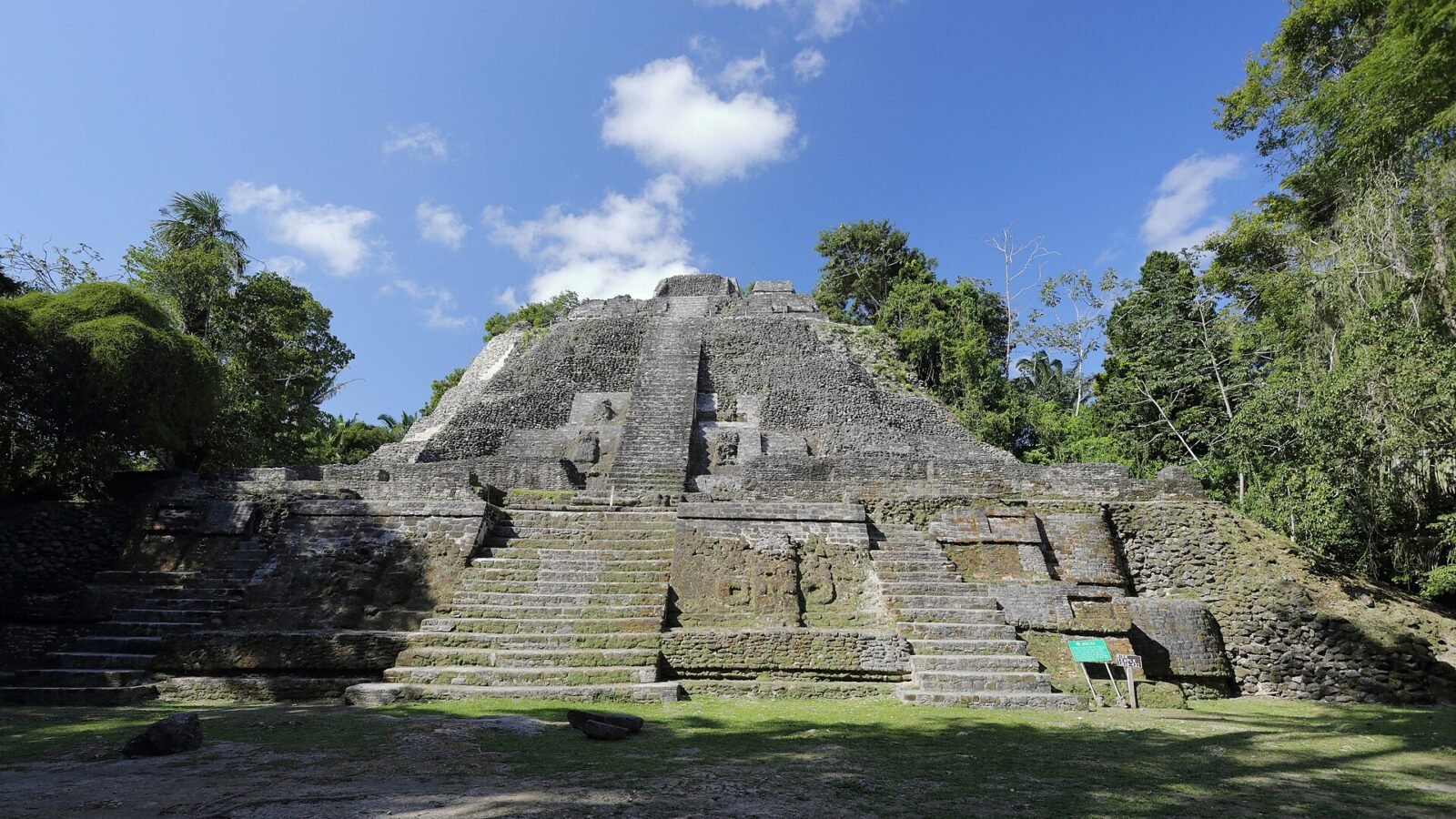
The High Temple remains among Lamanai’s most striking buildings. The Institute of Archaeology–CyArk virtual tour describes it as approximately 33 meters tall and built principally from locally available limestone blocks joined with mortar.
The monument helps visitors appreciate the labor and knowledge invested in Maya construction. Its scale also needs to be understood within a larger settlement. The Lamanai Field Research Center reports more than 700 Maya structures in the area. The temple is therefore one visible part of a much broader cultural landscape.
Colonial remains complicate the story
Lamanai’s history continued into the era of European intervention. The tourism board records the remains of two sixteenth-century Spanish churches and a sugar mill established in 1860. These are later layers of the same landscape, not ancient Maya monuments.
The churches speak to missionary efforts and colonial pressure; the industrial remains document a different economic project centuries later. Keeping these phases distinct allows the site to tell a fuller history without implying that occupation across time was peaceful, uniform or culturally unchanged.
Conservation connects the site with living communities
A 2014 University College London research account describes archaeological work at Lamanai as a long-term undertaking with community consequences. It records conservation and visitor-center development alongside guide training and artisan activities in nearby Indian Church.
More recently, the CyArk heritage project brought the Institute of Archaeology and community participants together for training in three-dimensional documentation and storytelling. Photogrammetry and interviews underpin an online High Temple experience available in English and Spanish. Its value lies in presenting local voices alongside the monument.
Reading Maya history across different places
Compared with the household remains discussed in KNN’s article on ancient Maya culture in El Salvador, Lamanai highlights a different question: how a settlement persisted through successive historical changes. These complementary perspectives remind readers that Maya civilization was diverse, and that individual places followed different paths.
Photograph: Lamanai’s High Temple, Martin Falbisoner, March 17, 2016, via Wikimedia Commons, licensed CC BY-SA 4.0. Resized for web display; the theme may crop the image. Image adaptations remain under the same license.
Sources and editorial note
Sources are linked throughout: NICH, the Belize Tourism Board, the Radiocarbon research record, the Lamanai Field Research Center, UCL and the Institute of Archaeology–CyArk project. This is a historical explainer, not an announcement of a new excavation or discovery.