By Lotta Goddess | Khemetic.News | Education, Technology & Community | November 13, 2026
A teacher in Ghana who drew computer software on a chalkboard became an international symbol of educational dedication. Microsoft, a technology-training company, individual donors and American nonprofits responded with computer facilities and training opportunities. Eight years later, documented results show real change—but the current lives of Akoto and the children are not fully accounted for.
In a classroom at Betenase Municipal Assembly Junior High School in Sekyedomase, Ghana, Richard Appiah Akoto drew the Microsoft Word interface with colored chalk. His students copied menus, icons and toolbars into their notebooks because they could not practice on working computers. The photographs went viral in February 2018. They triggered equipment donations and international interest—but they also exposed the larger problem of requiring children to study information technology without suitable equipment.
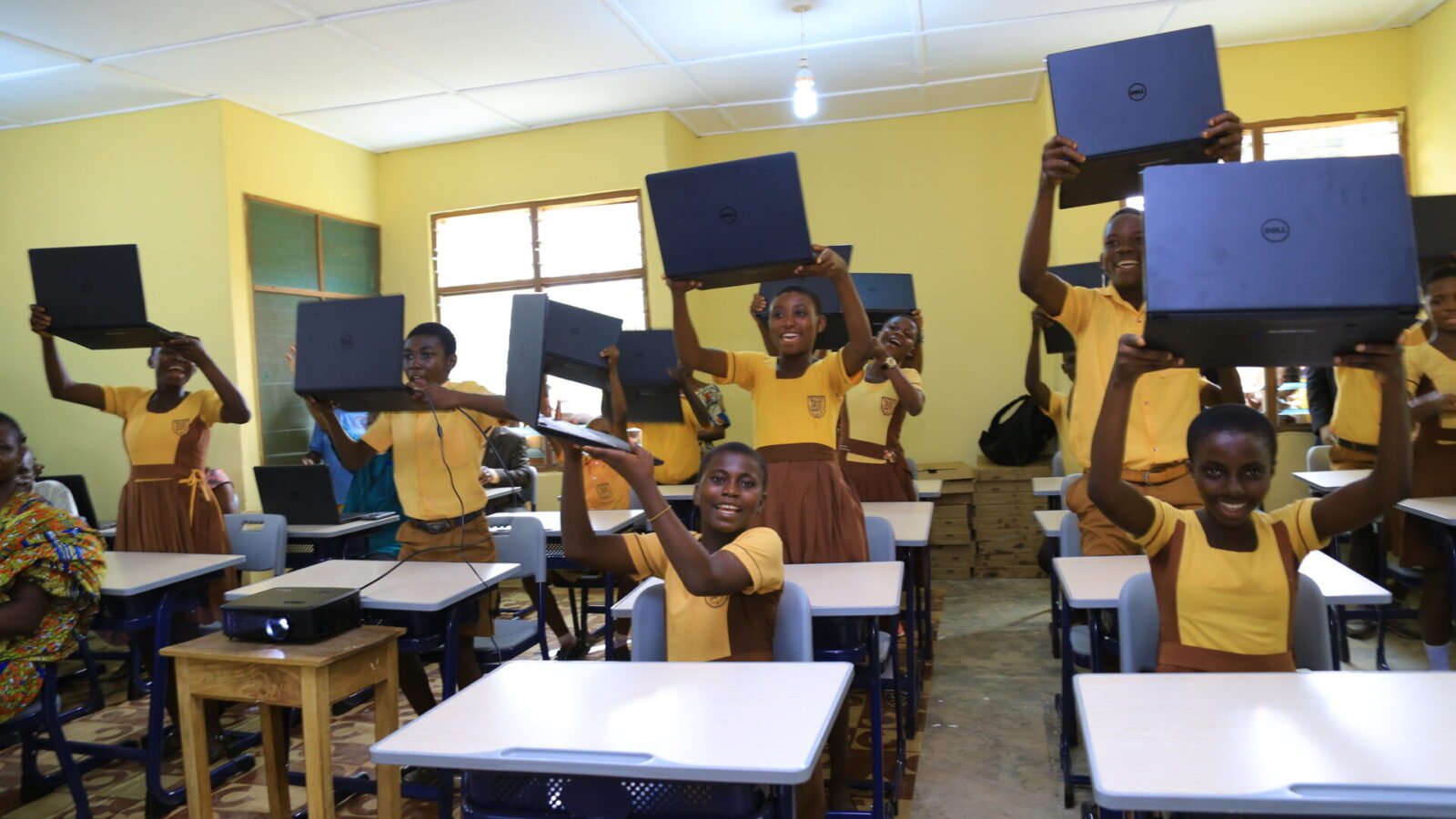
The documented response went beyond one laptop. Microsoft and local partner eSolutions Consulting supplied 27 laptops and outfitted a school lab. NIIT Ghana delivered five desktop computers and textbooks; a private donor sent another laptop. American nonprofit organizations later supported a separate 48-seat community facility. A 2022 program report counted 2,306 student visits to that community lab in just one quarter. Microsoft’s 2018 account and the 2022 Yamoransa report establish the central milestones.
A national computer exam without classroom computers
Akoto taught Information and Communication Technology to a class of roughly 47 teenagers. The school had lacked working computers for years, even as students were preparing for the Basic Education Certificate Examination, which includes ICT. In CNN’s March 2018 reporting, Akoto explained that he wanted children to recognize what a screen would look like when they eventually encountered a computer.
His blackboard lessons were not a staged stunt. He described repeatedly drawing monitors, keyboards, a mouse and software interfaces when a lesson demanded them. Although his ingenuity helped students visualize unfamiliar equipment, drawings could not provide the practical experience of using a mouse, keyboard or document editor. That gap was central to the story.
How a photograph reached Microsoft
Akoto posted classroom photographs on Facebook under the name Owura Kwadwo Hottish. Cameroonian technology entrepreneur Rebecca Enonchong amplified the story on social media and urged Microsoft to provide teaching resources. Microsoft responded publicly and invited Akoto to its March 2018 Education Exchange conference in Singapore. The advocacy helped attract a corporate response; it should not be conflated with a personal financial donation by Enonchong.
Microsoft reported that Akoto, then 33, received a standing ovation at an event attended by hundreds of educators from many countries. It was his first trip outside Ghana, according to the company’s contemporary interview. He was also offered professional-development opportunities through the Microsoft Certified Educator Program. An offer of training is not proof that he ultimately completed a certification.
The publicly documented organizations and individual donors
Public reporting identifies the following contributors. The table distinguishes actual equipment and funding from technical assistance or public advocacy; it does not purport to list every unrecorded private offer.
| Contributor | Documented role or assistance |
|---|---|
| Microsoft / Microsoft Ghana | 27 laptops, Microsoft Office Professional Plus, classroom furniture, storage, projector and screen, UPS, routers, initial connectivity, uniforms and educational supplies; international educator conference invitation. |
| eSolutions Consulting | Local Microsoft education partner supporting the school laboratory. |
| NIIT Ghana / BlueCrest College | Five desktops, ICT books and a laptop for Akoto. The institutional names should not be double-counted as separate donations. |
| Amirah Alharthi | Individual donor who sent a laptop from the United Kingdom in March 2018. |
| Unicaf / Unicaf University | Announced a full scholarship for a Master’s in Education and a study tablet; graduation has not been independently confirmed. |
| Friends of Yamoransa | U.S.-based nonprofit partner in the 48-seat community computer laboratory. |
| Helping Africa Foundation | U.S.-based nonprofit funding and coordination for the broader Yamoransa Model lab program. |
| TECHAiDE | Technical support, educational software and offline-learning tools for the community facility. |
| IMPLEMENTERS | Project coordination, implementation and reporting for the Yamoransa program. |
| Rebecca Enonchong and other advocates | Public amplification and advocacy that helped draw attention to Akoto; not established as equipment donors. |
Sources include Microsoft, NPR’s contemporaneous donor follow-up, Unicaf’s announcement, and Ghanaian reporting on the U.S. nonprofit project. The laptops supplied through Microsoft’s initiative were Dell-branded, but the reporting does not show Dell separately donated the devices.
When children finally touched the computers
Early donations arrived in March 2018. A private laptop reached the school on March 8; NIIT Ghana’s computers and books followed on March 12, according to NPR’s follow-up. A larger Microsoft-backed installation was documented later that month. Microsoft said the school received 27 laptops, Microsoft Office Professional Plus, networking equipment and one year of free 3G connectivity. Some local reports described a different internet term; the company’s own commitment is the more defensible confirmed figure.
In interviews published by Citi News, students described the difference between copying diagrams into notebooks and working with a real machine. A student named Emelia Serwaa spoke of hoping to excel in her ICT examination; Baafo Emmanuel recalled the earlier lessons that depended on chalkboard drawings. The new facility changed what lessons could include: mouse and keyboard practice, actual software use and demonstration by projector.
These interviews are evidence of immediate benefit, not proof of every student’s eventual exam grade or career. No reliable longitudinal record was found confirming where the original class members studied or worked after they left Betenase.
What changed for Akoto himself
Microsoft flew Akoto to Singapore for its Education Exchange in March 2018. In an international gathering he met teachers and education leaders, received recognition, and was offered access to professional training. The company later published a 2019 follow-up interview in which Akoto described how the experience broadened his understanding of digital teaching and inspired his work with students.
Unicaf also announced a scholarship opportunity for Akoto to pursue a master’s degree in education. The scholarship announcement verifies the offer, not a completed graduation. More fundamentally, access to a projector, computer and educational software altered Akoto’s day-to-day work; students no longer had to rely entirely on handwritten copies of an imaginary screen.
A second project: the 48-seat Yamoransa Model Lab 3
On September 21, 2018, partners inaugurated Yamoransa Model Lab 3 at Betenase, supported by the American nonprofit organizations Friends of Yamoransa and Helping Africa Foundation. Reporting identified a 48-seat technology laboratory and four-seat community business center, designed to support ICT, English, math and science. Organizers cited over 8,000 potential school-age beneficiaries from Sekyedumase and surrounding communities. That 8,000 figure is a projected catchment population, not a verified number of students who had already used the lab. Local coverage of the opening.
The longer-running Yamoransa Model program history says the 2018 photograph inspired Lab 3, although other community computer projects predated Akoto’s viral moment. The program was not founded personally by Akoto and the new facilities were not all Microsoft donations.
The strongest evidence of lasting impact: a 2022 report
The Yamoransa Model’s April–June 2022 report included an interview with Akoto and quarterly lab-use statistics. For Lab 3 in Ejura-Sekyeredumase, the report recorded 2,306 student visits, participation by 14 schools and use by five teachers. About 52 students regularly used the computers after school for independent study. The 2,306 number is visits, not necessarily unique students.
The report described students from senior high schools using the facility during vacations and Akoto teaching with a computer, projector and educational software. He said, “Teaching is enjoyable now. You teach with all the resources you need.” The firsthand testimonial supports a clear improvement in his working conditions. Because the report was produced by the program itself, its statistics should not be described as an independent audit.
What the 2025 evidence establishes—and what it does not
The Yamoransa Model’s 2025 impact and robotics event listed Lab 3 in Sekyedumase among participating facilities. Lab 3.1 in Akrokeri was a separate site; its competition results should not be assigned to Betenase. The 2025 listing shows continuing participation in the program but does not establish how many original laptops remained functional, whether any computers needed repairs, or how many specific students subsequently completed examinations or training.
Where is the teacher today? The November 2026 evidence gap
Despite the continued circulation of the 2018 photographs, a fully verified November 2026 interview with Akoto was not identified in the reviewed sources. The 2022 program report remains the strongest directly documented follow-up on his own teaching conditions. Public professional-profile listings do not independently confirm his current school assignment, job title, completed academic credentials or recent personal circumstances.
No public inventory reviewed establishes that the original computers remain operational in 2026. Nor does the evidence support claims that the program failed or that the donated equipment vanished. Both judgments would require a current site visit, equipment records or a documented account from school authorities.
The repercussions: philanthropy, inequality and accountability
The story exposed a structural contradiction: children faced ICT examination requirements without equal access to actual computers. Donated equipment narrowed an immediate gap. Yet laptops age, internet contracts expire, electricity and maintenance cost money, and teachers need continuous support. Those issues cannot be permanently solved by a single publicity-driven campaign.
Akoto urged broader support for school ICT labs beyond Betenase, and Microsoft described discussions with Ghanaian authorities about teacher training and digital education. An announced discussion is not evidence that a particular national program or agreement was implemented. The wider issue remains relevant in 2026: UNICEF’s assessment of Ghanaian children and adolescents documents continuing inequalities in opportunities and services.
The U.S. connection is substantial: Microsoft, an American technology company, contributed the main school lab; Friends of Yamoransa and Helping Africa Foundation supported the separate community facility. This is an example of American corporate and nonprofit involvement in international education, but long-term outcomes also depend on local institutions and sustained public investment.
What must still be investigated
A complete eight-year assessment would require an interview with Akoto, a current check of the Betenase and community facilities, records of equipment maintenance, comparable exam results over time and consent-based interviews with former students who are now adults. Until then, claims about the children’s later careers or Akoto’s current personal life remain unverified.
The enduring lesson
Akoto’s story is not proof that determination can replace technology. His chalkboard work showed how far a dedicated teacher would go for students; the response showed that the resources were possible all along. The documented 2022 teaching and usage data are evidence that at least some of the improvements lasted beyond the original headlines. Whether that progress has been sustained into late 2026 is an important question still awaiting direct verification.
Watch the video
The following viral retrospective is a secondary retelling of Akoto’s story, not a new 2026 interview. The dated reporting and project records above are the sources used for historical and follow-up claims.

Watch the original short video directly on YouTube (external video; its claims are assessed against the cited reporting).
Sources and verification
- Microsoft, April 16, 2018: New computer lab and donation details
- Microsoft, March 17, 2018: Akoto’s Singapore appearance and firsthand account
- Microsoft, March 27, 2019: Follow-up interview with Akoto
- NPR/WGBH, March 2018: Early donors and delivery timeline
- Citi News, March 2018: Student interviews following the donation
- Unicaf: Master’s scholarship announcement
- MyJoyOnline, September 2018: U.S.-backed community lab
- Yamoransa Model, Q2 2022: Lab 3 visits and Akoto interview (PDF)
- Yamoransa Model, 2025: Impact program and participant listing
- Yamoransa Model: Organization history and expansion
- UNICEF: Situation analysis of children and adolescents in Ghana
- Microsoft: Copyright permission and News Center editorial image guidelines
Photo note: Microsoft’s press-use policy permits News Center imagery for editorial reporting, subject to its terms and applicable individual-consent considerations. The viral Facebook chalkboard photograph is not reproduced here because its separate reuse rights have not been established. No personal contact with Akoto, his students or the school was conducted for this article.