By Lotta Goddess | Khemetic.News | November 13, 2026
Singapore’s 20-unit prototype is an early test of computers incorporating living human-derived neurons. The more consequential questions concern what the cells can really do, who donated them, who may profit, and how scientists should prepare for increasingly complex neural systems.
SINGAPORE — Researchers and industry partners have put a rack of computers incorporating living human-derived nerve cells into operation at the National University of Singapore. The project, announced publicly on August 17, 2026, brings together NUS Medicine, Singapore data-center company DayOne and Melbourne biotechnology firm Cortical Labs.
The installation contains 20 CL1 biological computing units, which combine cultured neurons, silicon microelectrodes, conventional software and life-support equipment. It was unveiled to invited visitors on August 6 after being brought online for research in July. The university calls it a prototype intended to explore computing and neuroscience applications—not a functioning replacement for an ordinary commercial data center. NUS Medicine’s original announcement describes a live research environment.
A viral headline says the entire facility runs on “800,000 human brain cells.” The figure is misleading. Singapore’s Straits Times reported at least 200,000 lab-grown neurons in each CL1, suggesting at least 4 million across 20 units. Other descriptions have cited higher counts for individual devices. These are approximate, configuration-dependent cell quantities—not a verified total of 800,000 for the Singapore rack.
What has been demonstrated is striking without exaggeration: electrically active human-derived cells can participate in a programmable machine. What has not been demonstrated is consciousness, humanlike intelligence, general-purpose AI performance or an independently measured whole-system energy advantage over equivalent silicon computers.
Related Khemetic.News reporting: Scientists Are Growing Human Brain Cells to Power Computers, Control Robots and Transform AI (November 6). This follow-up examines the Singapore deployment, tissue procurement and ethics in greater depth.
Inside the CL1: Where silicon meets living neurons
In a conventional computer, electronic circuits carry out defined operations. In the CL1, human-derived neurons are grown across a chip bearing an array of electrodes. Software sends patterns of electrical stimulation through the electrodes, records the activity produced by the cells and translates that activity into outputs. Cortical Labs calls its software interface the Biological Intelligence Operating System, or biOS.
Neurons can change their electrical activity and connections in response to stimulation. That property makes them interesting for experiments in adaptation and learning. Yet the circuit is a hybrid: electrode electronics, decoding algorithms, networking and simulated environments still matter. The cells are not processing data independently of conventional computing systems. The company’s CL1 technical overview explains the closed-loop design.
The living culture requires nutrient solution, appropriate gases, temperature control and protection from contamination. The Straits Times reported that technicians replenish its culture medium approximately every three days. Cortical Labs advertises the possibility of maintaining neurons for up to six months under supported conditions, not an unlimited lifespan.
A crucial distinction: CL1’s neurons on an electrode-equipped chip are not identical to the three-dimensional cerebral organoids grown by other laboratories. Both are forms of engineered human neural tissue, but they differ in structure, cell mixtures and research uses. Neither should be described as a complete miniature human brain.
Where do the human brain cells come from?
Scientists do not need to remove part of a living person’s brain to supply these computers. Many neural cultures begin with a donor’s blood or skin cells, which can be converted through laboratory reprogramming into induced pluripotent stem cells (iPSCs). Researchers then guide those cells to become neurons and other neural cell types. Nobel Prize-winning work by Shinya Yamanaka and colleagues in 2006–2007 established this route to pluripotency.
In Singapore’s case, the Straits Times reported that its neurons originated from blood cells reprogrammed into stem cells. NUS says the cultivation is overseen by neuroscience professor Rickie Patani. With proper laboratory banking, a stem-cell line can be expanded for repeated experiments without collecting a new sample for every machine.
Reprogramming does not transplant a donor’s memories or personality. Ordinary blood or skin cells do not contain the donor’s conscious experiences. But the cultured neurons retain genetic material derived from the original donor, bringing important questions about consent, medical confidentiality and reuse.
The publicly available launch materials reviewed for this report do not identify the individual donors, disclose the complete cell-line acquisition chain or publish the exact consent terms covering subsequent commercial computing uses. That absence of public detail is not evidence of unlawful procurement. It is a legitimate accountability question for a growing industry.
How scientists developed the idea
Biological computing grew out of several distinct scientific breakthroughs. In 2003, researchers at the Georgia Institute of Technology described the Hybrot, a robotic system linked to living rat neurons. Signals from the cell culture affected the robot, and electronic feedback returned information about the environment to the neurons. It was an early attempt to close the loop between living neural tissue and a machine.
Reprogramming mature cells into iPSCs in 2006–2007 subsequently made it possible to grow patient-derived neural cultures without taking tissue from the patient’s brain. In 2013, Madeline Lancaster and colleagues published seminal cerebral-organoid research showing how pluripotent stem cells could organize into tissue models that reflect selected aspects of developing human brain regions. Their Nature paper also demonstrated the relevance of organoids to studying microcephaly.
In 2022, researchers including Cortical Labs scientists connected cultured human-derived and rodent neurons to a simplified Pong game. Their DishBrain research in Neuron documented changes in neural activity during structured feedback. Its use of the word “sentience” in the title did not establish that the cultures were conscious or felt anything.
By 2025, Cortical Labs had packaged the concept into the CL1, making experiments more accessible through standardized hardware. In February 2026, the company posted a demonstration of cultures interacting with the game Doom. The interface was real, but conventional software supplied the game environment, controls and signal interpretation; the experiment did not prove general intelligence.
Other experiments: Organoids, speech recognition and remote laboratories
Indiana University — Brainoware: In a 2023 Nature Electronics study, researchers coupled a three-dimensional brain organoid to a high-density electrode array. They used its changing signals within a reservoir-computing system to carry out limited speech-recognition and mathematical-prediction tasks. The organoid did not understand speech as a human would; the system still relied on engineered input and output processing.
Johns Hopkins — Organoid intelligence: Neuroscientists and collaborators proposed a research agenda for using three-dimensional neural tissue to understand learning and explore computing. Their 2023 research perspective explicitly included ethical, legal and societal questions. The work is a scientific program, not proof that organoids are already superior to computers.
Switzerland — FinalSpark: The company’s Neuroplatform, described in 2024, lets researchers remotely stimulate and record activity from neural organoid cultures. It offers a cloud-like way to access living tissue experiments, although standardized reliability and commercially useful computation remain research challenges.
Stanford — Transplanted human organoids: Researchers published 2022 experiments showing that human cortical organoids transplanted into young rats could mature, integrate with circuits and influence certain experimental behaviors. The work illustrates how engineered neural tissue can interact with an existing brain, raising additional animal-welfare and human-animal chimera questions; it does not represent a fully human brain implanted in an animal.
Harvard and NIH — Long-lived models: A 2026 Nature study, highlighted by the National Institutes of Health, maintained organoids for approximately five years and identified changes reflecting prolonged cellular maturation. Long-term survival and more lifelike developmental markers should not be equated with consciousness.
Clinical investigations — Rare epilepsy: An October 2026 American Society of Human Genetics presentation described patient-derived organoids used to investigate antiseizure drug responses. It reported highly limited early clinical experience, not a proven routine medical treatment. Organoids are promising tools for studying disease and screening compounds, but results in a dish must still be validated for safety and benefit in patients.
Why companies are pursuing biological computing
The financial and scientific incentives are substantial. Living neurons may offer forms of adaptation that are difficult to reproduce in particular engineered tasks. Researchers hope to uncover useful applications in drug discovery, robotics, anomaly detection, cybersecurity and experiments involving sparse training data. DayOne also sees a possible response to the growing energy requirements of artificial intelligence.
An adult human brain consumes roughly 20 watts of metabolic power—a striking point of comparison, but not a fair benchmark for a rack of CL1 devices. The rack includes pumps, culture support, electronics and external infrastructure, while conventional processors accomplish many classes of tasks that today’s neural cultures cannot.
A June 2026 Lawrence Berkeley National Laboratory report estimated that U.S. data centers could use 11.8% of national electricity in 2030, with modeled scenarios ranging from 9.5% to 15.3%. These are forecasts, not measurements of future consumption. They illustrate why lower-power alternatives attract attention.
Meaningful efficiency comparisons must account for the entire CL1 system, nutrient manufacturing, cell production and replacement, cooling, computing speed, output accuracy and the particular workload. Lower wattage per device does not establish lower energy per useful computation. Independently reproduced task-matched benchmarks remain essential.
Who gave permission for the cells to become computers?
Even if no cultured network ever develops a morally relevant experience, its human origin raises questions today. A person might donate blood to support medical research without anticipating that a descendant cell line could later be used in a commercial computing service. Consent agreements vary: one-time use, broad future research, genomic analysis, sharing between organizations and profit-generating applications are not interchangeable concepts.
Responsible institutions should document original consent, the chain of custody, donor privacy, permissible future uses, opportunities to withdraw where practical and the treatment of commercial spin-offs. Singapore’s Bioethics Advisory Committee guidance and biomedical research regulations offer important context, but the precise legal requirements for any particular service depend on its activities and the form and identifiability of its human biological materials.
There are difficult ownership questions as well. A donor provides cells; researchers spend years establishing specialized lines; a company patents technology and sells access. Should donors receive additional disclosure or benefit sharing when their material becomes a recurring commercial resource? Can consent be withdrawn after a line has been duplicated and distributed internationally?
The history of Henrietta Lacks shows why these questions matter, particularly for communities harmed by past research abuses. Cells taken from Lacks in 1951 without her informed consent became the widely distributed HeLa line. That history does not prove wrongdoing by Cortical Labs or NUS. It explains why transparency and safeguards cannot be dismissed as secondary to innovation.
What if a neural culture could feel something?
There is no credible evidence that current CL1 cultures are conscious, possess personal identity or suffer in a way comparable to a person. Electrical activity, reaction to stimulation and adaptation are not sufficient to establish subjective awareness. The cultures lack the integrated anatomy, bodily systems and experiences of a whole human brain.
At the same time, there is no universally accepted test that would settle the consciousness question for every possible future engineered neural network. Researchers debate what organization, connectivity, sensory processing and environmental interaction might be necessary for experience.
That uncertainty supports proportionate oversight, not the assertion that conscious people are imprisoned in server racks. An independent ethics committee could evaluate new culture architectures, changes in electrical stimulation, possible welfare indicators and conditions under which additional protections should be considered. Pain in humans involves more than cellular electrical firing; exposing neurons to impulses does not on its own show they feel pain.
The most responsible response is to distinguish today’s evidence from future possibilities and update governance as experimental systems gain new capabilities.
Genetic privacy, commercialization and security
Neural cultures made from donor-derived iPSCs can retain genetic information. There is no demonstrated way for a remote CL1 customer to reconstruct a donor’s genome from ordinary computing outputs. The more realistic risks concern records held by the research organizations: cell-line identifiers, source materials, genome sequencing, linked medical information and cross-border transfers.
Publicly funded scientists and private providers should define how those records are secured, who may access them, whether reidentification is possible and what happens when cell lines move among laboratories. Commercial customers may also want clarity about permitted workloads and third-party access to their experiments.
Because Cortical Labs has identified cybersecurity and fraud detection among possible applications, regulators may need to consider restrictions on dangerous or discriminatory uses. Earlier research interest from security agencies is not evidence that Singapore’s project has been deployed for secret surveillance or military operations.
Could the technology replace ordinary computers?
Not on the evidence available today. Biological systems vary from culture to culture, respond differently as they mature, require maintenance and can become contaminated or die. Their outputs are harder to standardize than binary logic. Commercial services would have to establish reproducibility, reproducible training effects, quality controls, clear performance measures and continuity when a culture is replaced.
A neural culture that appears to learn one specialized task cannot automatically execute familiar workloads such as office software, encrypted transactions or the training of large language models. A conventional program still supplies much of the interface, and silicon hardware remains essential to the CL1.
Near-term usefulness may therefore arise from experimental neuroscience, drug screening and selected adaptive computing research, rather than a sudden transition away from electronic data centers.
What this means for the United States
U.S. institutions helped shape the field: Georgia Tech studied robot-neuron feedback; Indiana University developed Brainoware; Johns Hopkins proposed the organoid-intelligence framework; Stanford investigated integration into animal circuits; and U.S. biomedical teams are investigating patient-derived organoids. The policy consequences will not stop at Singapore’s border.
American legislators, research funders and universities face questions about standards for donor consent, genetic data protection, federal research oversight, ethical review, animal-substitute methods, importation of biological materials and potential commercial access to laboratory neural systems.
Researchers must also assess environmental claims carefully. If biological computing ever becomes a useful lower-energy complement to some AI tasks, independent lifecycle analysis will determine whether the benefits survive beyond a device-level demonstration. If it does not, the biomedical insight from studying neural cultures may still justify continued work.
What responsible regulation should require
- Verified provenance: clear records of original cell donation, permitted uses and custodianship of each cell line.
- Meaningful consent: disclosure of foreseeable research, commercial, genomic and cross-border uses, with review when applications materially change.
- Privacy safeguards: protections for sensitive donor-linked genetic and medical records.
- Independent ethics review: multidisciplinary oversight and a way to escalate welfare questions if neural systems become more complex.
- Honest performance standards: reproducible comparisons of accuracy, computing function and full-system energy consumption.
- Operational safety: contamination control, predictable replacement and safe handling of laboratory materials.
- Accountable customers: policies governing high-risk uses, access, and public disclosure of material incidents.
The unanswered questions—and the next decade
The partners have shown a functioning biological-computing research prototype. They have not publicly released a comprehensive accounting of donor identities or source-line terms, independent commercial computing benchmarks, proof of consciousness, or evidence that the Singapore rack can replace ordinary AI infrastructure.
Over the next decade, researchers may achieve more reliable organoid models, longer-lived neural cultures and specialized hybrid systems able to exploit biological adaptation. Whether any become economically competitive with silicon hardware remains uncertain. New forms of neural tissue may eventually require new welfare standards, but that is not a fact about present-day CL1 computers.
The genuine story is consequential enough without invoking The Matrix: living human-derived cells are being organized into programmable machines and proposed as a new commercial resource. The science deserves investigation. So do the donors, contracts, safety standards and economic incentives behind it.
The defining issue is not whether scientists can build a machine using human-derived neurons. They can. It is whether society establishes credible safeguards before such machines become ordinary infrastructure.
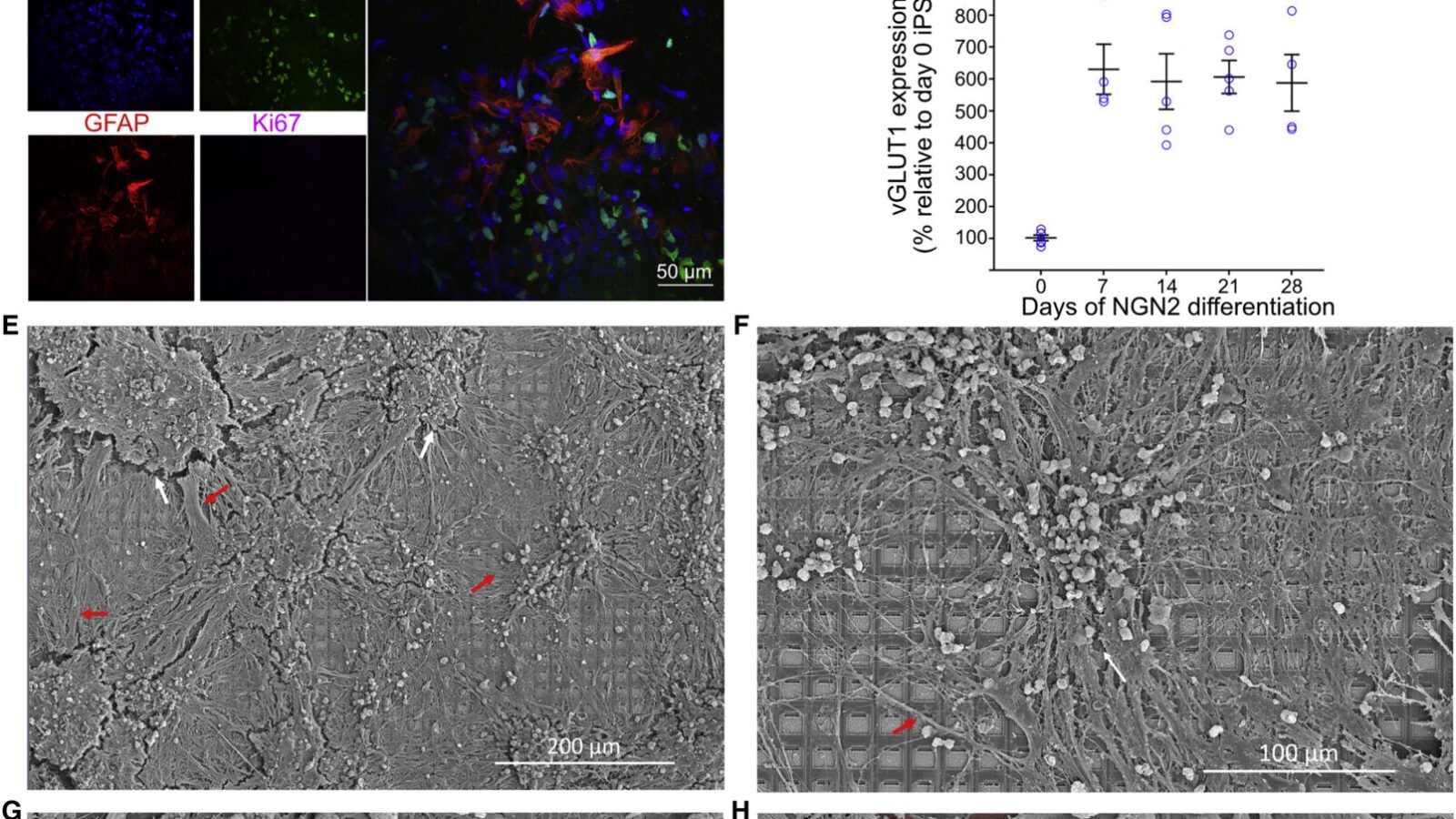
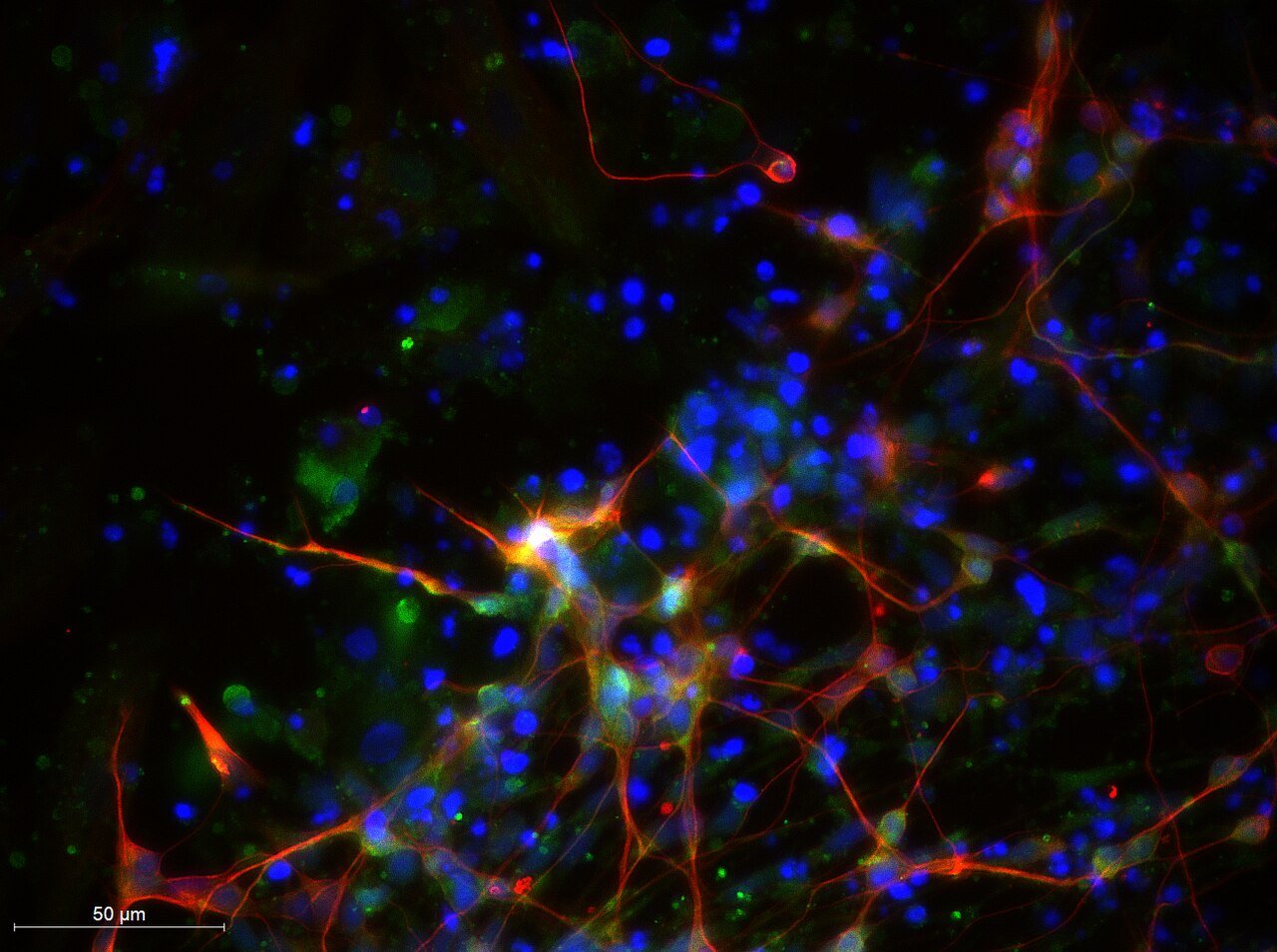
Featured scientific image: Actual microscopy and electron micrographs from Kagan et al.’s 2022 DishBrain study, including human iPSC-derived and rodent cortical neuron cultures on microelectrode arrays; not a photograph of the Singapore rack. Kagan et al. / Wikimedia Commons, CC BY 4.0; original research figure, unmodified.
Research video: Cortical Labs demonstrates Doom
The original February 25, 2026 Cortical Labs demonstration shows a neuron-electrode interface participating in a simplified interaction with Doom. The video documents a hybrid research interface, not subjective awareness or humanlike game-playing intelligence.

Sources and further reading
- NUS Medicine, Singapore’s biological data-center prototype (August 17, 2026)
- The Straits Times, reporting from the NUS research facility (August 15, 2026)
- Cortical Labs, CL1 product and research interface
- Kagan et al., Neuron (2022), DishBrain
- Lancaster et al., Nature (2013), cerebral organoids
- Cai et al., Nature Electronics (2023), Brainoware
- Smirnova et al., Frontiers in Science (2023), organoid intelligence
- FinalSpark Neuroplatform (2024)
- Revah et al., Nature (2022), transplanted cortical organoids
- Faravelli et al., Nature (2026), long-lived organoid maturation
- American Society of Human Genetics, epilepsy organoid research (2026)
- Lawrence Berkeley National Laboratory, U.S. data center energy forecast (June 2026)
- Singapore Bioethics Advisory Committee, research ethics guidance