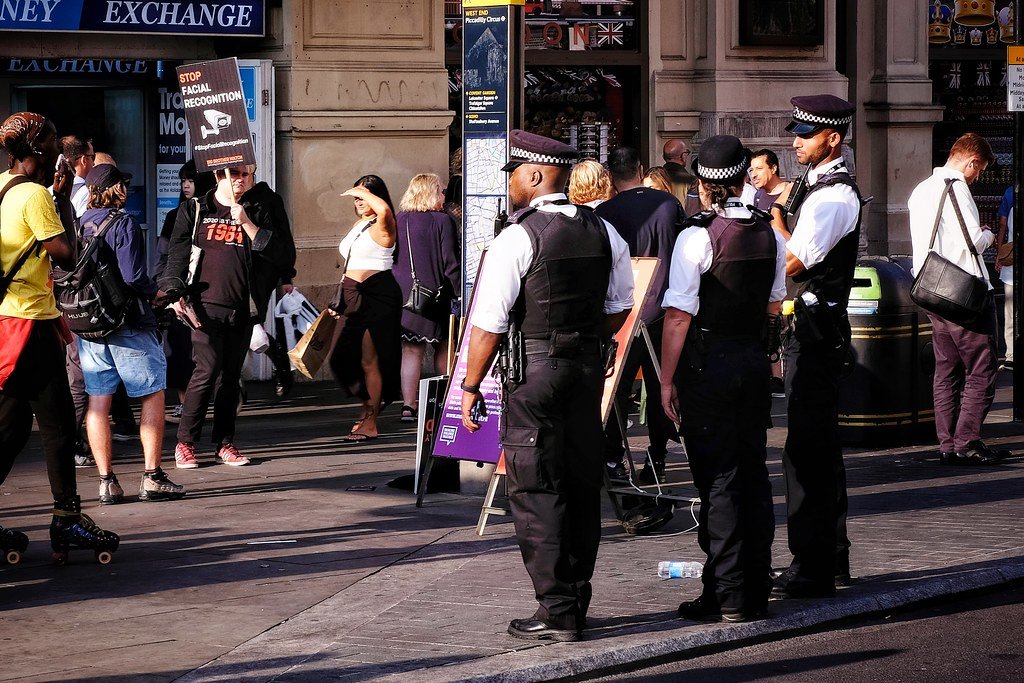
November 15, 2026 — People from ethnic minority communities accounted for 24% of those selected for South Wales Police smartphone facial-recognition scans in 2025, although they made up about 7% of the area’s population, according to figures obtained under freedom-of-information law and reported by The Guardian. The disparity raises questions about officers’ decisions to scan people — questions that also matter to U.S. communities adopting biometric policing tools.
The force recorded scans of 257 adults and 14 children, including two younger than 10. South Wales Police has acknowledged concern about disproportionality and says it will continue reviewing its approach through internal and independent oversight.
What the numbers actually measure
Ethnic minority residents made up roughly 7% of the police area’s population and 11% of people arrested there, but represented 24% of those selected for the mobile checks, according to the reported 2025 records. The Guardian characterized the selection disparity against the white population as approximately fourfold.
This does not mean facial-recognition software made four times more errors when examining minority faces. The statistics concern which people officers chose to scan, not the algorithm’s accuracy. They raise a serious question about selection practices without, by themselves, proving why individual checks occurred. Comparing scans to population totals or arrest data also involves different reference populations.
The system is called operator-initiated facial recognition, or OIFR. An officer takes a photograph on a police-issued smartphone and checks it against an image database to help identify someone. It differs from live facial-recognition systems that continuously scan crowds. South Wales Police says OIFR is intended for circumstances including individuals suspected of being wanted or missing, people at imminent risk of harm, and people unable or unwilling to supply identifying information.
More than half the checks involved suspected crimes, people unlawfully at large or alleged bail breaches. The records also included cases involving feared harm, missing people and the identification of deceased people. When a scan produced a match, an arrest followed in 48% of those matched cases, while approximately one-third led to no further action. That is a proportion of matches, not of all 271 checks.
What South Wales Police says about accuracy
South Wales Police says independent National Physical Laboratory testing of its NEC NeoFace M40 OIFR system identified no detectable bias by race, age or gender in the test conditions. The force says the software does not make the final identity decision; police officers must assess potential matches.
Strong laboratory results do not resolve whether police select people at unequal rates. The force says every deployment must be justified and scrutinized, notes that total OIFR use remains relatively small, and has promised to review opportunities for improvement with advisory and external scrutiny panels.
A separate UK police inspection reported in November identified risks when officers treated results from retrospective facial-recognition searches as evidence without adequate checks. That inspection concerned a different method and should not be confused with South Wales’ OIFR demographic figures.
Why U.S. residents should pay attention
The U.S. Government Accountability Office reported in 2024 that real-world biometric identification performance is less thoroughly studied than laboratory results. It highlighted the roles of deployment practices, human judgment, training, privacy and transparency in potentially unequal outcomes. Those findings do not independently confirm the cause of the Wales disparity, but they show that software testing alone cannot answer every civil-rights concern.
One American case illustrates the stakes. Robert Williams, a Black Detroit resident, was wrongfully arrested in 2020 after police relied on an incorrect facial-recognition lead. A 2024 settlement in Williams’ civil-rights lawsuit required Detroit police to use additional independent, reliable evidence before seeking an arrest warrant. The settlement also strengthened supervisory review; it did not constitute the city’s admission of legal liability.
The U.S. National Institute of Standards and Technology has likewise documented demographic differences in facial-recognition error patterns across algorithms and the importance of image quality. Its work should not be presented as a direct evaluation of the South Wales mobile police program.
The transparency question
For police departments on either side of the Atlantic, the accountability questions are concrete: Who is selected for a scan? Why? Are searches recorded and independently audited? How often are matches wrong? What additional evidence is required before arrest? How are images retained or deleted, and can a person challenge a mistaken identification?
Police officials emphasize the technology’s potential to identify wanted and missing people; civil-rights advocates emphasize the risks of unequal selection and wrongful suspicion. The Welsh figures make one point especially clear: measuring algorithm accuracy is not a substitute for checking the human decisions that determine whose face is scanned.