

The spleen, an organ tucked beneath the ribs on the upper left side of the abdomen, does more than support the immune system and filter blood. During breath-holding, it can contract and release stored red blood cells into circulation—a measurable response that may briefly boost the blood’s oxygen-carrying capacity.
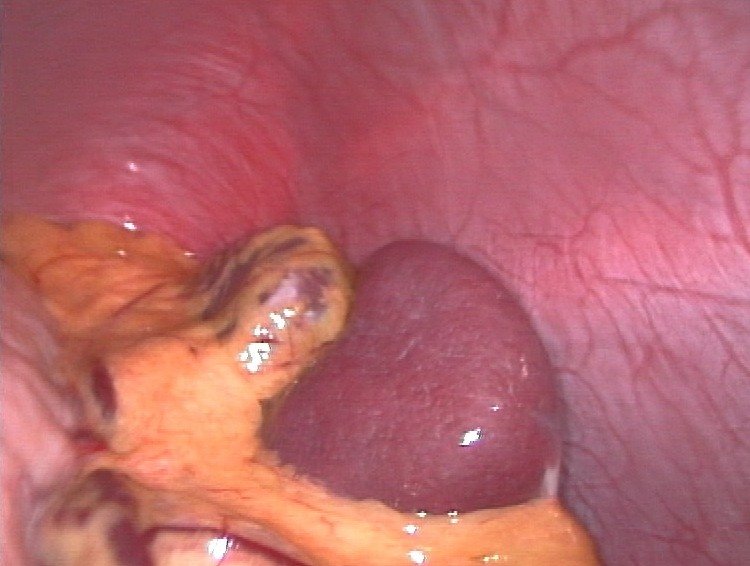
Featured image: actual human spleen during laparoscopic examination; an archival photograph, not from the breath-holding experiment. Credit: Hic et nunc / Wikimedia Commons, CC BY-SA 3.0.
The effect is well established in human physiology research, although it is hardly a newly discovered superpower. The term “useless organ,” used in a November 2026 Sciencing explainer, is misleading: the spleen performs important immune and blood-filtration functions.
What happens in the body during a breath hold
Researchers call a period without breathing apnea. The body responds through several overlapping mechanisms, including changes in heart rate, blood-vessel constriction and, in many people, contraction of the spleen. This releases some of the red blood cells stored within the organ into circulating blood.
Red blood cells contain hemoglobin, the protein that carries oxygen. Releasing stored cells does not create oxygen, and it does not replace breathing. It can temporarily change how much hemoglobin is present in circulating blood.
A human study measured the change
In a 2023 study published in Frontiers in Physiology, investigators compared breath-holding with rebreathing for similar periods. The experiment enrolled 18 participants; the researchers measured spleen volume by ultrasound in 13 of them.
During the breath-hold condition, the researchers recorded an average decrease in spleen volume of approximately 20.8% and an average 2.4% increase in hemoglobin concentration. The changes were smaller or absent during the rebreathing comparison. The average test duration was about 137 seconds, under controlled research conditions.
The investigators concluded that stopping respiratory movements itself appears to be an important trigger for the spleen’s response, rather than falling oxygen and rising carbon dioxide being the only signals. They also recorded changes in cardiovascular function associated with the so-called diving response.
These are averages from a small controlled study—not a promise that every person will experience the same change. The researchers noted variation across studies, and the measured spleen size and hemoglobin returned to baseline within minutes after the test series.
Scientists have known about the effect for decades
The idea predates the current headlines. A 2001 human study compared participants with and without spleens during repeated breath-holding and found evidence that the spleen contributes to increases in hemoglobin during the diving response. A 2005 study also examined how quickly spleen volume changes and recovers.
The research helps physiologists investigate oxygen conservation, athletic breath-hold diving and how the nervous system coordinates short-term stress responses. But it does not demonstrate that habitual breath-holding offers a general health benefit.

Why the spleen matters even when you are breathing normally
The spleen filters blood, removes aging or damaged red blood cells and helps defend against certain infections. People can live after spleen removal, but may face an elevated risk of serious infections and need specific medical precautions. The Cleveland Clinic’s spleen overview explains the organ’s roles in blood storage, filtration and immune protection.
What the research does not mean
A temporary increase in circulating hemoglobin is not a treatment for low oxygen, heart or lung disease, and it does not make prolonged underwater breath-holding safe. CDC reporting on drowning incidents identifies intentional hyperventilation and prolonged underwater breath-holding as dangerous behaviors that can lead to hypoxic blackout and drowning.
The scientific lesson is straightforward: an organ sometimes dismissed as dispensable is performing several important jobs, including a rapid physiological response when breathing stops. Its effect is real, measurable and temporary—not a substitute for oxygen.
Sources and further reading
- Sciencing (2026): The “Useless” Organ That Kicks In When You Hold Your Breath — news explainer prompting this report
- Persson and colleagues (2023), Frontiers in Physiology — primary human apnea-versus-rebreathing study
- Schagatay and colleagues (2001) — role of spleen emptying during repeated apneas
- Schagatay and colleagues (2005) — spleen volume changes during serial apneas
- Cleveland Clinic: Spleen function and anatomy — clinical background
- CDC: Dangerous underwater breath-holding behaviors — safety context


